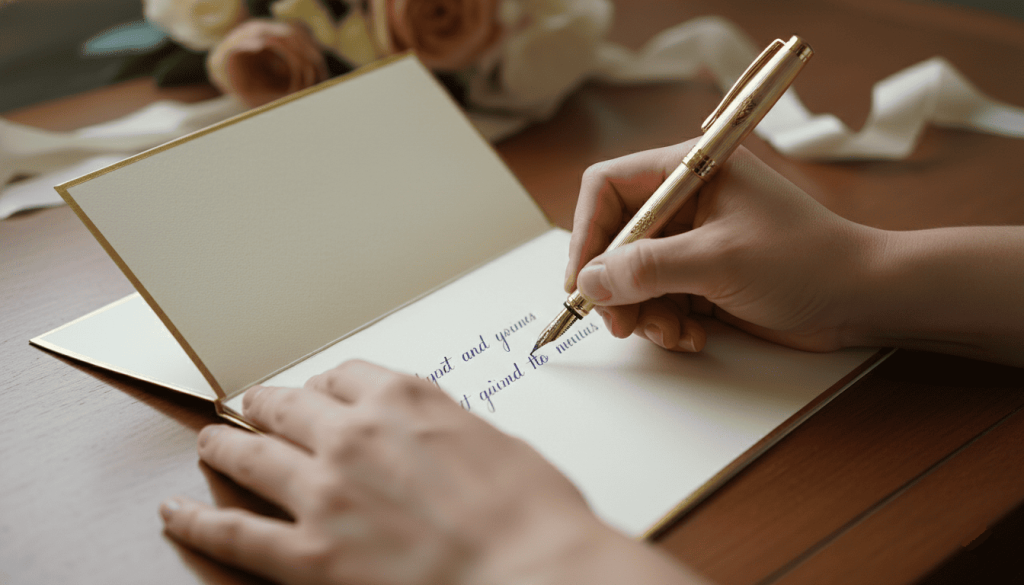
If you’re staring at a blank card the night before the wedding, here’s the short version: open with a clear congratulations, add one specific line about the couple, and close with a warm wish for their marriage. That’s the whole formula. Everything below is just variations on those three beats — sorted by how close you are to the couple and the tone you want to strike.
I’ve watched couples open their card box at the end of the night more times than I can count, and the cards they reread on the drive home are never the ones with the fanciest quotes. They’re the ones where someone wrote a real sentence that only that person could have written. So before you copy a line word-for-word, swap in a name, a memory, or a detail. That one change does more than any perfect phrase.
Quick answer
Start with congratulations, add one personal line about the couple, and end with a wish for their future together. Match the tone to your relationship — heartfelt for close family, short and warm for coworkers. A simple “Congratulations on your wedding! Wishing you both a lifetime of love and happiness” never misses.
The three-part formula that works every time
Wedding cards run small, and that’s a gift — you don’t have to write a speech. The structure I give every guest who asks me at the rehearsal dinner has three parts, and you can write the whole thing in under a minute.
Open with congratulations. “Congratulations,” “So happy for you both,” “Cheers to the newlyweds.” This sets the tone and tells the couple, in one beat, that you’re glad to be here. Address both partners, not just the one you know better — both of them will read this card.
Add one personal line. This is the part most people skip, and it’s the only part that matters. A fond memory, something you admire about them as a couple, a small inside reference. “I’ve never seen Dana laugh the way she does around you” beats any greeting-card line ever printed.
Close with a wish. Send them into married life with something: a wish for adventure, for patience, for a kitchen that’s always a little too crowded with friends. Then sign off. Done.
According to The Knot’s guide to wedding wishes, the messages couples value most are the ones that feel sentimental and tailored to the relationship — not the most polished. That tracks with everything I’ve seen at the card table.
What to write for a close friend
This is where you get to be yourself. Friends want your voice, not a Hallmark voice. Reference the years you’ve known each other, the version of them you got to see before this day, the thing you’re genuinely excited about.
- “Watching you find your person has been one of the best parts of being your friend. So happy for you both — here’s to everything that comes next.”
- “From late-night talks about whether you’d ever meet someone, to this. I’m so glad I was wrong to worry. Congratulations, you two.”
- “You’ve gained a husband and I’ve gained a brunch companion who actually shows up on time. Kidding. Mostly. Love you both.”
- “I can’t wait to grow old and embarrassing alongside the two of you. Congratulations on your wedding.”
One of my brides last spring told me the card that made her cry was from her college roommate, and all it said was a single shared memory and the line “I always knew it’d be him.” Specific beats grand, every time.
What to write for family
Family cards carry a little more weight, and the relationship shapes the tone. A message to your child reads differently than one to a cousin you see at reunions. Lean into the role you’ve played and the hopes you carry for them.
For your son or daughter
- “Watching you become the person standing up there today has been the honor of my life. I love you both, and I can’t wait to see the home you build.”
- “You were worth every sleepless night. Wishing you a marriage as full of love as the one you grew up in. All my love, always.”
For a sibling, cousin, or relative
- “Welcome to the family — we’re loud, we’re early to everything, and we already adore you. Congratulations to you both.”
- “I’ve watched you wait for the right one, and they were worth it. So happy for you, cousin. Here’s to the next chapter.”
What to write for a coworker or acquaintance
When you don’t know the couple well, the move is simple, warm, and short. There’s no pressure to be clever or deeply personal — a sincere congratulations is exactly right and won’t read as cold. Keep your message general, kind, and free of inside references you don’t actually have.
- “Congratulations on your wedding! Wishing you both a lifetime of love and happiness.”
- “So happy to celebrate this milestone with you. Best wishes to you and your new spouse.”
- “Wishing you joy today and a beautiful life together. Congratulations to you both!”
If you’re signing a card that’s going around the office, two genuine sentences in your own handwriting are worth more than a long message you clearly labored over. Sincerity scales down just fine.
Madison’s note
“If you go completely blank, write the date and where you are: ‘Sitting at table 7 watching you two dance, and I just had to tell you how happy I am for you.’ Naming the moment you’re in is the easiest way to sound like a person instead of a card aisle. It works every single time.”
— Madison Cole, Certified Wedding Planner
Funny wedding card messages
Humor lands well when it’s affectionate, not at anyone’s expense, and when both partners are in on the joke. Remember that both of them will read it, so save the story about the bachelor party for a different audience. A light touch beats a roast.
- “Marriage is about give and take. You’ll give, and they’ll take the last slice of pizza. Congratulations — you’ll be great at it.”
- “Congratulations! May your coffee be strong and your arguments about the thermostat be short.”
- “You found someone who’ll put up with you forever. Frankly, we’re all relieved. Cheers to you both.”
- “Here’s to a lifetime of splitting the dessert and never agreeing on the temperature. So happy for you two.”
Sentimental and heartfelt messages
For the cards meant to be kept, slow down and say the real thing. Sentimental doesn’t mean flowery — it means honest. Name what you actually hope for them and why this matters to you.
- “May you always be each other’s safe place to land. Wishing you a marriage full of small ordinary days that turn out to be the best ones.”
- “Love isn’t the wedding — it’s the thousand quiet mornings after. Wishing you ten thousand of them. Congratulations.”
- “You’ve built something rare. May it only deepen with time. So much love to you both on your wedding day.”
- “Here’s to weathering the storms together and dancing in every bit of sunshine. Congratulations on your marriage.”
Formal wedding card wishes
For a formal couple, an older relative, or a wedding where the tone is buttoned-up, keep the language clean and classic. These read beautifully and never feel out of place.
- “Wishing you a lifetime of love, joy, and happiness. Congratulations on this wonderful occasion.”
- “May the years ahead be filled with lasting love and abundant joy. With warmest congratulations.”
- “It is a privilege to celebrate your marriage. Wishing you every happiness in the years to come.”
- “Congratulations on your marriage. May your union be blessed with health, happiness, and enduring love.”
Religious and faith-based messages
If the couple is religious, a line of blessing or scripture can be the most meaningful thing in the card. The one rule: match the message to their actual beliefs and practice. If you’re not sure how observant they are, keep faith references light or skip them — a verse that feels heavy to a couple who don’t worship regularly can land wrong. When in doubt, “Wishing you a marriage blessed with love” carries warmth without overstepping.
- “May God bless your marriage with grace, patience, and a love that grows deeper every year. Congratulations.”
- “Praying for a lifetime of joy and faith shared between you. So happy to celebrate this day with you both.”
- “Wishing you a home filled with blessings and a love that honors the One who brought you together.”
What not to write in a wedding card
A few things reliably miss, and they’re easy to sidestep once you know them. None of these are about being stiff — they’re about keeping the focus on the couple.
- Inside jokes only one partner gets. Both people read the card. A reference that excludes one of them, even kindly, deflates it.
- Anything about exes or “took you long enough.” It reads as a dig even when you mean it warmly.
- Marriage “advice” you weren’t asked for. A short well-wish beats a paragraph on how hard marriage is. Save the wisdom for when they ask.
- Gushing you don’t mean. Emily Post’s long-standing guidance on wedding notes is to be enthusiastic but not to gush — overstating it reads as hollow. The Emily Post Institute makes that point about thank-you notes, and it applies just as well to the cards you send.
- Money talk. If you’re giving cash, the card isn’t the place to mention the amount or explain it. Let the gift speak for itself.
There’s one old etiquette wrinkle worth knowing: traditionally you congratulated the groom and offered “best wishes” to the bride, on the dated logic that congratulating her implied she’d been lucky to land him. That rule has quietly retired. Congratulating both partners is completely standard now, and nobody at a 2026 wedding is parsing your verb choice. Write “congratulations” to whomever you like.
How to sign off a wedding card
The sign-off should match the warmth of your message — don’t write a heartfelt note and then end on a flat “Sincerely.” A few that fit most cards:
- Warm and close: “With love,” “All our love,” “Love always.”
- Friendly: “Cheers,” “So happy for you,” “Hugs.”
- Formal: “With warmest wishes,” “With love and best wishes,” “Fondly.”
If the card is from a couple or family, sign all the names. If it’s just you, your first name is plenty — they know who you are.

When to send a wedding card
You have more room here than people think. A card can travel with your gift before the wedding, ride along to the reception for the card box, or arrive after — etiquette generally gives you up to a couple of months on either side of the date. Sending it ahead of time is the most considerate move because it doesn’t add to the pile the couple sorts through afterward, but a thoughtful card is welcome whenever it lands.
If yours is running late, don’t over-apologize — just acknowledge it lightly and move on: “A little late, but no less excited for you both.” The couple will be glad you wrote at all. And if you’re still mapping out your own timeline for stationery and sending, my guide on when to send wedding invitations walks through the dates that actually matter so nothing arrives too early or too close to the day.
Frequently asked questions
What do you write in a wedding card if you don’t know the couple well?
Keep it warm and general: a congratulations, a wish for their happiness, and a sign-off. Something like “Congratulations on your wedding! Wishing you both a lifetime of love and happiness” is sincere and never feels cold. You don’t need to be personal to be kind.
Is it okay to write a funny message in a wedding card?
Yes, as long as the humor is affectionate and both partners are in on the joke. Keep it clean and skip anything that singles out one person or references things from before the relationship. A light, warm laugh is welcome — a roast is not.
How long should a wedding card message be?
Short. Two to four sentences fits most cards and reads best. Wedding cards don’t leave much room, and a tight, sincere note beats a cramped paragraph. If you have a lot to say, send a separate letter or email after the wedding.
Do you congratulate the bride or the groom?
Both. The old rule of congratulating only the groom and wishing the bride well is long retired. Address your message to the couple as a pair, and use “congratulations” freely for either partner.
What do you write in a belated wedding card?
Acknowledge the delay briefly without over-apologizing, then share your wishes: “A little late, but just as thrilled for you both — wishing you a lifetime of happiness.” A late card is still a meaningful gesture, and the couple will appreciate that you wrote.
The one thing to remember
You will not regret writing something specific, and you will never regret keeping it sincere. The couple won’t grade your phrasing — they’ll feel whether you meant it. Pick the message above that sounds most like you, swap in a name or a memory, and sign your name. That’s a card worth keeping.
Sources
- The Knot — Wedding Wishes: What to Write in a Wedding Card
- The Emily Post Institute — Wedding Note Dos and Don’ts
— Madison Cole, Certified Wedding Planner