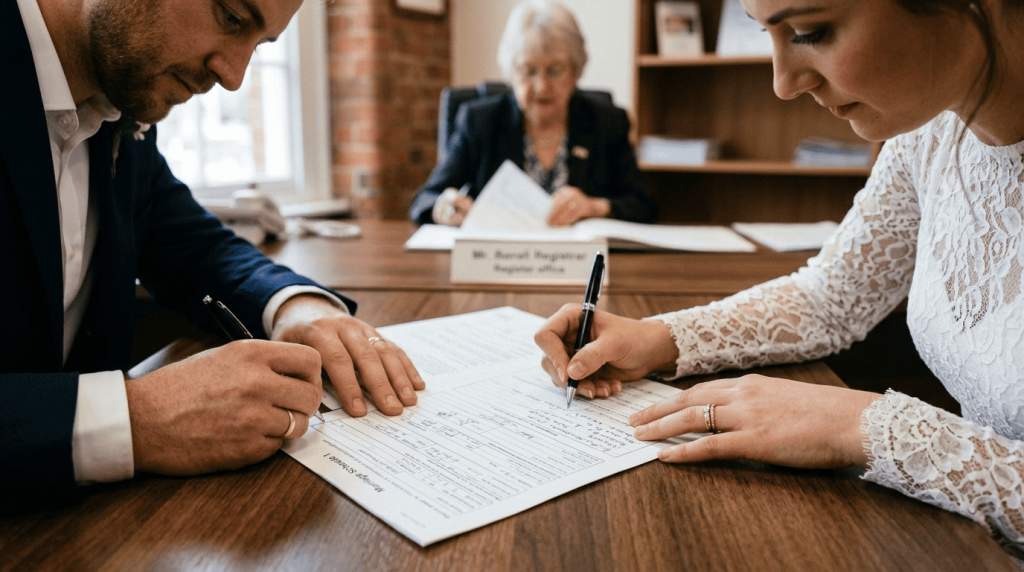
A spouse is your partner in a marriage: your husband or wife, or simply the person you are legally married to, regardless of gender. The word covers either half of a married couple, which is exactly why it stays so useful when “husband” or “wife” feels too narrow or too formal. After helping more than 200 couples cross from engaged to married, it is the word I reach for most on a wedding day.
Definition
Spouse (noun) — a person you are legally married to; either partner in a marriage, whether a husband or a wife.
What does spouse actually mean
Merriam-Webster keeps it plain: a spouse is “a partner in a marriage”, a husband or a wife. The single most useful thing about the word is that it is gender-neutral. One term covers either married partner, so you do not have to specify who is the husband and who is the wife, or assume there is one of each.
The word also carries a built-in condition: marriage. Calling someone your spouse signals that the two of you are legally wed, which is what separates it from words like boyfriend, girlfriend, or partner. If you are not married, you do not technically have a spouse yet.
In tone, spouse sits a notch more formal than husband or wife. You will see it on tax forms, insurance paperwork, and hospital intake sheets far more often than you hear it across the dinner table, where most people just say “my husband” or “my wife.”
Where the word spouse comes from
Spouse traces back to the Latin sponsus (a groom) and sponsa (a bride), both meaning “betrothed” or “pledged.” Those came from the verb spondēre, “to promise solemnly,” according to the Online Etymology Dictionary. The word reached English through Anglo-French (espus and espuse) and settled into the language in the 13th century.
That same Latin root gives us sponsor and espouse, which tells you something about what the word has always meant at its core. Strip it back and a spouse is literally the one you pledged yourself to: a promise made out loud, then made official.
Did you know
Back in the early 1200s, English had the word spouse-breach for adultery. For a stretch, “spouse” even worked as a verb meaning “to marry,” so you could once “spouse” someone.
Spouse vs. partner, husband, and wife

These words get used loosely, but they are not interchangeable. Here is how I sort them out for couples who want the right one on a wedding website or an invitation:
- Husband: the male partner in a marriage.
- Wife: the female partner in a marriage.
- Spouse: either one, gender-neutral, and always married.
- Partner: broader. It works for married and unmarried couples alike, says nothing about gender, and does not assume a marriage at all.
- Significant other: broader still, and more casual. It covers any committed romantic relationship, married or not.
- Fiancé / fiancée: the person you are engaged to but not yet married.
The line that trips people up most: you do not become a spouse the day you get engaged. Until the wedding, you are each other’s fiancé and fiancée. If you are still sorting those out, I break them down in my guides to what fiancé really means and the difference between fiancé and fiancée.
When you actually become someone’s spouse
The exact moment is the marriage itself. Once your officiant pronounces you married and the marriage license is signed and filed, you are spouses in the eyes of the law. Not at the proposal, not at the rehearsal, not when the invitations go out: the wedding is the threshold.
At the weddings I plan, you can almost watch the word change in real time. Two people walk down the aisle as fiancés, and the first time the officiant says something like “please welcome the newlyweds and their spouse,” you can see it land on their faces. That shift is the whole point of the ceremony.
After that, the paperwork catches up. Your married status starts showing up on official documents, which is where the words spouse, husband, and wife begin doing real legal work. It is worth understanding the difference between your marriage license and your marriage certificate, since one authorizes the wedding and the other proves it happened. Many people also update their name at this stage, which has its own steps and timeline, all of which I walk through in my guide to changing your name after marriage.
One honest caveat: in legal and government settings, “spouse” specifically means a legally married partner, and who exactly qualifies can depend on your state and the particular rule in play, including how common-law and same-sex marriages are recognized. For anything tied to your own benefits, taxes, or immigration, that is a question for an attorney, not a wedding planner.

Frequently asked questions
The questions I hear most when couples and guests run into this word:
Does spouse mean husband or wife?
Both. Spouse is the gender-neutral word for either partner in a marriage. A husband is a male spouse, and a wife is a female spouse, so the word simply lets you refer to one without specifying which.
Is a spouse the same as a partner?
Not quite. Every spouse is a partner, but “partner” is broader and also covers unmarried couples. Spouse specifically means the two of you are legally married, while partner makes no claim about marriage at all.
Can you call someone your spouse if you are not married?
Technically, no. The word carries marriage built into it. Unmarried couples usually use partner, significant other, or boyfriend and girlfriend instead, and switch to spouse once they are legally wed.
Is your fiancé your spouse?
No. Your fiancé or fiancée is the person you are engaged to. They only become your spouse once the wedding takes place and the marriage is legally official.
If you have just gotten engaged, you have a few more months as fiancés before the word applies to you, so there is no rush. Enjoy the in-between.
Written by Madison Cole, Certified Wedding Planner
Sources
- Merriam-Webster Dictionary, “Spouse.” merriam-webster.com
- Online Etymology Dictionary, “Spouse.” etymonline.com
- The Knot, “What’s a Spouse? Meaning, History and Alternative Titles.” theknot.com
Sources
- Merriam-Webster Dictionary, “Spouse.” merriam-webster.com
- Online Etymology Dictionary, “Spouse.” etymonline.com
- The Knot, “What’s a Spouse? Meaning, History and Alternative Titles.” theknot.com