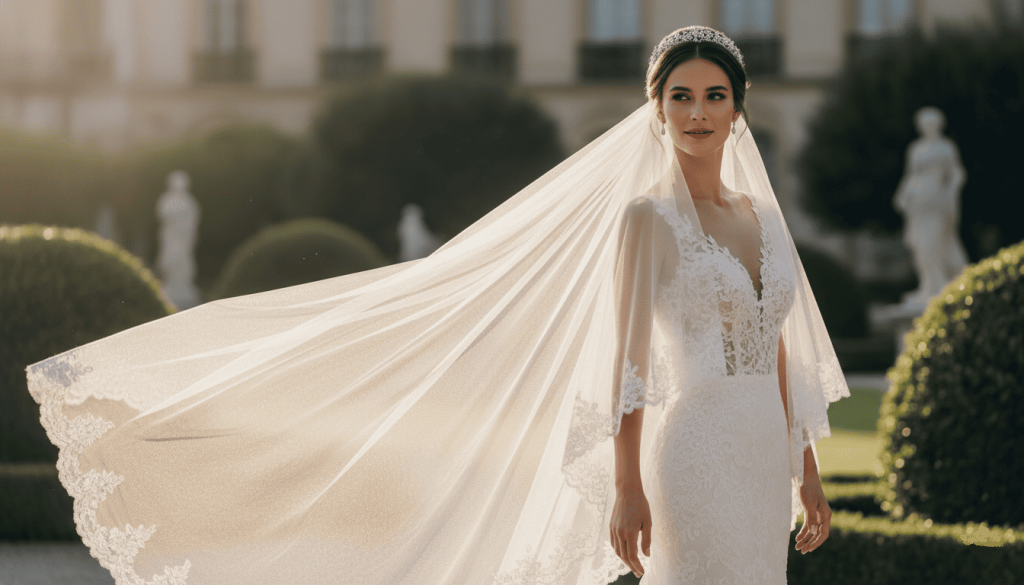
A veil is a piece of cloth or netting worn over the head, and sometimes the face, that a bride traditionally wears during her wedding ceremony. In its broadest sense the word means any head or face covering, but at a wedding it has become one of the most recognizable bridal accessories there is. I’ve planned more than 200 weddings on the East Coast, and the veil is the single piece most of my brides go back and forth on the longest. Here I’ll walk you through what a veil actually is, where the tradition comes from, the main types and lengths, and how to decide whether one belongs in your look at all.
Definition
Veil — a length of fabric or netting worn over the head, and sometimes the face, traditionally worn by a bride during her wedding ceremony.
What a veil actually is
Outside of weddings, a veil is simply a covering for the head or face. Merriam-Webster defines it as a length of cloth worn over the head and shoulders, and sometimes the face, and traces the word back to the Latin vēlum, meaning “sail” or “curtain.” That same word has covered nuns, mourners, and brides for centuries.
In a wedding, the meaning narrows. A bridal veil is an accessory, usually made of tulle, lace, or silk, that attaches to the hair with a comb, clip, or headpiece and falls anywhere from the chin to well past the hem of the gown. Most brides I work with wear it for the ceremony and take it off for the reception, when they want to move, hug, and dance without managing yards of fabric.
So the short version is this: every bridal veil is a veil, but not every veil is bridal. The wedding kind is the one that comes with all the history.
What a wedding veil symbolizes
For most of its history, the veil carried meaning tied to modesty and purity. According to The Knot’s wedding experts, brides historically wore veils to signal innocence, though the symbolism has always been layered with older religious and even superstitious beliefs.
One of the oldest threads is protection. Ancient Roman brides are often said to have worn a flame-colored veil, the flammeum, believed to shield them from evil spirits on the way to the ceremony. The idea of a covering that guards the bride shows up again and again across cultures.
Then there’s the practical, slightly less romantic origin. In eras of arranged marriages, a veiled face is traditionally said to have kept the groom from seeing his bride until the union was sealed, so neither family could back out at the last moment. The lifting of the veil at the altar, often by the bride’s father as he gives her away or by the couple themselves after their vows, became the moment the bride was formally revealed. If you’re writing your own ceremony, that single gesture is worth planning deliberately, and it pairs naturally with the language you choose in your wedding vows.
Wedding fact
The flame-colored Roman flammeum is one of the earliest documented wedding veils, worn to ward off evil spirits long before “purity” became the dominant reading. Source: The Knot, on the history and meaning of the wedding veil.
Types of wedding veils by length
Length is the first decision, because it changes the whole proportion of your look. These are the tiers I walk brides through, from shortest to longest.
Elbow length
An elbow-length veil falls to roughly the elbows. It’s light, easy to wear all day, and works beautifully with fitted gowns and ball gowns where you want the bodice and waist to stay visible.
Fingertip length
The fingertip veil reaches the bride’s fingertips when her arms rest at her sides. It’s the most popular length I see, mostly because it suits nearly every silhouette and height without overwhelming the dress.
Ballet (waltz) length
A ballet veil, sometimes called waltz length, falls somewhere between the knee and the ankle. It gives movement and drama without a full train to manage, which makes it a favorite for outdoor and garden ceremonies.
Chapel length
A chapel-length veil extends to the floor and pools slightly behind the bride, usually pairing with a gown that has its own train. This is where the veil starts to read as formal.
Cathedral length
The cathedral veil is the longest and most formal option, sweeping well past the train. It’s built for grand ceremonies, long aisles, and the kind of processional photo people frame. It also needs the most help on a windy day, which I’ll come back to.
Popular veil styles
Length tells you how far the veil falls. Style tells you how it’s cut, gathered, and worn. These are the ones that come up most in my fittings:
- Blusher (two-tier): a shorter front layer worn over the face and flipped back after the ceremony. This is the piece that creates the classic “unveiling” moment.
- Mantilla: a circular veil, usually edged in lace, draped over the crown of the head rather than gathered. It has Spanish and Catholic roots and reads romantic and traditional.
- Drop veil: a single piece of fabric draped over the head with no comb or gathering. It’s minimalist and modern, and it photographs cleanly.
- Birdcage: a short piece of netting that covers part of the face, with a vintage 1940s and 1950s feel. Ideal for retro looks and city hall ceremonies.
- Juliet cap: a fitted cap that sits on the crown with the veil attached, evoking 1920s and 1930s glamour. A favorite for vintage-leaning brides.
Do you have to wear a veil?
No. A veil is a tradition, not a rule, and plenty of the brides I plan for skip it entirely in favor of a hairpiece, a comb, fresh flowers, or nothing at all. The veil’s old associations with purity feel dated to a lot of couples, and there’s no etiquette penalty for leaving it out.
That said, brides who do choose one usually have a specific reason. The unveiling moment gives the ceremony a clear emotional beat. A veil frames the face in photos and reads instantly as “bride.” And for couples marrying in a house of worship, a head covering may be expected or meaningful. If any of those matter to you, a veil earns its place. If none of them do, you’ve lost nothing by going without.
How to choose a veil that works with your dress
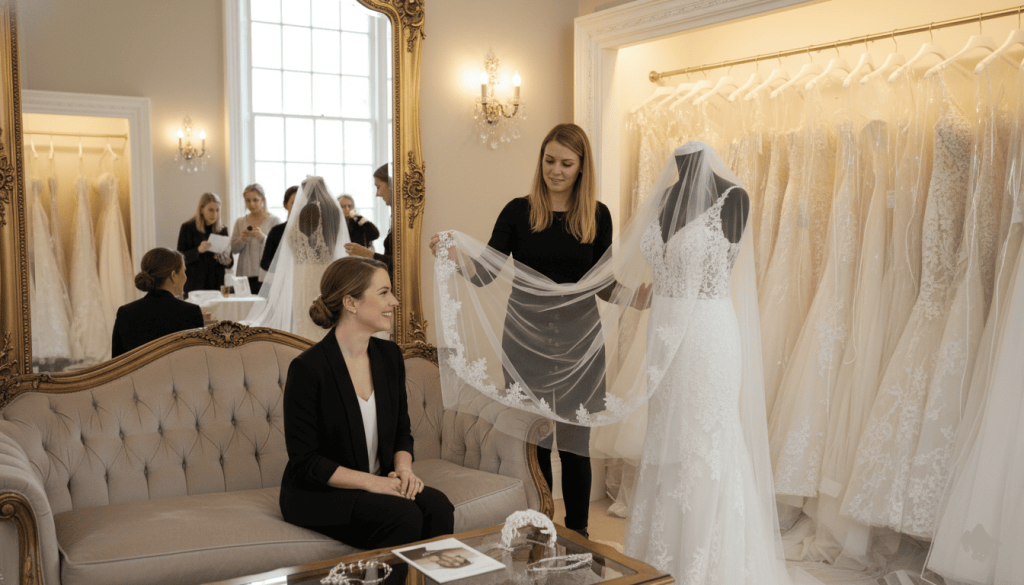
Here’s what I tell my brides when they ask me where to start. Match the length to the gown, not the other way around. A cathedral veil over a short, simple dress looks off-balance, while a fingertip veil disappears against a heavily trained ball gown. Pull the veil and the dress together at the same fitting whenever you can. For the full silhouette conversation, see my guide to choosing a wedding dress before you lock in a veil.
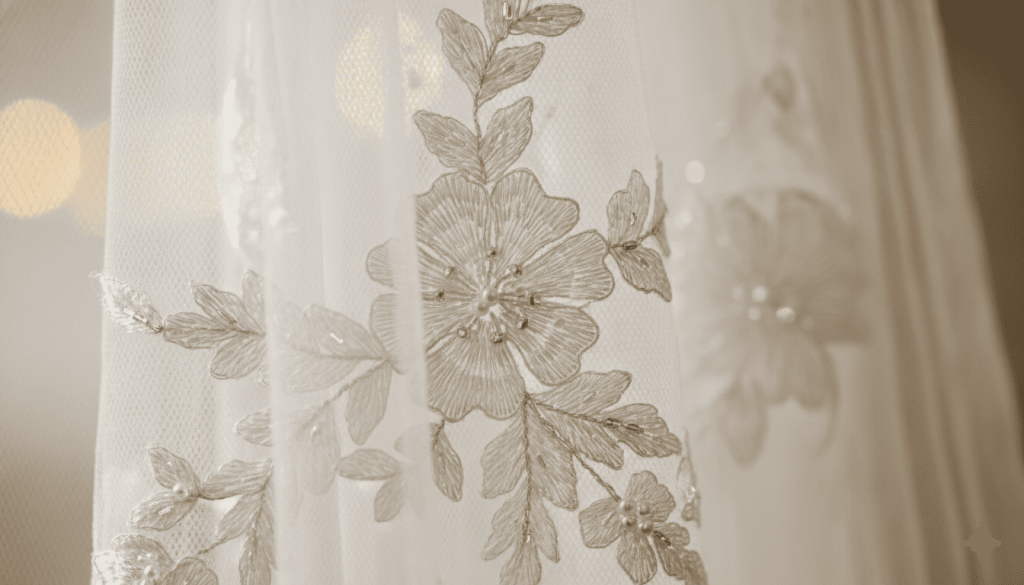
Two details trip people up. First, color: a “white” veil and an ivory gown will fight each other in photos, so order a fabric swatch and match the veil to the dress, not to an idea of white. Second, fabric and stiffness: soft tulle drapes and moves, while a stiffer or heavily edged veil holds a more sculptural shape. Neither is better. They just photograph differently.
Madison’s note
“If you’re marrying outdoors and you’ve fallen for a cathedral veil, weight the hem or have a backup plan. I’ve watched a long veil turn into a sail in a 15-mph breeze, and a second hairpin in the bride’s bag saved the processional more than once.”
— Madison Cole, Certified Wedding Planner
One more thing worth coordinating early: who handles the veil during the ceremony. If a parent is lowering or lifting the blusher, build it into the run-through so the moment lands smoothly. The mother of the bride is often the one to help with placement just before the bride walks, so loop her in at the rehearsal.
Veil questions I hear most
Is a veil required for a wedding?
No. A veil is optional in every non-religious context. Some faith traditions expect a head covering, but outside of those, wearing one is entirely your call. Many brides choose a comb, flowers, or a clean updo instead.
Does a veil have to cover your face?
It doesn’t. The face-covering layer is the blusher, and it’s a separate choice from the veil itself. You can wear a single-layer veil that falls behind you with nothing over your face, which is what most modern brides do.
What length veil should I choose?
Match it to your gown. Fingertip is the most universally flattering length and the one I recommend when a bride is unsure. Save chapel and cathedral lengths for gowns with trains and formal venues.
What’s the difference between a veil and a blusher?
The veil is the full piece that falls behind you. The blusher is the shorter front layer worn over the face and flipped back during the ceremony. A two-tier veil includes both; a single-tier veil has no blusher.
When is the veil lifted during the ceremony?
Traditionally the blusher is lifted either by the bride’s father when he gives her away, or by the couple right after their vows. There’s no fixed rule, so decide what feels right and write it into your ceremony order.
The veil is one of those details that looks simple until you’re standing in the bridal suite deciding on it. Treat it like any other part of your look: pick the one that fits your dress, your venue, and the ceremony moment you actually want, and ignore the rest. For more on the small traditions that shape a ceremony, browse my collection of wedding ideas, and if you’re decoding other bridal customs, my explainer on what a promise ring is covers another one couples ask me about constantly.
Sources
- Merriam-Webster Dictionary, “Veil.” merriam-webster.com
- The Knot, on the history and meaning of the wedding veil. theknot.com
- Britten Weddings, Wedding Veil Guide (types, styles and lengths). brittenweddings.com
— Madison Cole, Certified Wedding Planner