Of every part of a ceremony I’ve helped pull together across 200+ weddings, the personal vows are the one couples panic about most and remember best. I’ve watched a groom who swore he “wasn’t a words guy” read three sentences that left the whole front row in pieces, and I’ve watched a bride read a polished, beautiful paragraph that sounded like it came off a greeting card and landed on nobody. The difference was never talent. It was whether the words actually sounded like the person saying them.
So if you’ve decided to write your own vows and you’re staring at a blank page wondering where to begin, you’re in exactly the right place. This is the process I walk my couples through. It works whether you’re funny, sentimental, terrified of public speaking, or all three at once. I’ll show you what to put in, how to structure it, how long it should run, the mistakes I see every season, and a few real examples to get you unstuck.
You don’t need to be a writer. You need to be honest, specific, and willing to write an ugly first draft. That’s the whole secret.
How to write your wedding vows, step by step
Agree on the ground rules together
Decide jointly that you’re both writing your own, then align on tone and rough length so one of you isn’t cracking jokes while the other is in tears.
Brainstorm without editing
Dump every memory, inside joke, and specific moment onto the page. No filtering yet. You can’t shape what you haven’t gotten out of your head.
Use a simple four-part structure
A short story, what you love, your actual promises, and a closing line. It keeps you from rambling and gives the vows a shape guests can follow.
Write the ugly first draft
Too long, too raw, too honest. Don’t worry about grammar or being poetic. The point is to have raw material to cut down, not a finished piece.
Read it out loud and cut hard
Anything that sounds borrowed, generic, or like something you’d never actually say, cut it. Aim for one to two minutes, roughly 150 to 300 words.
Practice, then print a clean copy
Rehearse a few times, hand a copy to your officiant or a trusted friend, and bring printed vows in a large font on the day. Don’t try to memorize them.
Before you start: a few things to settle
The biggest vow disasters I’ve seen didn’t happen at the writing desk. They happened because the couple skipped the conversation that’s supposed to come first. Before either of you writes a word, you need to agree on a handful of basics together, even if you’re keeping the actual wording a surprise.
- You’re both writing them. There is nothing wrong with traditional vows where you repeat after the officiant. But if one of you is writing personal vows and the other isn’t, it creates an awkward imbalance at the altar. Decide together.
- Tone. Romantic? A little funny? Serious and tender? You don’t have to match exactly, but you should be in the same neighborhood so the moment feels cohesive.
- Length. Pick a rough target so one of you doesn’t deliver thirty seconds while the other reads for four minutes. I’ll give you a number in a moment.
- How private they stay. Most couples keep the words secret until the ceremony, but you can share them with your officiant for a length-and-tone check. That’s smart, and I recommend it.
Have that talk early. It takes ten minutes and saves you a genuinely uncomfortable surprise in front of 120 guests.
Step 1: Agree on tone and length with your partner
I put this first on purpose. The single most common piece of advice from officiants I’ve worked alongside is to align with your partner before you write, not after. You don’t want to be promising to hold each other through illness and grief while your partner is promising to always let you control the remote. Both are valid. They just need to live in the same emotional register.
One officiant I’ve staffed dozens of weddings with puts it bluntly: when vows clash in tone, half the couples scramble to rewrite the night before, and the other half shrug and say “honestly, that’s exactly us.” If you’re the second kind of couple, lean into it. If you’re not, this conversation is your insurance policy.
And if public speaking genuinely terrifies you, decide that now too. It is completely acceptable to ask your officiant to structure your vows as call-and-response so you only have to say “I do” or “I will.” You can also read the same lines to each other at the same time. Personal vows are a choice, not a requirement, and there’s no medal for white-knuckling through something that makes you miserable.
Step 2: Brainstorm before you write a single polished line
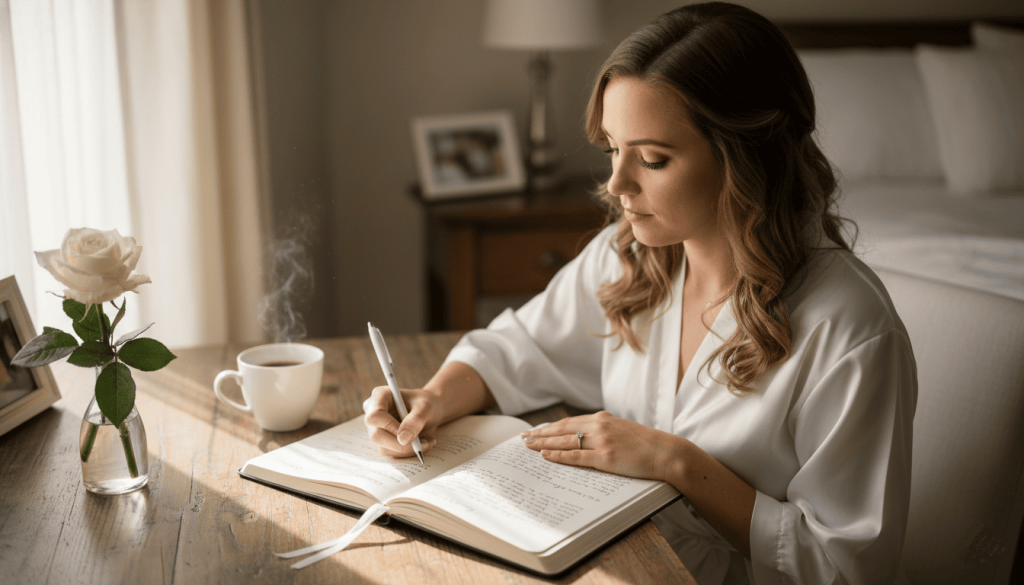
Here’s where most people get stuck: they try to write the finished vows on the first sitting. Don’t. Your first job is to gather raw material, and the way you do that is by answering specific questions, freely, with zero pressure to make any of it sound good.
Sit down with a notes app or a piece of paper and answer these. Write fast, write messy, write more than you’ll ever use.
- When did you actually know? Not “I always knew.” The real moment. The specific Tuesday, the specific kitchen, the specific thing they said.
- What’s one small, unglamorous thing they do that quietly makes your life better?
- What did you struggle through together, and what did it teach you about them?
- What do you admire most about who they are, separate from how they treat you?
- What are you actually promising? Not in theory. In your daily, real life.
That last question is the one that separates vows people remember from vows people forget. “I promise to love you forever” is true and also says nothing. “I promise to be the one who gets up with the dog at 6 a.m. so you can sleep, even when I’m furious about it” tells your partner you see the actual shape of your life together.
Step 3: Use a simple structure so you don’t ramble
A blank page is paralyzing. A structure isn’t. Across the planners and officiants I trust most, the same skeleton shows up again and again because it works: it gives your vows a beginning, a middle, and an end, and it keeps you from spiraling into a four-minute monologue. Here’s the version I hand my couples.
Open with a short story or a declaration
Start by addressing your partner and grounding the moment in something specific: how you met, a turning point, or the thing that made you sure. One or two sentences. This is your hook, and it tells your guests whose story they’re about to hear.
Say what you love and admire about them
Move into who they are and what they mean to you. Keep it concrete. “You’re kind” is a shrug. “You’re the person who remembers everyone’s coffee order and quietly picks up the check” is a portrait.
Make your actual promises
This is the spine of the whole thing. These are your “I promise to” and “I vow to” lines. Aim for three to five real promises that reflect how you genuinely plan to show up. Mix the tender ones with the daily, practical ones. The specificity is what makes them yours.
Close with a line that lands
End on a single clear sentence that brings it home: a promise restated, a declaration, or a forward look at the life you’re building. You can nod to your guests here, but keep the focus on your partner. The last line is what everyone walks away remembering, so make it count.
A four-part vow structure that works
| Section | What goes here | Rough length |
|---|---|---|
| Story or opening | How you knew, a turning point, or a direct address | 1-2 sentences |
| What you love | Specific traits and small, telling details | 3-4 sentences |
| Your promises | 3-5 concrete “I promise to” lines, tender and practical | 4-6 sentences |
| Closing line | One clear declaration or forward look | 1 sentence |
Step 4: Write the ugliest first draft you can
Now you write, and I want you to write badly on purpose. Take your brainstorm pile, drop it into the four sections, and let it be too long, too sappy, too honest. Do not edit while you draft. Editing and writing are different jobs, and trying to do both at once is why people sit frozen for an hour.
Forget being grammatically correct. Forget sounding like a poet. Nobody is grading this, and your partner does not want a polished essay. They want to hear how you actually talk to them across the dinner table or in the dark at the end of the day. If a sentence sounds like something a stranger could have written about any couple, it doesn’t belong to you yet.
Get it all down. You’ll be amazed how much you have once you stop trying to make it perfect. The raw material is everything. The polish comes next, and it’s the easy part.
Step 5: Read it aloud, then cut without mercy
This is the step that turns a draft into vows. Stand up and read the whole thing out loud, ideally to yourself in a room with the door closed. Reading aloud does two things at once: it catches every phrase that sounds borrowed or stiff, and it tells you exactly how long your vows actually run.
Then cut. Every line that makes you cringe, every phrase that sounds like it came off someone else’s wedding, every sentence you’d never say to this person in real life, take it out. What’s left when you’re done trimming is the real thing. I’ve never once had a couple regret cutting their vows down. I’ve had plenty wish they’d cut more.
Did you know
Roughly 7 in 10 couples who hire an officiant choose to write their own vows rather than use the traditional script, according to officiants who track their own ceremonies. Source: Eloping Is Fun, officiant ceremony data.
Step 6: Practice, but don’t memorize
Rehearse your vows a few times in the days before the wedding so the words feel familiar in your mouth. But please don’t try to memorize them. I discourage memorizing every season, because the second your nerves spike at the altar, a memorized speech is the first thing to vanish. A printed copy in your hand is not a failure. It’s what every smart couple does.
Print your final vows in a large font, well spaced, so you can find your place easily when you look up at your partner and back down. A small card or a clean notebook photographs beautifully and holds steady when your hands are shaking, which they will be. Hand a second copy to your officiant as a backup, and have them review your draft at least two weeks out for length and tone. That early read-through is also the gentle deadline that guarantees you actually finish writing.

How long should wedding vows be?
Short. Shorter than you think. The sweet spot nearly every officiant and planner agrees on is one to two minutes of speaking, or about 150 to 300 words per person. That’s long enough to say something that matters and short enough to get through before your emotions, or your guests’ attention, give out.
I’ve watched genuinely beautiful vow moments dissolve into sobbing somewhere around paragraph four, and once you’ve lost the room to length, no amount of lovely writing pulls it back. If you’re aiming for a clean structure, think of it as four to five sentences of story and appreciation, four to five sentences of real promises, and one closing line. Ten to thirteen sentences total is plenty.
When to start writing your vows
Earlier than you want to, and here’s the honest reason: vows get harder to write the closer you get to the wedding, not easier. Early on you have calm and perspective. The week of, you have a seating chart melting down and a florist who’s gone quiet, and the last thing your brain can do is find tender words.
I tell my couples to start at least two to four weeks out. Two weeks is the floor most officiants recommend, which leaves room to write, sit with it, revise, and practice. If you’re a perfectionist or you wrestle with words, give yourself a month. The actual writing might only take you thirty focused minutes once you’ve done your brainstorm, but you want the runway so it never becomes a 2 a.m. panic the night before. If you want to slot this into the bigger picture, my month-by-month wedding planning timeline shows exactly where vow-writing should land alongside everything else.
Wedding vow examples to get you unstuck
Examples aren’t templates to copy. They’re proof that simple, specific language beats grand language every time. Here are a few patterns I’ve seen land beautifully, with the structure doing the quiet work underneath.
A grounded, promise-forward opening
One pattern that surfaces over and over frames marriage as a choice you keep making, not a state you settle into: “I chose you when things were easy. I choose you now when things are complicated. And I’ll keep choosing you, in a heartbeat, every single time.” It works because it’s active, honest about the hard parts, and impossible to fake.
The specific, unglamorous promise
Tender promises are lovely, but the ones that get a laugh and a tear in the same breath are the specific ones: “I promise to keep stealing your fries and pretending I didn’t, to be the first one up so the coffee’s ready, and to never once make you assemble the furniture alone.” Specificity reads as love because it proves you’ve been paying attention.
A short, sincere close
You don’t need fireworks to finish. “You are my favorite person and my favorite home. I can’t wait to spend the rest of my ordinary, wonderful days with you.” One clean sentence, said while looking them in the eye, does more than a paragraph of poetry.
If you want to mix in something borrowed, a line from a song you both love or a favorite book can be a lovely jumping-off point. Just make sure your own words carry the weight, and the quote supports them rather than replacing them.
Common mistakes I see every season
After enough ceremonies, the same handful of stumbles show up again and again. None of them are fatal, and all of them are easy to avoid once you know to watch for them.
- Writing for the guests instead of your partner. Your vows are between the two of you. Don’t strain to make them universally funny or impressive for the crowd. Write them as if no one else were listening, and the crowd will feel it precisely because it’s real.
- Going too long. The single most common fix I make. If you’re past two minutes, you’re past it. Cut.
- Staying generic. “You complete me” and “my best friend” are true for millions of couples. Trade every abstract line for a specific one and your vows instantly become yours alone.
- Leaving it to the night before. Procrastination guarantees panic-writing, and panic-writing reads exactly like what it is.
- Mismatched tone. One of you reads a comedy set, the other reads a eulogy. Solved entirely by the conversation in Step 1.
- Memorizing. Hold the card. Always hold the card.
Tools that actually help
You don’t need much to write good vows, but a few things genuinely make it easier. A simple notes app on your phone is perfect for capturing memories as they pop into your head over the weeks before, which beats trying to summon them all in one sitting. A small notebook or a single index card, printed in large type, is what you’ll actually read from on the day, and it photographs far better than a folded sheet of printer paper. And a trusted second reader, your officiant or a close friend who can keep a secret, is worth more than any app for a quick gut-check on length and tone.
If writing speeches is becoming a theme in your wedding party, the same honesty-over-polish approach carries straight over to toasts. My breakdown of best man speech examples and toast-writing tips uses a similar framework you can hand to anyone in your crew who’s sweating their moment at the mic.
Frequently asked questions
How long should wedding vows be?
One to two minutes of speaking, or roughly 150 to 300 words each. That’s about ten to thirteen sentences. It’s long enough to say something meaningful and short enough to finish before nerves or emotions take over. When in doubt, shorter wins.
When should I start writing my vows?
At least two to four weeks before the wedding. Vows get harder to write as the day gets closer, not easier, so early gives you room to draft, revise, and practice. Give yourself a full month if you’re a perfectionist. The writing itself can take as little as thirty focused minutes once you’ve brainstormed.
What if I’m not a good writer?
It doesn’t matter, and your partner won’t care. Sincerity beats fancy language every time. Write the way you actually talk to them, be specific about real moments, and skip anything that sounds borrowed. The most moving vows I’ve heard came from people who swore they couldn’t write.
Should my vows be funny or serious?
Whatever sounds like you, as long as you and your partner are roughly aligned. A mix of warmth and a little humor often lands best because it mirrors how real couples talk. Just agree on tone beforehand so one of you isn’t cracking jokes while the other is in tears.
Should we share our vows with each other before the wedding?
Most couples keep the exact wording a surprise, which makes the ceremony more powerful. But it’s smart to share them with your officiant or a trusted friend at least two weeks out, so someone can confirm they’re roughly the same length and tone. That outside read also keeps you honest about finishing on time.
Do I have to write my own vows?
Not at all. Traditional vows where you repeat after your officiant are completely valid and beautiful. If public speaking makes you anxious, you can also ask your officiant to use a call-and-response format so you only say “I do,” or speak your lines at the same time as your partner. Personal vows are an option, never an obligation.
Bringing it all together
Writing your own vows comes down to six honest steps: agree on tone and length, brainstorm without editing, lean on a simple four-part structure, draft it ugly, read it aloud and cut, then practice from a printed card you’ll hold in your hand. Keep them around one to two minutes, make every line specific to the two of you, and start at least a couple of weeks out so the words come from calm instead of panic.
The vows people remember are never the most polished ones. They’re the truest ones. Say the real thing, look your person in the eye, and let it be a little imperfect. That’s what everyone in the room came to feel. If you’re still mapping out where this fits among everything else on your plate, my full collection of wedding ideas and planning inspiration can help you build the rest of the day around a ceremony that already sounds like you.
— Madison Cole, Certified Wedding Planner