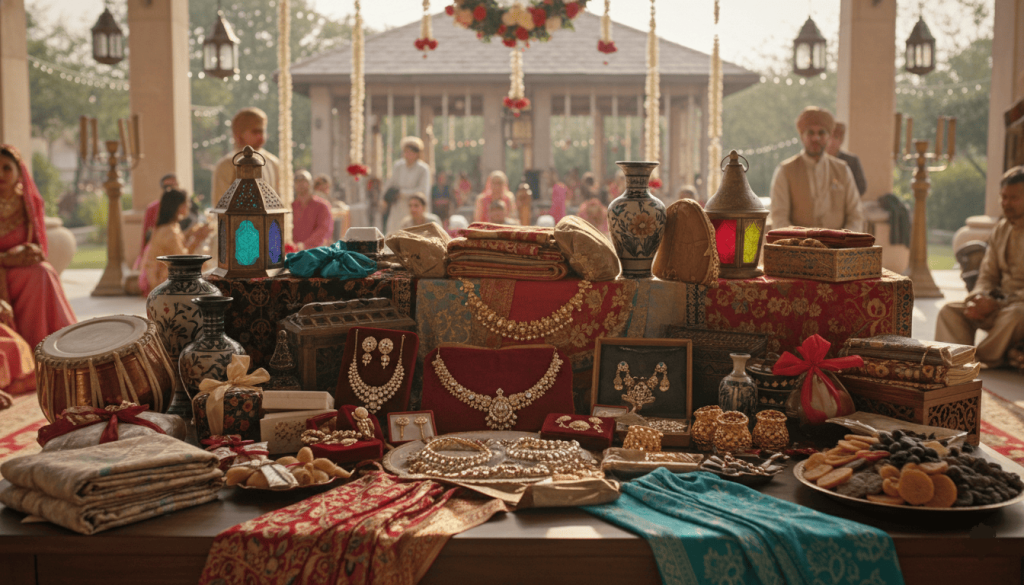
A dowry is money, property, or goods that a bride’s family gives to the groom or his family at the time of marriage. It is one of the oldest marriage customs on record, and it still shapes weddings in parts of the world today. The couples I work with usually run into the word in one of three places: a cross-cultural wedding where two families are blending traditions, an old family story about a great-grandmother’s hope chest, or a period drama where someone’s whole future hinges on what her family can put on the table. Here is what the term actually means, where it came from, and how it differs from the customs people mix it up with.
Definition
Dowry — the money, property, or goods a bride’s family transfers to the groom or his family at the time of marriage.
What a dowry actually is
At its simplest, a dowry is wealth that moves with the bride from her birth family into her marriage. It can be cash, land, livestock, furniture, linens, or jewelry. The custom is most common in patrilineal cultures, where a wife is expected to live with or near her husband’s family, so the transfer helps anchor her in a household that is not her own.
The reasons behind it are more practical than romantic. A dowry was meant to give the new household a financial start, and to give the bride a measure of security if she was widowed or divorced. In some societies it functioned as a stand-in for the inheritance a daughter would otherwise have received from her father’s estate.
So even though the wealth is handed to the groom or his family, the older logic was that it traveled for the benefit of the wife and the home she was building. That is also why a dowry is not the same thing as one person buying another, no matter how it looks in a costume drama. If you are sorting through other marriage vocabulary at the same time, it helps to know what the word spouse actually means before you go any further.
Dowry vs. bride price vs. dower
This is where almost everyone trips up, and it is the single most useful thing to get straight. Three customs sound similar and move in completely different directions. The label depends entirely on who pays whom.
A dowry flows from the bride’s side to the groom’s side. A bride price (also called bridewealth) is the opposite: the groom or his family pays the bride’s family. A dower is different again, settled by the groom on the bride herself, and it stays under her ownership. Mixing these up is what leads people to wrongly assume older marriages were always about “buying” a wife.
Three customs, three directions
| Custom | Who pays | Who receives |
|---|---|---|
| Dowry | Bride’s family | Groom or his family |
| Bride price (bridewealth) | Groom or his family | Bride’s family |
| Dower | Groom | Bride herself (stays hers) |
One quick note on words that look modern but carry old weight: the term fiancé, and what it really signals, comes out of the same world of betrothal agreements where dowries were negotiated long before the wedding day.
Where dowries come from
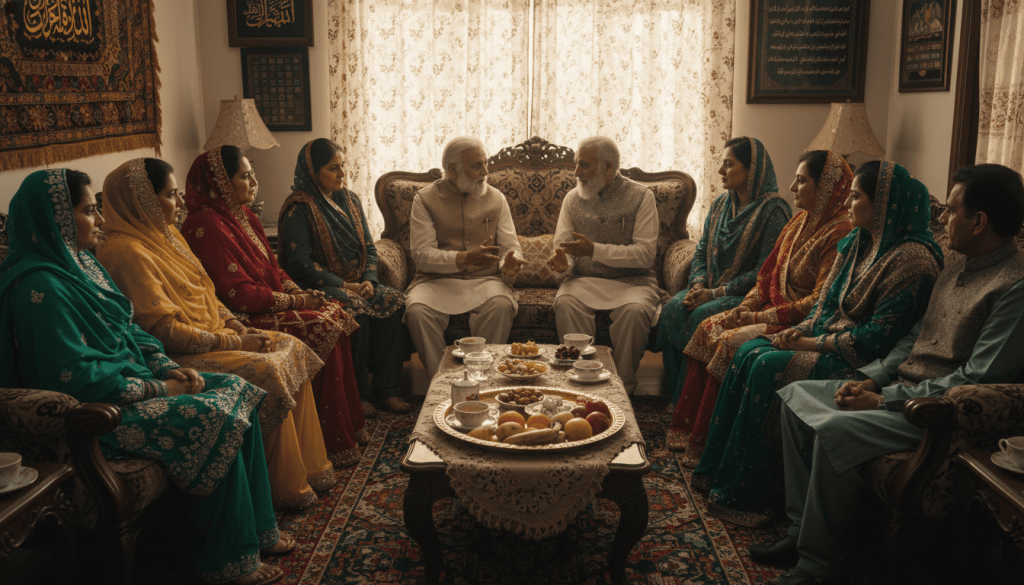
The dowry is genuinely ancient. References to it show up in some of the earliest written law codes, including the Code of Hammurabi, the Babylonian legal text dated to roughly 1792 to 1750 B.C. The custom almost certainly predates the records we have of it.
In medieval and aristocratic Europe, a dowry did heavy lifting. It made a daughter a more attractive match, it built wealth and influence between powerful families, and it could even help settle border or policy disputes through strategic marriages. Failure to provide a proper dowry could sink a match entirely.
Dowries also have long histories in South Asia, Africa, and beyond, taking on different forms in each region. The thread that ties them together is the same: marriage was a transaction between families, not only a bond between two people.
Did you know
The dowry is old enough to appear in the Code of Hammurabi, a Babylonian law code from roughly 1792 to 1750 B.C. It is one of the oldest marriage customs ever written down. Source: EBSCO Research Starters; Britannica.
Dowries in the Western wedding tradition
If you grew up in the United States, the dowry probably reached you in a softer, half-forgotten form: the hope chest. Also called a dowry chest, trousseau chest, or cedar chest, it was a trunk a young woman filled with linens, quilts, table cloths, and household goods in the years before marriage. In Britain the same idea went by the “bottom drawer.”
The lineage runs straight back to the decorated wooden chests of medieval Europe, and the tradition crossed the Atlantic with European settlers, including the German communities who became known as the Pennsylvania Dutch. As women gained their own income and independence, the hope chest faded from a financial necessity to a sentimental keepsake. You can even see its echo in the modern bridal shower, where guests still send a couple off with goods for their new home.
This is where I see the word come up most often in my own work. It is rarely a couple planning an actual dowry. It is someone honoring a grandmother’s hope chest, or two families gently blending customs in a cross-cultural wedding, and wanting to understand the history before they borrow from it. If a token of commitment is what you are really after, it is worth understanding how a promise ring works instead.
Cultural variation
In medieval Europe : aristocratic brides arrived with a dowry of land or cash plus a richly carved chest of linens, a forerunner of the American hope chest. In parts of South Asia : dowry can still be expected at marriage, even though India formally outlawed the practice in 1961. In Islamic marriage : the groom gives a payment called mahr to the bride herself, which is a dower rather than a dowry, and Indian law treats mahr separately.
Are dowries still practiced today?
In much of the world, the dowry has steadily declined and largely disappeared from everyday marriage. In most Western countries there is no specific dowry law because the custom simply faded as women gained legal and economic standing.
It has not vanished everywhere. Dowries are still expected or demanded in parts of Asia, Africa, and the Middle East, often in places where women have fewer paths to employment and the transfer carries real financial weight for a family.
The harder truth is that the custom has also been tied to serious harm. In India, dowry demands have driven harassment, abuse, and what are recorded as “dowry deaths.” India outlawed the giving, taking, and demanding of dowry under the Dowry Prohibition Act, 1961, with later criminal provisions targeting dowry-related cruelty. Even so, enforcement is uneven and the practice persists. India’s National Crime Records Bureau still logged more than 6,000 dowry-related deaths in 2023, a reminder that a custom with ancient roots can carry a very modern cost. Whatever a marriage looks like on paper, the legal side matters, which is why it helps to understand the difference between a marriage license and a marriage certificate wherever you live.

Frequently asked questions
The questions I get asked most about dowries come down to a few recurring mix-ups. Here are the short, plain answers.
Is a dowry the same as a bride price?
No. They run in opposite directions. A dowry goes from the bride’s family to the groom or his family, while a bride price (or bridewealth) is paid by the groom’s family to the bride’s family.
Is giving a dowry illegal?
It depends on the country. In India, giving, taking, or demanding a dowry has been a crime since the Dowry Prohibition Act of 1961. In most Western countries there is no specific dowry law, because the custom faded long ago.
Do people still give dowries in the United States?
Not in the traditional sense. The closest echo is the old hope chest or trousseau, where a bride collected household goods for her future home. Today it survives mostly as the loose idea of what each person brings into a marriage.
What is the difference between a dowry and a trousseau?
A trousseau is the personal clothing, linens, and household items a bride collects for herself. A dowry is wealth transferred to the groom or his family. The trousseau stays with the bride; the dowry changes hands.
Was a dowry ever given to the bride herself?
When wealth is settled directly on the bride and stays under her control, that is a dower, not a dowry. In Islamic marriage the equivalent is mahr, a payment the groom gives to the bride as her own.
The takeaway for couples today
For almost anyone planning a wedding now, “dowry” is a word you are more likely to read about than budget for. When it turns up on a wedding website, in a family heirloom story, or in a cross-cultural celebration, it is pointing back to a custom about families and futures, not a line item you need to plan around. Understand where it came from, keep it separate from bride price and dower, and you will read every old marriage story more clearly.
Sources
- Britannica, definition and history of dowry. britannica.com
- EBSCO Research Starters, dowry as a social custom and its origins. ebsco.com
- Cornell Law School, Legal Information Institute, dowry definition and cultural variation. law.cornell.edu
- The Dowry Prohibition Act, 1961, India Code (Government of India). indiacode.nic.in
— Madison Cole, Certified Wedding Planner