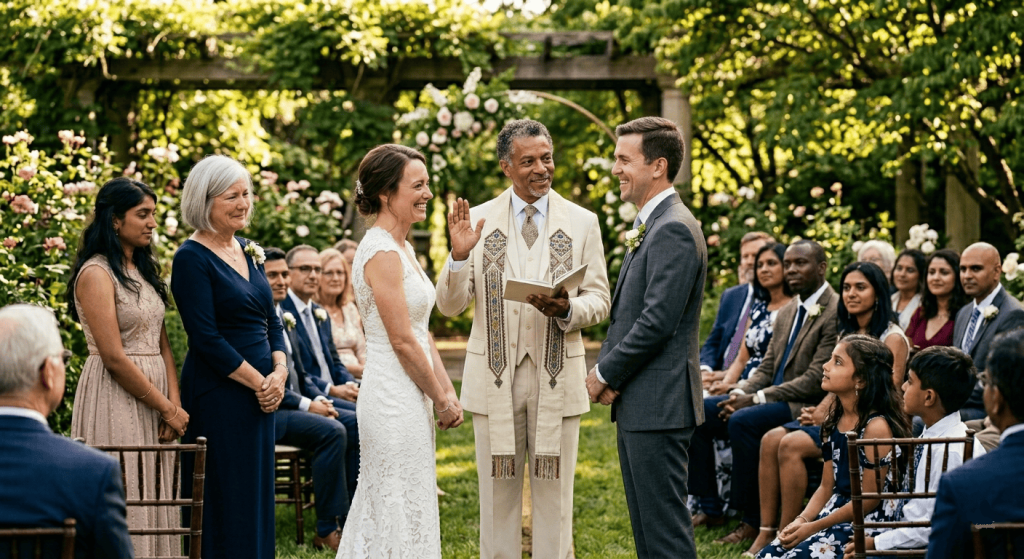
A wedding officiant is the person who leads your ceremony and signs the legal paperwork that makes your marriage official. No officiant, no marriage. In nine years and more than 200 weddings, I’ve watched couples agonize over flowers and centerpieces, then forget the one vendor who actually marries them. Here’s what an officiant really does, the four main types, and what you should expect to pay.
Definition
Wedding officiant — the person legally authorized to perform your ceremony and sign your marriage license, so your union is recognized by the state where you wed.
What does a wedding officiant actually do?
Most couples picture the officiant as the person standing at the front saying a few words. That’s the visible 10%. The real job starts months before the ceremony and ends with a signature that has legal weight.
Here is what a good officiant handles, start to finish:
- Crafts and personalizes the ceremony — the script, the order of events, the readings, and how your personal vows are woven in.
- Leads the ceremony on the day, sets the pace, and keeps the processional, vows, ring exchange, and pronouncement flowing.
- Offers premarital guidance in some cases, from a single planning meeting to several counseling sessions, depending on the officiant and your faith tradition.
- Handles the legal piece by confirming they’re authorized in your state, then completing, signing, and filing your marriage license with the county clerk after the ceremony.
That last point is the one I never let my couples treat casually. A gorgeous ceremony with an unfiled license means you held a beautiful party but you are not legally married. The officiant is the person responsible for making sure that paperwork is signed by the couple, the witnesses, and them, then mailed back on time.
The 4 types of wedding officiants
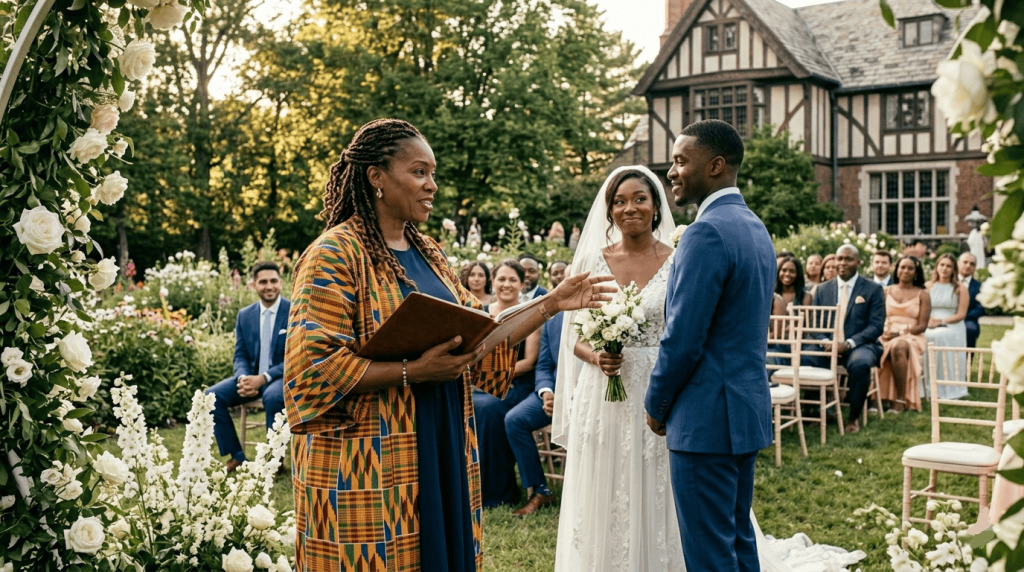
The kind of ceremony you want, whether it’s religious, secular, or legal-only, points you toward the right person to lead it. There are four broad categories, and plenty of couples blend them.
The four types of officiants at a glance
| Type | Who they are | Best for |
|---|---|---|
| Religious | Priest, pastor, rabbi, imam, pandit | Faith-based ceremonies, congregation members |
| Professional | Independent, secular or interfaith celebrant | Custom, personalized ceremonies |
| Civil | Judge, justice of the peace, court clerk | Courthouse weddings, elopements, legal-only |
| Friend or family | Someone you love, ordained online | Personal, budget-friendly ceremonies |
Religious officiants
This is your priest, pastor, rabbi, imam, or pandit, someone authorized to marry couples within a faith tradition. If you’re a member of a congregation, your clergy may marry you at little or no fee, though the house of worship usually has its own venue charge and an expected donation.
Book early. A church or temple wedding often comes with premarital classes or counseling, and popular dates fill up fast, especially in spring and fall.
Professional (independent) officiants
A professional officiant is an independent celebrant who marries couples for a living, secular or spiritual. They’re the most flexible option for a custom ceremony, and they’re who I recommend when a couple wants something that sounds like them rather than a template.
A strong professional will meet with you, learn your story, write a personalized script, run the rehearsal, and manage every legal detail. You’re paying for experience and polish, and on the day, it shows.
Civil officiants
A civil officiant is a judge, justice of the peace, or court clerk who performs the ceremony at city hall, a courthouse, or another government office. This is the route for couples who want to elope or simply make the marriage legal without a big production.
It’s fast, low-cost, and refreshingly free of fuss. You’ll still need your marriage license in hand, and many clerks’ offices require you to book an appointment.
A friend or family member
Having someone you love marry you has become genuinely common, and done well, it’s one of the most moving ceremonies you can have. The catch is logistical: your friend usually needs to get ordained online, and your state has to recognize that ordination.
If this is your plan, send your chosen person my full walkthrough on how to become a wedding officiant so they handle the ordination and paperwork correctly. I’ve seen a license rejected because a well-meaning brother filled out one line wrong, and that is a phone call no couple wants on their honeymoon.
How much does a wedding officiant cost?
In the US, the average wedding officiant costs about $300, with most couples spending between $200 and $450, according to WeddingWire. The number swings widely by region, ceremony type, and how much customization you want.
Professional officiants in major metros run higher. The Knot puts the national range for a professional officiant from roughly $266 to $900, depending on location, travel, rehearsal time, and added rituals or custom vows. Here’s how it breaks down by type.
Officiant cost by type
| Officiant | Typical cost | Notes |
|---|---|---|
| Civil | $40–$100+ | Courthouse or clerk fee; cheapest legal route |
| Religious | Donation | Often a $200–$500 donation; venue fee is separate |
| Professional | $300–$600 | Higher in big metros; custom scripts and travel add up |
| Friend or family | Free–$50 | Online ordination cost only, where the state allows it |
| Marriage license | $30–$100 | Paid to the county; required no matter who officiates |
Ranges are US averages and vary by state and city. Confirm fees directly with your officiant.
Whatever route you choose, remember the marriage license fee is separate and unavoidable, typically $30 to $100 paid to your county. For a sense of where the officiant fits in your overall numbers, see my breakdown of how much a wedding costs.

How to pick the right person to marry you
The officiant sets the emotional tone of the entire day. A flat, generic ceremony makes even a stunning venue feel hollow, and a warm, well-written one can make a backyard feel like the most important place on earth. So I tell my couples to prioritize chemistry as much as credentials.
Before you book, check a few practical things: confirm they’re authorized in your state, ask for a sample script or a recording, and get clear on what’s included (rehearsal, travel, license filing). If you’re going the professional route, lock it in early, ideally as you build out your wedding planning timeline, because the best ones book a year ahead.
Madison’s note
“Ask your officiant one question before you sign: what’s your backup plan if you’re sick or stuck on the day? The pros I trust always have another authorized officiant on call. A friend marrying you rarely does, so I make sure a licensed standby exists. It has saved two of my couples from a no-show panic.”
— Madison Cole, Certified Wedding Planner
One more thing worth saying out loud: the most expensive officiant is not automatically the best one for you, and the free family member is not automatically a risk. Match the person to the ceremony you actually want, then make sure the legal box is checked. Do those two things and you’ve handled the one vendor you genuinely cannot do without.
Common officiant questions
What’s the difference between a civil and a religious officiant?
A civil officiant is a government official, such as a judge, justice of the peace, or court clerk, who performs legally binding ceremonies without religious content. A religious officiant is clergy authorized within a faith tradition, like a priest, rabbi, imam, or pastor, who marries couples according to that faith. Both can make your marriage legal; the difference is the tone and content of the ceremony.
Can a friend or family member officiate my wedding?
Yes, in most US states, as long as they get ordained, usually online, and your state recognizes that ordination. A few states have stricter rules, so always check local requirements before counting on it. Have your friend handle ordination well ahead of time, not the week of the wedding.
How much do you tip a wedding officiant?
For a professional officiant, a tip of $50 to $100 is a kind gesture but not required, since they set their own fee. For religious officiants who don’t charge, a donation of $100 to $300 to the house of worship is customary. A friend or family member who marries you deserves a heartfelt gift rather than cash.
What does “officiant” mean, and how do you say it?
An officiant is the person who officiates, meaning the one who legally performs your wedding. It’s pronounced oh-FISH-ee-uhnt. The legal term for performing the ceremony is “solemnization,” which is why you’ll sometimes hear that an officiant “solemnizes” a marriage.
Sources
- The Knot — How Much Does a Wedding Officiant Cost. theknot.com
- WeddingWire — Wedding Officiant Cost Guide. weddingwire.com
- Zola — The Duties of a Wedding Officiant. zola.com
Written by Madison Cole, Certified Wedding Planner
Madison planned more than 200 weddings out of Charleston, South Carolina between 2015 and 2024, from backyard ceremonies to historic mansions and destination weddings, before turning to editorial work. She writes One Stop Wedding Planner to give couples the same straight-talking playbook she handed her clients for nine years.