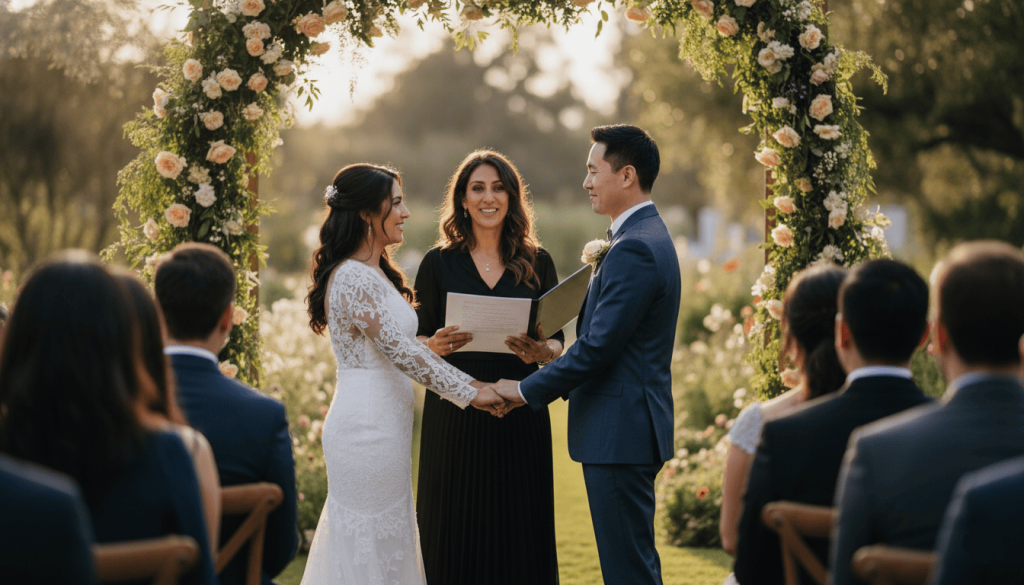
“Become a wedding officiant” sounds like it should involve seminary, robes, and years of training. It doesn’t. In most of the country you can get the legal authority in the time it takes to order takeout. I’ve planned more than 200 weddings, and some of the most moving ceremonies I’ve watched were run by a brother, a college roommate, or a best friend who decided to get ordained online a few weeks earlier.
Here’s the part nobody tells you, though: the ordination is the easy 10%. The other 90% is the paperwork and the delivery. I’ve stood in the back while a panicked friend realized the marriage license was still sitting on the couple’s kitchen counter, and I’ve watched a couple have to redo their license because the officiant forgot to return it in time.
So if you’ve been asked to marry two people you love, this is the version I’d give you over coffee: how to get ordained, how to figure out what your state actually requires (because it varies more than you’d think), the one legal job you cannot fumble, and how to write and run a ceremony that sounds like the couple instead of a generic script. I’m a planner, not a lawyer, so treat your county clerk as the final word on the legal details. But after this, you’ll know exactly what to do, and in what order.
How to become a wedding officiant, step by step
Get ordained online
Sign up with a recognized church like American Marriage Ministries or the Universal Life Church. It’s free, takes a few minutes, and you must be 18 or older.
Check your state and county rules
Officiant requirements vary by state and even by county. Some places need nothing extra; others require you to register first.
Register or file your credentials if required
Where registration is required, do it well before the wedding, not the week of. Those offices can move slowly.
Get familiar with the marriage license
The couple obtains it. You review it before the ceremony, sign it after, and return it to the issuing office by the deadline.
Write a legally valid ceremony
Build your script around the two legal must-haves: the Declaration of Intent and the Pronouncement. Everything else is yours to shape.
Rehearse and run the ceremony
Read it out loud, time it, and bring a printed copy, the license, and a pen on the wedding day.
Sign and return the license
After the ceremony, sign the officiant section, have the witness or witnesses sign, and get the license back to the county on time.
Before you start: a quick reality check
You don’t need a religious background, a license to practice, or any experience to do this. In nearly every state, the requirements come down to two things: you have to be 18 or older, and you have to be asked by the couple. That’s it for eligibility.
What you do need is a little time and a willingness to be the calm person in the room. Budget roughly this much:
- The legal setup: a few minutes to get ordained, plus an hour or two if your area requires registration.
- The ceremony: a few hours over a couple of weeks to write, edit, and rehearse a script that actually fits the couple.
- The day itself: the ceremony, the signing, and getting the license back to the county afterward.
If you’re comfortable speaking in front of 50 to 200 people for ten minutes, you’re already most of the way there. If public speaking terrifies you, that’s worth an honest conversation with the couple before you say yes. The legal part is forgiving. A wobbly delivery in front of everyone they know is harder to walk back.
Step 1: Get ordained online
For most people, the first real step is to get ordained online through a recognized church. The two everyone uses are American Marriage Ministries and the Universal Life Church. Both are non-denominational, both ordain you for free, and both take about as long as filling out a shipping address. You’ll need to be 18 or older, and you don’t have to hold any particular faith to do it.
Becoming an ordained minister this way is what gives you the legal authority to perform a wedding in the majority of states. Which church you pick barely matters for the ceremony itself. What matters is that you keep your ordination confirmation somewhere you can find it, because a few counties will ask to see proof before they let you sign a license.
You’ll see both churches offer paid extras: a printed certificate, an officiant package, a letter of good standing. None of those are required to perform a legal ceremony. Buy them only if your county specifically asks for documentation, or if the couple wants a framed keepsake.
Step 2: Check your state’s officiant requirements
This is the step most first-time officiants skip, and it’s the one that causes the headaches. Officiant requirements vary by state, and sometimes by county within the same state. Ordination gives you authority in most places, but a handful of jurisdictions add their own paperwork on top, and the rules are genuinely inconsistent across the map.
States where it’s basically no paperwork
Plenty of states let an ordained officiant show up and perform the ceremony with nothing filed in advance. California is a clear example. According to the California Department of Public Health, the state makes it unnecessary for officiants to file credentials with the county clerk or anyone else, and California doesn’t keep a central registry of clergy. In states like this, ordination plus a correctly handled license is the whole job.
States and cities that require registration
Other places want you on file first. New York City is the textbook case: officiants have to register with the City Clerk before they can perform a ceremony there. Some counties elsewhere ask you to bring your ordination credentials to the clerk’s office to be recorded. And a small number of counties have, at times, questioned online ordinations altogether.
The safe move is the same everywhere: confirm the rules with the clerk in the specific county where the couple will get their license. Do it the same week you agree to officiate, not the week of the wedding. American Marriage Ministries keeps state-by-state guides that are a good starting point, but the county clerk is the source that counts. If you’re early enough in the process to build this into a broader plan, my month-by-month wedding timeline shows where the officiant paperwork should land.

Step 3: Register or file your credentials (if required)
If your county or state does require registration, treat it as an errand to knock out early. The exact process differs by location, but you’re usually asked for some combination of these:
- Proof of ordination, such as your confirmation or a printed certificate from the church.
- A government-issued photo ID.
- A short registration form, sometimes filed in person and sometimes online.
- A small fee, often under $50, though many places charge nothing at all.
The mistake I see is people leaving this until the rehearsal. Clerk’s offices keep their own hours, sometimes require appointments, and don’t care that your wedding is Saturday. Get the paperwork settled a month or two out and the rest of the process gets a lot calmer.
Step 4: Get familiar with the marriage license (your one true legal job)
Here is the part I’d underline twice. The ceremony is the emotional center of the day, but the marriage license is the legal one, and it’s the piece a friend officiant is most likely to fumble. A wedding without a kiss is awkward. A wedding without a properly completed and returned license isn’t legally a marriage yet.
A few things to get straight, because the difference between the paperwork and the keepsake trips people up constantly. If the distinction is fuzzy for you, my breakdown of a marriage license versus a marriage certificate walks through it. The short version for officiants:
- The couple gets the license, not you. They apply for it at the county and bring it to the wedding.
- Review it before the ceremony. In California, performing a marriage without first reviewing the license is actually a misdemeanor, per the state’s vital records office. Even where it isn’t a legal requirement, reading it in advance catches spelling errors and missing fields while there’s still time to fix them.
- Sign the officiant section after the ceremony. You complete your portion, and the required witness or witnesses sign theirs. Rules on witnesses vary; California, for instance, requires one witness signature and allows a maximum of two on a public license.
- Return it by the deadline. The signed license goes back to the office that issued it, within a set window. California gives the officiant 10 days. Miss the deadline and the couple can be stuck redoing paperwork.
Madison’s note
“I ask every friend officiant to do one thing: get the license from the couple a full week early and read it together over the phone. I’ve caught a misspelled middle name, a wrong county, and a blank field that would have voided the whole thing, all on calls that took five minutes. It is the cheapest insurance at a wedding.”
— Madison Cole, Certified Wedding Planner
Once the license is handled correctly, almost nothing else about the day can go legally wrong. That’s why I’d rather a first-time officiant over-prepare on this one piece than polish their speech for an extra hour.
Step 5: Write a ceremony that’s legally valid (and sounds like them)
A ceremony can be ten minutes or thirty, religious or completely secular, traditional or written entirely from scratch. But for the marriage to be legally binding, two elements almost always have to appear, no matter how you dress them up:
- The Declaration of Intent. This is the “Do you take…” exchange that ends in “I do.” It’s the couple stating, out loud and freely, that they want to be married.
- The Pronouncement. This is the moment you, as the officiant, declare them married. It’s short, but it’s the line that legally seals the ceremony.
Everything around those two beats is yours to build. A structure I hand to friend officiants looks like this: a warm welcome, a short story about how the couple met or who they are together, an optional reading or two, the personal vows, the ring exchange, the Declaration of Intent, the Pronouncement, and the kiss. If the couple is writing their own vows, point them to my guide on how to write wedding vows so all three of you are working from the same playbook.
One honest piece of advice: write for the ear, not the page. Read every draft out loud. Anything that makes you stumble when you say it will make you stumble at the altar, too.
Step 6: Run the ceremony on the wedding day
By the wedding day, the hard thinking is done. Your job is to stay calm and keep the ceremony moving. The officiants who make it look easy all do the same small things:
- Rehearse out loud, more than once. Ideally at the actual rehearsal, in the actual spot, so you know where to stand and how your voice carries.
- Time it. Most ceremonies land best between 8 and 20 minutes. Long ceremonies lose the room, and guests are usually standing or seated in the sun.
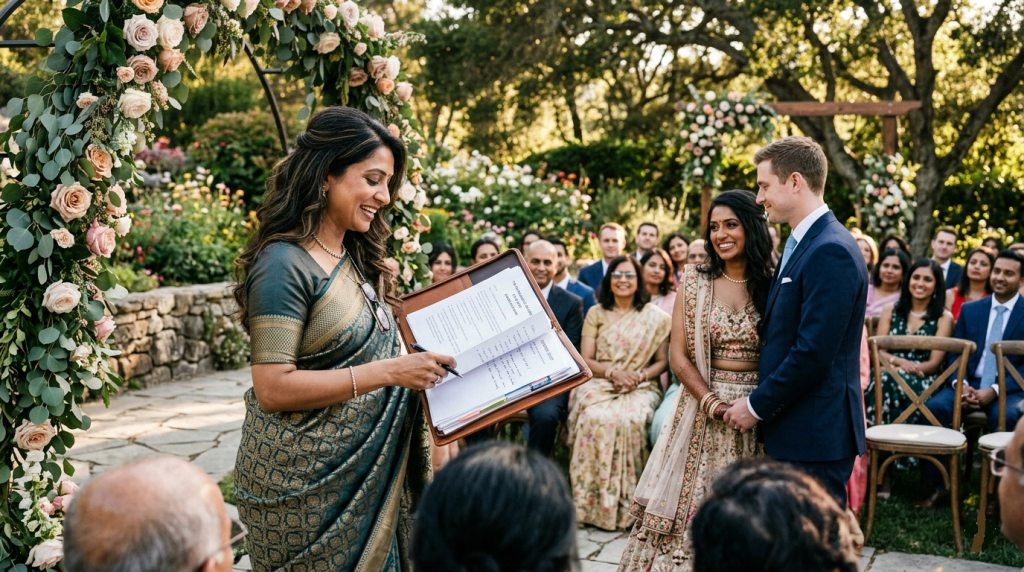
- Bring a printed script. Two copies, in a folder or a small binder, not on your phone. Phones die, glare happens, and a binder reads as intentional.
- Coordinate your cues. If there’s a planner or a day-of coordinator, confirm with them when you walk out, when the music stops, and who hands you the rings and the license.
- Handle the signing calmly. Right after the ceremony, before the party swallows everyone, gather the couple and witnesses and complete the license while people are still in one place.
I’ve watched first-time officiants who were nervous all week completely settle the moment they started speaking, because they’d rehearsed and they trusted their binder. The ones who struggle are almost always the ones who winged it.
Common mistakes I see friend officiants make
None of these are hard to avoid once you know to look for them. Every one of them, though, I’ve watched happen at a real wedding:
- Leaving registration to the last week. If your area requires it and the clerk’s office is closed or booked, you’re stuck. Handle it early.
- Never rehearsing out loud. Reading silently is not rehearsing. The first time you hear your own ceremony shouldn’t be in front of 150 people.
- Skipping one of the two legal elements. A beautiful ceremony that forgets the Declaration of Intent or the Pronouncement can leave the marriage legally incomplete.
- Mishandling the license. Forgetting to review it, forgetting a witness signature, or forgetting to return it on time. This is the big one, and it’s entirely preventable.
- Writing a 30-minute speech. Love for the couple is not measured in minutes. Tight and heartfelt beats long every time.
Real planner tips
A few things I’ve learned from watching this go beautifully and watching it go sideways:
- Confirm the county rules the day you say yes. One phone call to the clerk’s office removes 90% of the legal anxiety.
- Read the license with the couple a week out. Names, dates, county. Fix typos while there’s still time.
- Print two copies of your script. One for you, one tucked with the planner as a backup.
- Decide in advance who hands you the license. Assign it to one specific person so it isn’t lost in the shuffle.
- Keep the Pronouncement short and loud. It’s the legal line and the emotional peak. Say it like you mean it, and project.
- Return the license yourself. Don’t hand it to the couple as they leave for the honeymoon. Take responsibility for getting it back to the county.
It’s also worth saying out loud to the couple what this saves them. Professional officiants in my market run anywhere from $300 to $800 and up, so a friend stepping in is a real line item off the budget. If they’re still mapping out where their money goes, my guide on how to budget for a wedding shows where that savings is best redirected.
Frequently asked questions
The questions I get most often from friends and family members who’ve just been asked to officiate:
How do you get ordained online to officiate a wedding?
Pick a recognized online church such as American Marriage Ministries or the Universal Life Church, fill out their free ordination form, and you’ll have your credentials within minutes. You need to be at least 18. Save or print your ordination confirmation, since some counties ask to see proof before you can sign a marriage license.
Is an online-ordained minister legally allowed to marry people?
In most of the United States, yes. Ordination through a recognized church gives you the legal authority to solemnize marriages in the majority of states. A small number of counties have at times questioned online ordinations, so the safest move is to confirm with the county clerk where the marriage license is issued before the wedding.
Can I officiate a wedding for a friend or family member?
Absolutely, and it’s one of the most common reasons people get ordained. Some of the warmest ceremonies I’ve planned were led by someone close to the couple. You follow the same steps as a professional: get ordained, check your local requirements, write the ceremony, and handle the marriage license correctly on the day.
Do officiant requirements really vary by state?
They vary a lot. California, for example, doesn’t require ordained officiants to register or file credentials with the county at all, while New York City requires officiants to register with the City Clerk before performing a ceremony. Always check the rules in the specific county where the license is issued.
How much does it cost to become a wedding officiant?
Getting ordained through American Marriage Ministries or the Universal Life Church is free. Some states or counties charge a small registration or filing fee, usually under $50. Optional extras like a printed certificate or officiant package cost more, but you don’t need them to perform a legal ceremony.
How far in advance should I get ordained?
I tell friends-turned-officiants to get ordained as soon as they say yes, ideally a couple of months out. Ordination itself is instant, but if your area requires registration, those offices can be slow, and you want the paperwork settled long before the rehearsal.
These are the sources I leaned on for the legal details in this guide, all official church or government offices rather than secondhand summaries:
Sources
- American Marriage Ministries. Free Online Ordination and State Guides. theamm.org
- Universal Life Church. How to Officiate a Wedding. ulc.org
- California Department of Public Health. Marriage Officiant FAQ. cdph.ca.gov
- New York City Clerk. Marriage Officiant Registration. cityclerk.nyc.gov
The bottom line
Becoming a wedding officiant is genuinely fast: get ordained online, confirm what your county requires, and you have the legal authority. The care goes into the two things the ordination websites breeze past, which are handling the marriage license without a single misstep and delivering a ceremony that sounds like the people getting married. Do those well and you’ll give the couple something a hired officiant rarely can, which is a ceremony led by someone who actually knows them.
If you’re the one steering the whole event and not just the ceremony, my complete walkthrough on how to plan a wedding covers the rest of the day around you, from timeline to budget to the run of show.
Written by Madison Cole, Certified Wedding Planner.