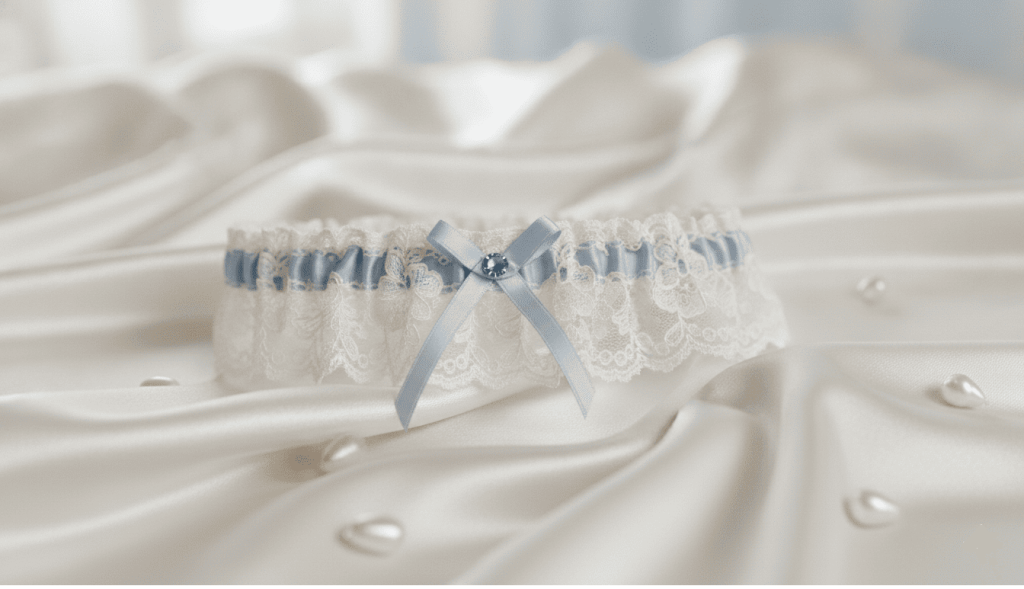
A wedding garter is a band of fabric — usually lace, ribbon, or elastic — worn snugly around the bride’s upper thigh, under her dress. It once had a real job: holding up stockings. Today it’s purely decorative, worn as a keepsake, used for the lighthearted “garter toss” at the reception, and often doubling as a bride’s “something blue.” In my years planning weddings on the east coast, the garter is one of those details brides ask me about late — usually a month out, when they’re deciding whether to do the toss at all. Here’s what that little band of lace actually means, where the tradition came from, and how to decide if it belongs in your day.
Definition
Garter — a band of lace or ribbon worn around the bride’s upper thigh, originally used to hold up stockings and now worn as a keepsake or for the wedding garter toss.
What is a wedding garter, exactly?
Strip away the wedding context and a garter is a simple thing: a narrow band fastened around the leg to keep a stocking from sliding down. For centuries both men and women wore them, and they were a practical part of everyday dress. Once pantyhose arrived in the late 1950s, the everyday garter mostly disappeared — and what survived migrated almost entirely into weddings.
The modern bridal garter is decorative, not functional. It’s typically made of stretch lace or satin, held in place by an elastic band, and worn around the mid-thigh. Brides wear it under the gown, where almost no one sees it, which is part of the charm — it’s a small, private detail that’s yours alone unless you choose to make it part of the toss. Some brides buy a single garter; many buy two, for reasons I’ll get to below.
Where the wedding garter tradition comes from
The garter is often called one of the oldest wedding customs in the Western world, with roots that go back to medieval Europe. The origin story isn’t a romantic one. In that era, there was a strong belief that owning a scrap of the bride’s clothing brought good luck and good fortune to whoever held it. After the ceremony and feast, guests would sometimes follow the couple and grab at the bride’s gown for a lucky token — occasionally tearing her dress in the process.
To get ahead of the grabbing, the custom shifted: instead of letting guests rip at her clothes, the bride (or the groom) would remove a single, easily detachable item — the garter — and toss it to the crowd as a distraction. Over the centuries that act softened into the playful reception moment we recognize today. By the Victorian era, openly tossing a garter was considered a little scandalous, and the gentler bouquet toss rose up alongside it as a more modest alternative. The two have been a matched pair at receptions ever since.
Did you know
By The Knot’s 2023 Real Weddings Study, fewer than a third of couples — about 31% — still did the bouquet toss, and the garter toss came in even lower. The tradition is fading, but it’s far from gone. Source: The Knot Real Weddings Study, 2023.

What the wedding garter symbolizes
Over the centuries the garter has stood for a handful of things, and the meaning has drifted as the custom moved from superstition to spectacle to keepsake. Historically it carried associations with good luck, fertility, and fidelity — blessings the couple hoped to share with their guests. Blue garters picked up an extra layer of meaning, since blue has long signaled love and faithfulness, which is exactly why so many brides use the garter as their “something blue.”
If you ask ten brides today what their garter means to them, you’ll get ten different answers. For some it’s a nod to history and the women in their family who wore one. For others it’s a romantic detail meant just for their partner. And for plenty of couples, the toss is simply a fun, slightly cheeky moment on the dance floor with no deep meaning attached at all. None of those readings is more correct than the others.
The garter toss, explained
The garter toss is the reception tradition most people picture when they hear the word “garter.” It usually happens later in the evening, often after the cake cutting and around the same time as the bouquet toss. The bride sits in a chair, the groom removes the garter from her leg — by custom the left leg, though there’s no rule about it — and then tosses it over his shoulder to a group of single guests. Whoever catches it is jokingly said to be the next one married. At some weddings the garter-catcher and the bouquet-catcher are even paired up for a photo.
Here’s the honest part: this is one of the most debated traditions in the wedding world, and a lot of couples now skip it. Some find the removal too theatrical for their crowd; others simply don’t want a competitive scramble in the middle of their reception. That’s completely fine. Skipping the toss doesn’t mean skipping the garter — and doing the toss doesn’t mean you have to make a production of it. I’ve seen it done in ten quick, charming seconds, and I’ve seen couples leave it out entirely and never miss it.
Types of wedding garters
Most of the confusion I field about garters comes down to one thing: brides don’t realize there are essentially two roles a garter can play. Here’s how they break down.
The keepsake garter
This is the nice one — usually the prettier lace, sometimes embroidered with a date, initials, or a charm, and often made or chosen with the intention of keeping it forever. Brides save these in a memory box, pass them down, or simply tuck them away with the dress. If you’re only buying one garter and you want it to last, this is the one to invest in.
The toss garter
This is a second, simpler, less expensive garter made specifically to be thrown. It takes the abuse of the toss so your keepsake doesn’t have to. Toss garters are usually lightweight and plain, since they’re going to sail across a room into a crowd of groomsmen.
The garter set
A set is simply the keepsake and the toss garter sold together, usually in matching styles. If you want to do the toss and keep a garter, a set is the simplest route — and it’s what I steer most of my brides toward.
Across all three, the materials are similar: stretch lace, satin ribbon, a touch of crystal or pearl, and very often a hint of blue worked in so the garter pulls double duty as your something blue. Like a wedding veil, it’s an accessory with a long history that brides personalize to make their own — you can read more about what a wedding veil is and where that tradition came from if you’re curious how another bridal classic evolved.
How to wear the garter — or skip it
Wearing one is easy: slide it up to about mid-thigh, where the leg is slimmest, so it stays put without pinching. If you’re keeping it on through dinner and dancing, choose comfort over tradition and pick whichever leg feels better. If you’re doing the toss, position the toss garter lower on the leg so the groom can reach it without an awkward search under your gown.
The bigger decision is whether to include the garter at all, and I want to take the pressure off that one.
Madison’s note
“Here’s the one thing I tell every bride who’s on the fence: buy a set. Wear the pretty keepsake garter all day, and toss the cheaper second one — so you’re not throwing your heirloom lace into a crowd of groomsmen. It’s the easiest way to keep the tradition without losing the piece you actually want to keep.”
— Madison Cole, Certified Wedding Planner
The garter lives under your gown, so it’s worth thinking about alongside the dress itself — the silhouette and fit affect whether a garter sits comfortably and whether it’s even visible during a toss. If you’re still in the early stages, my full walkthrough on how to choose a wedding dress covers how to think about what goes underneath. And if you do plan a toss, slot it into the right spot during the evening — I map out exactly where reception moments like this land in my month-by-month wedding timeline guide.
Etiquette note
There’s no etiquette rule that requires a garter or a garter toss — both are entirely optional. If the toss doesn’t suit your crowd, leave it out and keep the garter as a private keepsake. It’s a personal tradition, not a social obligation, so there’s no faux pas in skipping it.
If you want a few playful ways to put your own stamp on the details — from a personalized garter to swapping the toss for something that feels more like you — my running list of wedding ideas worth stealing is a good place to start.

Wedding garter questions, answered
Which leg does the wedding garter go on?
There’s no strict rule, but tradition puts the garter on the bride’s left leg, worn around the mid-thigh. In practice, choose whichever leg is more comfortable — especially if you plan to keep it on through dinner and dancing.
Do you need a garter for your wedding?
No — a garter is entirely optional. Plenty of brides skip it. Some wear one purely as a keepsake or as their something blue, and others wear one only for the toss. It’s a personal choice, never a requirement.
What’s the difference between a toss garter and a keepsake garter?
A keepsake garter is the nicer one a bride keeps after the wedding, often saved as an heirloom. A toss garter is a second, less expensive band thrown to guests during the garter toss, so the keepsake stays intact. Many brides buy them together as a set.
When is the garter removed during the wedding?
If a couple does the garter toss, it usually happens at the reception — often after the cake cutting and around the same time as the bouquet toss. The groom removes the garter and tosses it to the single guests.
Is the garter toss outdated?
It’s less common than it used to be — by The Knot’s 2023 Real Weddings Study, fewer than a third of couples did the bouquet toss, and the garter toss is even less popular. Many couples now skip it or keep the garter private, while others still enjoy it as a fun reception moment. Neither choice is wrong.
The bottom line
A garter is a small band of lace with a long, slightly odd history — from a medieval good-luck token to a Victorian-era reception game to the keepsake (and optional toss) it is today. Wear one as your something blue, save it as an heirloom, throw it for the fun of it, or skip it altogether. Whatever you choose, you’re in good company, because there’s no single right way to do it.
Sources
- The Knot — Wedding Garter Tradition & Toss; The Knot Real Weddings Study, 2023. theknot.com
- Brides — Wedding Garter Traditions, Old and New. brides.com
- Garter — history and origin of the garment. wikipedia.org
Written by Madison Cole, Certified Wedding Planner. Madison has planned 200+ weddings on the US east coast and writes about wedding planning and attire at One Stop Wedding Planner.