Send your wedding invitations 6 to 8 weeks before the wedding date. That single window covers most couples I work with, and it is the same number Emily Post, The Knot, and Zola all land on. The reason it has held for decades: it gives guests enough room to confirm, book travel, and mail back an RSVP, without being so early that your invitation gets buried in a drawer.
But the full picture has more moving parts than one number. Your save-the-dates, your order and design lead time, your RSVP deadline, and whether anyone is flying in all shift the math. Here is the whole timeline I give my couples, with the exceptions that actually matter.
Quick answer
Send your wedding invitations 6 to 8 weeks before the wedding date, with your RSVP deadline set 3 to 4 weeks before the day. If you skipped save-the-dates or guests are traveling for a holiday weekend, push that to 10 to 12 weeks. For a destination wedding, mail invitations about three months out.
The short answer: 6 to 8 weeks before the wedding
The standard etiquette window is 6 to 8 weeks before the wedding date, and it has real staying power. The Emily Post Institute sets invitations at six to eight weeks out, with save-the-dates going earlier. Anna Post, who co-authored the family’s wedding etiquette guide, has described the mailing date as roughly eight weeks, flexible down to six or up to ten depending on travel.
Why this range and not, say, three months? Because the calendar has to work backward from your caterer’s final headcount, not forward from your excitement. Eight weeks out gives guests time to respond by a deadline, leaves you a window to chase the stragglers, and still lands close enough that nobody forgets they said yes.
If you set your RSVP deadline 3 to 4 weeks before the wedding, the whole sequence clicks into place. Mail at eight weeks, ask for responses by three weeks out, spend the final fortnight on seating charts and your final count. That is the rhythm I build into every month-by-month wedding planning timeline I hand a couple.
What’s included in the full invitation timeline
Most timelines online only tell you when to drop invitations in the mail. In practice, four milestones run in sequence, and the mailing date is just the third one. Here is the full stationery timeline, start to finish.
The save-the-dates go first, then the order and design step (the one couples chronically forget), then the invitations themselves, and finally your RSVP deadline. Each one feeds the next.
The full wedding invitation timeline
| Milestone | When | Why it matters |
|---|---|---|
| Save-the-dates | 4 to 6 months before (8 to 12 months for destination or peak-season dates) | Locks your date on guests’ calendars before they book other plans |
| Order & design invitations | About 4 months before the wedding | Leaves room for proofing, printing, and assembly without rush fees |
| Mail invitations | 6 to 8 weeks before (10 to 12 weeks with no save-the-date or a holiday weekend) | The standard etiquette window; guests plan travel and respond on time |
| RSVP deadline | 3 to 4 weeks before | Gives you time to follow up and hand the caterer a final count |
One etiquette rule sits underneath this whole table, and it trips people up: anyone who receives a save-the-date must receive a formal invitation. The Emily Post Institute is firm on it. So your save-the-date list is not a draft, it is a promise. Keep your B-list off it entirely.
How the timing changes by wedding type
The 6-to-8-week window is the default, not the law. Four variables move it, and most couples are dealing with at least one of them.
Destination weddings
If guests are flying in, give them more runway. Send save-the-dates 8 to 12 months out and mail the formal invitations about three months before the wedding. Zola and most planners agree on the longer lead time, because airfare and hotel blocks only get more expensive and harder to book the longer guests wait.
No save-the-dates? Push the invitations earlier
Save-the-dates exist to do the early heavy lifting. If you skip them, your invitation is now doing two jobs, so it needs to go out sooner. Mail it 10 to 12 weeks before the wedding instead of six to eight. This is common for shorter engagements, where there was never a save-the-date phase to begin with.
Holiday weekends and peak travel dates
A wedding near Thanksgiving, Christmas, or a long weekend competes with everyone else’s travel plans. Add a buffer and send invitations 10 to 12 weeks out. Guests booking flights for a holiday weekend in October need far more notice than guests driving across town for a Saturday in July.
Paper RSVP cards versus digital responses
If your invitation includes a physical RSVP card that has to travel back to you by mail, lean toward the eight-week end of the window so the round trip has time to happen. If you are collecting responses through your wedding website or a QR code, you can comfortably hold to six weeks, since the reply is instant.
When to order your invitations, not just mail them
This is the step that derails couples, because it happens long before the date that shows up on every checklist. Mailing is the finish line. Ordering and designing is where the time actually goes.
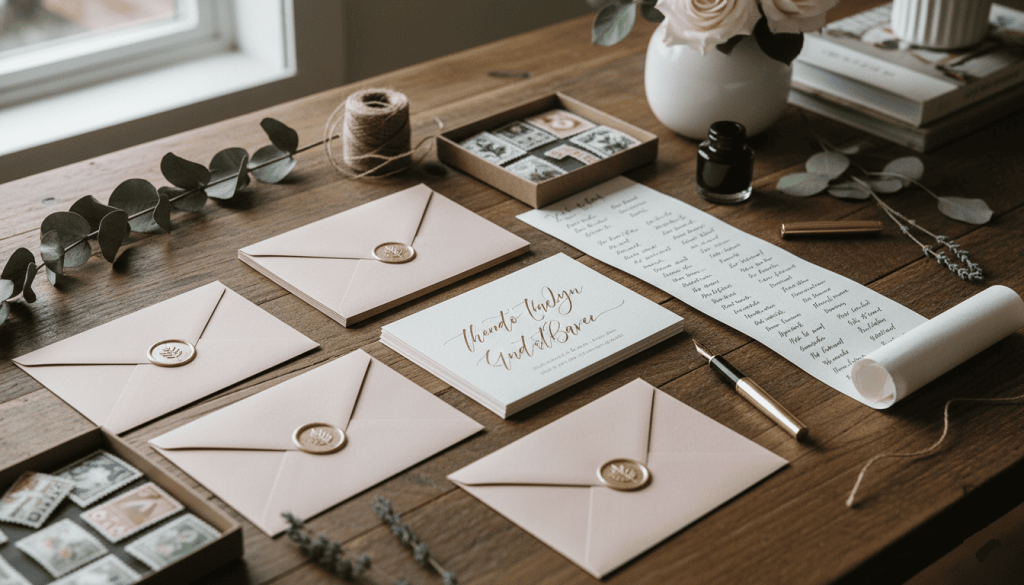
Start the design process about four months before the wedding, which puts ordering roughly two months ahead of your mailing date. That buffer absorbs the parts nobody schedules: proofing rounds, a reprint when a name is misspelled, shipping, and the surprisingly slow work of stuffing and stamping envelopes by hand.
If you have your heart set on letterpress, foil, or any specialty printing, add two to three weeks on top. Those processes run on the print studio’s calendar, not yours. The same logic applies to addressing your invitations by hand or with a calligrapher, which can take a week or more on its own.
The invitation timing mistakes I see every season
After enough weddings, the same few errors show up on repeat. None of them are fatal, and all of them are avoidable once you know where to look.
1. Mailing four months out because earlier feels safer
This is the most common one, and it backfires. An invitation that arrives too early gets set aside, then forgotten, and the RSVP never comes. I have watched it happen with otherwise organized guests. Eight weeks is close enough that the date stays top of mind.
2. Sending save-the-dates to the B-list
Because a save-the-date obligates you to send a full invitation, treating it as a casual heads-up creates a real problem. If your numbers come in high and you need to trim, you cannot quietly drop someone who already has a card on their fridge. Only send save-the-dates to guests you are certain about.
3. Setting the RSVP deadline too close to the wedding
A deadline of one week out leaves you no room to chase the people who never reply, and there are always people who never reply. Set it 3 to 4 weeks before so you have time to call the non-responders and still meet your caterer’s cutoff.
4. Forgetting to budget time for addressing and assembly
Couples plan the mailing date down to the day, then lose a full week to envelope addressing they never scheduled. Build assembly and addressing into the four-month order window, not the final week.


Frequently asked questions
Is three months too early to send wedding invitations?
For a local wedding, yes, three months is usually too early. The 6-to-8-week window is the sweet spot, because invitations sent too far out tend to get misplaced before the RSVP comes back. Three months is the right call only for a destination wedding or a date that falls on a busy holiday weekend.
Do save-the-dates and invitations go to the same people?
Yes. The Emily Post Institute is clear that anyone who receives a save-the-date must receive a formal invitation. That makes your save-the-date list a commitment, not a maybe, so keep your B-list off it and only send to guests you are sure about.
When should the RSVP deadline be?
Set your RSVP deadline 3 to 4 weeks before the wedding. That leaves you time to follow up with anyone who hasn’t replied and still hand your caterer a final headcount before their cutoff, which is often one to two weeks out.
How early should I order my invitations?
Start designing about four months before the wedding, which puts your order roughly two months ahead of the mailing date. That window covers proofing, printing, shipping, and assembly. Add two to three weeks if you want letterpress, foil, or another specialty finish.
Can I send wedding invitations by email?
Etiquette still favors paper for a formal wedding, and the Emily Post Institute treats emailed invitations as a faux pas for the main event. Digital invitations are fine for casual or short-notice weddings, and they follow the same 6-to-8-week guest timeline. The upside is instant RSVP tracking and no envelopes to stuff.
Sources
- Emily Post Institute — Wedding Invitations 101. emilypost.com
- The Knot — When to Send Wedding Invitations. theknot.com
- Zola — When Should You Send Out Your Wedding Invitations. zola.com
So the headline holds: mail at 6 to 8 weeks, work backward from your caterer's count, and protect the design window earlier than feels natural. Get those three right and the rest of your stationery falls into place. When you're ready to put it on paper, my full guide to addressing wedding invitations the right way walks you through outer envelopes, titles, and the etiquette that makes guests feel personally welcomed.
Written by Madison Cole, Certified Wedding Planner