You have the invitations in hand, a stack of beautiful envelopes on the table, and a guest list that suddenly feels like a pop quiz on titles, last names, and who exactly gets a plus-one. This is the moment almost every couple I work with stalls. Across 200+ weddings I planned out of Charleston, addressing the envelopes is the task couples underestimate the most, then panic about the week the calligrapher’s deadline lands.
Here is what I want you to know before you write a single name: the rules are simpler than the internet makes them sound. Most of what trips people up is not wedding invitation etiquette at all. It is a messy address spreadsheet, a name spelled wrong, or a suite that turned out to need extra postage. Get the list clean and the rest falls into place.
The other thing worth saying upfront: the formal inner and outer envelope system that gets treated like law online is now optional. Plenty of my couples skip the inner envelope entirely and address one envelope per household. Both are correct. This guide walks you through the full formal version so you understand every piece, then shows you exactly what to write for every guest scenario, whether you use one envelope or two.
How to address your wedding invitations, step by step
Build a clean address list
Collect full legal names and complete mailing addresses for every household before you touch an envelope.
Address the outer envelope formally
Use courtesy titles and full names, spell everything out, and center the complete address on the front.
Add the inner envelope, if you use one
List only first names or titles and last names, and spell out exactly who is invited, including children and plus-ones.
Match the wording to each guest
Married couples, unmarried partners, families, single guests, and titled guests each follow a slightly different format.
Write the return address
It goes on the back flap of the outer envelope and tells guests where to send gifts and responses.
Weigh a finished suite before you buy stamps
Assemble one complete invitation, take it to the post office, and buy postage for the real weight.
Before you start: build a clean address list
Nine years of weddings taught me that the envelopes go fast once the names are right, and slowly when they are not. So the real first step is not calligraphy. It is a clean, complete address list, ideally a single spreadsheet with one row per household.
For each row, capture full legal first and last names, courtesy titles, the names of any children invited, and the complete mailing address. The Emily Post Institute makes the same point in its guide to wedding invitations: allow plenty of time, and get organized by gathering every name and address before you assemble anything.
A few field habits that save you later:
- Collect addresses through your wedding website or a quick group text, not memory. People move, and the address you had two years ago is often wrong.
- Ask how guests want to be addressed when titles get complicated, especially for doctors, military officers, and couples with different last names. One message now beats a re-print later.
- Lock the list before you hand it to a calligrapher or printer. Every change after that point costs time and, often, money.
If you are still mapping out when invitations go in the mail relative to everything else, my full breakdown of when to send wedding invitations lays out the timeline, and the wedding planning checklist shows where this task lands in the bigger picture.
Inner vs. outer envelope: what actually changed
The classic formal invitation uses two envelopes. The outer envelope is the one that travels through the mail. The inner envelope is unsealed, sits inside, holds the invitation suite, and names only the specific people invited.
The reason the two-envelope system exists is partly practical and partly social. The outer envelope takes the abuse of the postal system, and the inner envelope makes it crystal clear who is and is not invited. That clarity is the whole point: the inner envelope is where you signal, by omission, that the kids are not included or that a guest does or does not get a plus-one.
Here is the part most guides bury. As Zola and other stationers note, single-envelope invitations are now the more common choice. If you only have one envelope, you simply use the outer-envelope format for everyone invited, and you spell out children’s names and plus-ones right there. Nobody at your wedding will think less of you for using one envelope. I have planned plenty of polished, formal weddings that did exactly that.

Step 1: Address the outer envelope formally
The outer envelope is your guest’s first impression of the celebration, so it follows the most formal conventions. Three rules cover almost everything:
- Use courtesy titles and full names. The Knot calls writing out both recipients’ full names with their titles the foolproof option, because it works cleanly for couples of every gender.
- Spell everything out. No abbreviations on a formal envelope. “Street,” not “St.” Spell out the state. Skip middle initials in favor of full middle names, or leave the middle name off entirely.
- Center the full mailing address on the front of the envelope, exactly as you would any letter.
That is the frame. The wording inside the frame changes with who you are inviting, which is the next step.
Step 2: Add the inner envelope, if you’re using one
The inner envelope drops the formality a notch. You can use titles and last names (“Mr. and Mrs. Reynolds”) or, for people you are close to, first names only (“Emily and Jonathan”). No address goes on the inner envelope, because it never touches the mail.
This is also where children and plus-ones live. If a family’s kids are invited, their first names go on a line below their parents’ names. If a single guest gets a plus-one, “and Guest” belongs here, on the inner envelope, never on the outer one. More on that in the scenarios below.
Step 3: Address every guest scenario
This is where the real questions come up. Below is the format for each common situation, with the outer and inner envelope shown so you can adapt to one or two envelopes. The order of names, the titles, and the question of whose name goes first all shift slightly by scenario.
A married couple
The traditional format puts the husband’s title and full name first: “Mr. and Mrs. James Reynolds.” The wife’s first name is not used in this strict version, and there is no middle name for him.
The modern version, which more of my couples choose, uses both partners’ names: “Mr. James Reynolds and Mrs. Emily Reynolds,” or simply “James and Emily Reynolds.” Either is correct. If you go modern, listing the partner you know better first is perfectly acceptable.
- Outer: Mr. and Mrs. James Reynolds
- Inner: Mr. and Mrs. Reynolds, or James and Emily
A married couple with different last names
If she kept her own name, list both full names connected by “and,” on one or two lines depending on length. Per the Emily Post Institute, this reads “Ms. Emily Chen and Mr. James Reynolds.” If she uses her husband’s name socially but her own professionally, follow her preference.
- Outer: Ms. Emily Chen and Mr. James Reynolds
- Inner: Ms. Chen and Mr. Reynolds, or Emily and James
An unmarried couple living together
Both names go on the envelope, connected by “and,” with the person you know better listed first (or alphabetically by last name if you want a neutral rule). Use separate full names with titles.
- Outer: Ms. Nancy Fellows and Mr. Scott Dunn
- Inner: Ms. Fellows and Mr. Dunn, or Nancy and Scott
A same-sex couple
Same rules, same respect. List both full names with titles, either alphabetically by last name or by who you know better. There is no etiquette reason to do anything different for a same-sex couple than for any other couple.
- Outer: Mr. Daniel Ruiz and Mr. Aaron Webb
- Inner: Mr. Ruiz and Mr. Webb, or Daniel and Aaron
A family with children
This is one of the most-searched scenarios, and the rule is clean. On the outer envelope, address only the parents. On the inner envelope, list the parents on the top line and the children’s first names below, oldest to youngest. If you are using a single envelope, the children’s names go on the line below their parents on that one envelope.
The Emily Post Institute notes that for a more formal touch you can use “Miss” for young girls and “Master” for boys under thirteen, though most couples I work with simply use first names for kids. A note on age: guests 18 and older receive their own separate invitation, not a spot on the family envelope.
- Outer: Mr. and Mrs. Henry Kelly
- Inner: Mr. and Mrs. Kelly, Sarah and Jonathan
If you want to invite a whole family without naming each member, “The Kelly Family” on a single line is acceptable and signals that everyone in the household is welcome. If parents who are hosting also appear on the invitation itself, my guide to the mother of the bride role covers how their names are handled on the wording.
A single guest with a plus-one
Address the outer envelope to the guest you know by name. The “and Guest” goes on the inner envelope only. The Emily Post Institute is firm on this: writing “Mr. James Smith and Guest” on the outer envelope feels impersonal, which is exactly the problem the two-envelope system solves.
If you know the plus-one’s name and can confirm the spelling, use it instead of “and Guest.” It is a small touch that lands well.
Etiquette note
According to the Emily Post Institute, a guest’s spouse, fiancé, or live-in partner should always be invited by name, while a casual boyfriend or girlfriend who does not share a residence does not have to be. When you do extend a plus-one, “and Guest” goes on the inner envelope, and the outer envelope stays addressed to the guest you know. It keeps the invitation feeling personal instead of generic.
A single guest, no plus-one
Straightforward: title and full name on the outer envelope, title and last name (or first name) on the inner.
- Outer: Ms. Isla Adams
- Inner: Ms. Adams, or Isla
A divorced or widowed guest
Keep it simple and current. A divorced guest is usually addressed by her own first and last name with “Ms.” A widowed guest is traditionally addressed using her late husband’s name, but many widows now prefer their own first name. When in doubt, ask how she would like to be addressed. This is the one place where guessing can sting, so a quick check is worth it.
A guest with a professional title
Doctors, military officers, judges, and clergy use their professional titles on the outer envelope. A single doctor is “Dr. Barbara Hanson.” A married couple where one is a doctor reads “Dr. Barbara Werner and Mr. James Werner.” If both are doctors, you can write “The Drs. Werner” or “Drs. Barbara and Robert Werner.” For military and judicial titles, the rank or title comes first; if you are unsure of the exact form, the Emily Post Institute keeps an up-to-date reference, and confirming with the guest is always safe.
Don’t forget the return address
The return address goes on the back flap of the outer envelope, never the inner one. It does double duty: it is where the post office returns anything undeliverable, and it is the address guests use to send gifts and mail their responses. Traditionally it is handwritten, but a printed flap, an address label, or a return-address stamp is completely acceptable today.
Whose address you use is a real decision. If you are managing gifts and replies yourself, use your home address. If a parent is hosting or handling the logistics, theirs may make more sense. Pick one and use it consistently across the suite.
How to get the names on the envelope
You have three routes, and the right one depends on your guest count, your budget, and how much you trust your own handwriting.
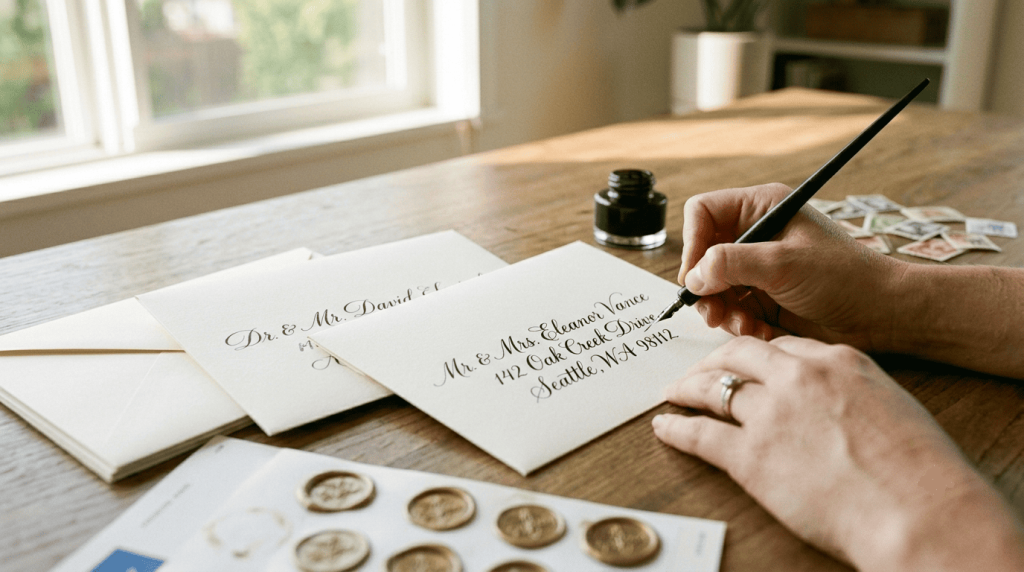
Calligraphy is the most traditional and the most beautiful, and a professional hand-letters each envelope in ink. It is also the slowest and the priciest, and the best calligraphers book up early in peak wedding season. In my own bookings I have seen rates run anywhere from a few dollars to roughly ten dollars per envelope, so a 120-guest list adds up fast.
Printed addressing, where a clean serif or sans-serif font is printed directly onto the envelope or onto labels, is the practical choice for larger lists. It is fast, consistent, and far cheaper. Many stationers offer it as an add-on, and if you are still choosing a vendor, my Zazzle wedding invitations review walks through one popular option.
Hand-writing them yourself works for small, intimate weddings and adds a personal feel, as long as your handwriting holds up across 60 envelopes at 11 p.m. Be honest with yourself about that last part.
Common mistakes I see every season
After enough weddings, the same handful of slip-ups shows up again and again. None of them is a disaster, but all of them are avoidable.
1. Abbreviating “Street,” “Avenue,” and state names
On a formal invitation, everything is spelled out. “Apartment,” not “Apt.” “South Carolina,” not “SC.” It feels fussy until you see it next to an abbreviated version, and then the difference is obvious.
2. Putting “and Guest” on the outer envelope
The plus-one belongs on the inner envelope, or you write the guest’s actual name if you know it. “And Guest” on the mailing envelope reads as an afterthought, which is the one thing you do not want a guest to feel.
3. Guessing at a title or a hyphenated name
If you are not sure whether someone goes by “Dr.,” whether a couple shares a last name, or how a name is spelled, ask. A thirty-second text now prevents a re-print and an awkward correction later.
4. Underestimating postage on a heavy suite
A multi-piece suite with a thick invitation, an RSVP card, a reception card, and an inner envelope often weighs more than a single stamp covers. Square envelopes usually cost extra too. Assemble one complete invitation and weigh it at the post office before you buy a single stamp.
5. Leaving no proofing buffer before mail day
Couples block time to address the envelopes but forget to leave a few days to proofread the finished stack against the master list. Build that buffer in. Catching three wrong addresses on your kitchen table is easy; catching them after they are postmarked is not.

How to address wedding announcements (it’s not the same)
People often lump these in with invitations, but wedding announcements are a different mailing with a different job. Announcements go out to people who were not invited to the wedding, sharing the news after the fact. They never include an RSVP and never ask for anything, which is what keeps them from reading as a gift grab.
The addressing itself follows the same name and title conventions as invitations: courtesy titles, full names, complete addresses spelled out. The differences are that announcements use a single envelope, and they are mailed the day of the wedding or shortly after, not weeks ahead. So you can prepare and address them in advance, then drop them in the mail once you are officially married.
Frequently asked questions
On wedding invitations, whose name goes first?
For a married couple in the traditional format, the husband’s title and name go first (“Mr. and Mrs. James Reynolds”). In the modern format, and for unmarried or same-sex couples, you can list the person you know better first, or go alphabetically by last name. None of these is wrong, so pick the approach that fits the couple and stay consistent across your list.
Where does the address go on a wedding invitation envelope?
The guest’s full mailing address goes centered on the front of the outer envelope, exactly like any other letter. Your return address goes on the back flap of that same outer envelope. The inner envelope carries no address at all, only the names of the people invited.
How do you address a wedding invitation to a family?
Address the outer envelope to the parents only (“Mr. and Mrs. Henry Kelly”). On the inner envelope, put the parents on the top line and the children’s first names below, oldest to youngest. If you use a single envelope, the children’s names go on the line below their parents there. Guests 18 and older should receive their own invitation rather than a spot on the family envelope.
Is the inner envelope necessary?
No. The inner envelope is a traditional touch that is now optional, and single-envelope invitations are the more common choice today. If you skip it, use the formal outer-envelope format for everyone and spell out children and plus-ones right on that one envelope.
How do you address a wedding invitation to a guest and their plus-one?
Address the outer envelope to the guest you know by name. Put “and Guest” on the inner envelope, not the outer one. If you know the plus-one’s name and can confirm the spelling, use it instead of “and Guest” for a more personal touch.
Do you use abbreviations when addressing wedding invitations?
On a formal invitation, no. Spell out street types, apartment, and state names in full, and avoid middle initials. The standard courtesy titles “Mr.,” “Mrs.,” “Ms.,” and “Dr.” are the accepted exceptions, since they are always abbreviated.
Sources
Sources
- Emily Post Institute — Addressing and Sending Wedding Invitations. emilypost.com
- Emily Post Institute — Wedding Invitations 101. emilypost.com
- The Knot — How to Address Wedding Invitations. theknot.com
- Zola — How to Address Wedding Invitations: Etiquette & Examples. zola.com
One last thing before you mail them
Once the envelopes are addressed and proofed, resist the urge to drop the whole stack in a mailbox. Walk them into the post office and ask them to hand-cancel the batch instead of running it through the automated sorter. It is gentler on a thick suite and wax seals, and it costs little to nothing. Then check my full timeline for when to send wedding invitations so they land in the right window.
Get the list clean, match the wording to each guest, and weigh before you stamp. Do those three things and the rest is just nice handwriting.
— Madison Cole, Certified Wedding Planner