Updated June 2026
Affiliate disclosure: some links in this guide are affiliate links, and OSW may earn a small commission at no extra cost to you. This never changes which pieces I recommend. I only point you toward what I would put on a real bride or guest. Read our editorial policy.
I have planned more than 200 weddings across the East Coast, from backyard ceremonies in Charleston to black-tie ballrooms and barefoot beach vows in the Outer Banks. And in all those years, the question I field most often is not about flowers or seating charts. It comes from the guests, usually two or three weeks out, usually some version of: what am I supposed to wear to this?
The honest answer is that what to wear to a wedding comes down to four things you can read straight off the invitation: the dress code, the venue, the season, and the time of day. Get those four right and you will look like you belong in the room. Get them wrong and you are the guest in a sundress at a formal evening reception, or the one sweating through wool at a July garden ceremony.
This guide is the same playbook I hand my couples to forward to their guest lists. I will walk you through every common wedding dress code and what it actually means for women, men, and nonbinary guests, then how to adjust for season and venue, the color rules that genuinely matter (and the one everybody panics about that no longer does), the mistakes I watch guests make every season, and where to shop once you know what you are looking for.
Whether you are a wedding guest, a plus-one who has never met the couple, or a parent trying to coordinate, you will find your situation below. Let’s decode it.
In this guide
- How to read a wedding dress code
- Wedding dress codes, decoded
- What to wear by season
- What to wear by venue and time of day
- The color rules that actually matter
- Common mistakes guests make
- Where to shop for wedding guest outfits
- Real planner tips
- Wedding guest attire questions I hear most
How to read a wedding dress code
Before you open a single shopping tab, read the invitation and the couple’s wedding website. The dress code lives in one of those two places about 90% of the time. If it isn’t listed anywhere, that absence is itself information, and I will tell you how to read it in a minute.
A dress code is not the whole story, though. The same words mean different things at 2 p.m. in a garden than they do at 7 p.m. in a hotel ballroom. The Emily Post Institute frames it well: the time of the wedding and the nature of the service are your best guide to its formality. So I teach guests to stack four questions, in this order.
- What dress code is written? Black tie, cocktail, semi-formal, and so on. This sets your ceiling and floor.
- Where is it held? A historic mansion pulls dressier than a vineyard lawn, even at the same stated formality.
- What season is it? Fabric and color shift with the calendar more than most guests expect.
- Daytime or evening? Evening reads more formal and leans into richer, darker palettes.
When two of these pull in opposite directions, formality wins. It is always safer to be a notch dressier than the room than a notch too casual. In 12 years I have never once seen a guest regret being slightly overdressed. I have seen plenty wish they had skipped the jeans.
The quick version, before you shop
- ✓ Find the dress code first on the invitation or the couple’s wedding website
- ✓ Stack four levers: dress code, venue, season, time of day
- ✓ When in doubt, dress up, not down
- ✓ The real hard no is white and its cousins: ivory, cream, champagne, light gold
- ✓ Black is fine at most modern weddings, despite the old rule
- ✓ Plan for an 8-hour day: comfort and broken-in shoes beat a perfect photo
Wedding dress codes, decoded
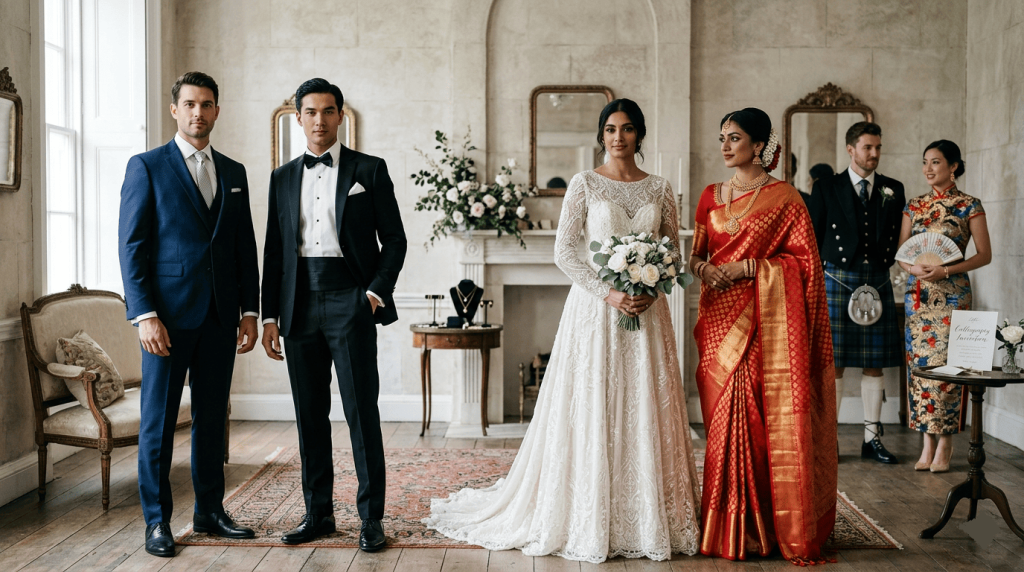
Here is every dress code you are likely to see on an invitation, from the most formal down to the most relaxed, with what it means for everyone at the table. If you want to go deeper on any single one, I have full breakdowns linked throughout.
White tie
The most formal code there is, and the rarest. You will probably go your whole life without one. Women wear a floor-length evening gown, ideally with elegant jewelry and a clutch. Men wear a full black tailcoat, white waistcoat, white bow tie, and formal shoes. Nonbinary guests can anchor to either, as long as the formality reads at the top of the scale. If you ever get a white-tie invitation, the venue will tell you everything: think state dinners and old-world estates.
Black tie
This is the formal code you will actually encounter, almost always an evening event. Men wear a tuxedo: black or midnight-blue, black bow tie, patent or polished leather shoes. If you are deciding between renting and buying, my breakdown of a tuxedo versus a suit for a wedding walks through when each is worth it. Women wear a floor-length gown or a very polished formal midi. Nonbinary guests can wear a tux, a tailored dark suit with formal touches, or a formal gown. The one thing black tie does not tolerate is a regular business suit.
Black-tie optional and formal
This code gives guests room. Per the Emily Post Institute, black-tie optional means a tuxedo is welcome but a dark, well-cut suit with a tie is perfectly correct. Women have the widest range here: a floor-length gown, a formal midi, or a dressy cocktail dress in a rich fabric all work. “Formal” without the black-tie qualifier reads almost identically: aim high, lean into darker or jewel tones for evening, and you are safe.
Cocktail attire
Cocktail is the most common wedding code in the country right now, and the one guests misread most. It sits a notch below formal and a notch above semi-formal. Women wear a knee-length or midi dress, a dressy jumpsuit, or elegant separates. Men wear a suit in any season-appropriate color with a tie. For the full rundown, see my guide to cocktail attire and the plain-English definition in what cocktail attire actually means. If you are unsure how a cocktail dress differs from a formal one, length is your quickest tell.
Semi-formal and dressy
Semi-formal is cocktail’s slightly more relaxed sibling, and the daytime-versus-evening cue matters most here. Women wear a midi or knee-length dress, a nice skirt-and-top, or a tailored jumpsuit. Men wear a suit, tie optional for afternoon, encouraged for evening. The line between this and cocktail trips people up constantly, so I wrote a side-by-side on semi-formal versus cocktail attire, plus the standalone semi-formal dress code guide.
Dressy casual and “festive”
These are the codes that send guests texting me at 11 p.m. Dressy casual is not jeans-and-a-nice-top casual; it means a sundress, a midi, or slacks with a blazer, no tie required. Festive is a couple inviting you to bring color, pattern, or a little sparkle, while still dressing for a celebration. Read both as “put-together and elevated,” never as “whatever I’d wear to brunch.”
Casual and beach
The most relaxed code, and the one with the most traps. Casual still rules out jeans, t-shirts, sneakers, and anything you would wear to the gym. Women wear a flowy maxi, a sundress, or a floral midi. Men wear linen or lightweight trousers with a collared shirt, blazer optional. For beach weddings, breathable fabric and a heel you can actually walk on sand in (block heel, wedge, or a smart flat) will save your evening.
Etiquette note
If no dress code is listed at all, let the venue and time decide for you. A 6 p.m. hotel or country-club reception almost always wants cocktail attire; a midday outdoor ceremony reads semi-formal or dressy casual. The Emily Post Institute’s long-standing guidance is that the invitation and the hour are your clearest signal, so when the words are missing, read the setting instead, and reach out to the couple only as a last resort.
What to wear by season
Two guests can follow the exact same dress code and one still looks off, because they ignored the calendar. Fabric and color are where the season shows up, and they matter even when the whole event is indoors.
For spring and summer weddings, reach for chiffon, silk, cotton, and lighter linen in florals, pastels, and bright clear colors. For fall and winter, the room expects velvet, brocade, heavier crepe, and faux fur accents in jewel tones, deep neutrals, and rich darks. A flowy floral that sings in June looks thin and out of place at a December candlelit reception, and a velvet gown that glows in December is miserable at a July beach.
Layering is the move for shoulder seasons and any outdoor evening. A wrap, a shawl, or a tailored jacket lets you dress for a warm ceremony and a cool reception in the same outfit, which is the kind of small foresight that separates a comfortable guest from a shivering one at the sparkler send-off.
Madison’s note
“I had a guest show up to an outdoor August wedding in Beaufort in a floor-length velvet gown because the invite said formal. She was elegant for the first 20 minutes and overheating by the toasts, and she spent the reception in the air-conditioned restroom. Formal in August still means breathable. Read the code and the thermometer together.”
— Madison Cole, Certified Wedding Planner
What to wear by venue and time of day
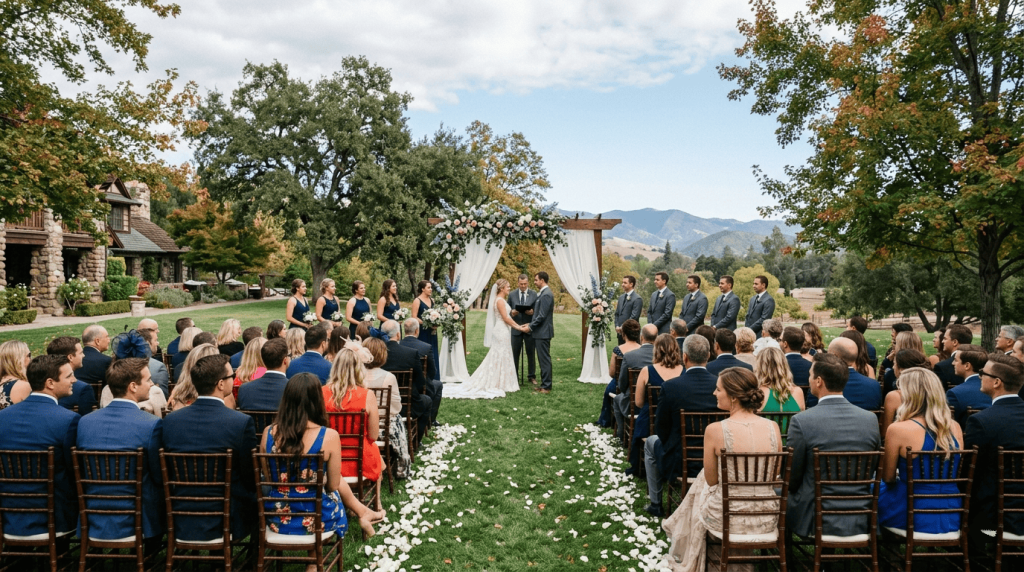
The setting nudges every dress code up or down, and the smart guest reads it. A ballroom, historic mansion, or private club pulls everything dressier, so keep the tie on and skip the open collar. A vineyard, farm, or garden gives you room to relax a notch and to choose footwear that survives grass. A house of worship may expect covered shoulders or, for some traditions, a head covering, so a wrap in your bag is never wrong.
Time of day does the rest. Daytime weddings run lighter and a touch more casual; evening weddings read formal and lean into richer, darker palettes. When a couple marries at 4 p.m. and parties past sunset, dress for the evening and bring a layer for the gap.
Five questions to ask before you commit to an outfit
- What does the invitation or website actually say about attire?
- Is the ceremony indoors or outdoors, and on grass, sand, or floor?
- Does the hour lean daytime-light or evening-formal?
- Will my fabric and color suit the season?
- Can I sit, stand, eat, and dance comfortably in this for eight hours?
The color rules that actually matter
Most of the “rules” guests stress about are noise. A few are real. Here is what genuinely matters once you are dressed correctly for the code.
The one true hard no is white and everything adjacent to it. Unless the couple specifically asks for white attire, skip white, ivory, cream, ecru, champagne, and light gold. This is the rule that causes the most genuine upset, because guests assume “no white” and forget that champagne and pale blush photograph as white in a lineup next to the wedding party. When I am asked, I tell guests: if you have to squint to decide whether it reads white, choose something else.
Now the rule everyone whispers about and that no longer holds the way it used to: black. After 200-plus weddings, I can tell you black is widely accepted at modern weddings, and the Emily Post Institute and major editorial guides agree it now reads as chic rather than funereal. The only contexts where I steer guests away are a daytime garden or beach celebration that is clearly bright and informal, or a couple who has explicitly asked for color. Otherwise, a black cocktail dress or a dark suit is one of the safest choices you can make. I dig into the nuance in whether you can wear black to a wedding.
Two smaller cues round it out. Try to avoid the wedding party’s color if you happen to know it, so you are not mistaken for a bridesmaid in photos. And save the head-to-toe sequins, bright red, and bold animal print for another night out; they are fun, but they pull focus, and at someone else’s wedding the focus belongs on the couple.
Common mistakes guests make, and the easy fix
These are the five misreads I see every single season. None of them are about taste. They are about overlooking one of the four levers.
1. Reading “dressy casual” as actually casual
This is the single most common slip. Dressy casual and festive are still elevated codes. The fix is simple: treat the word “dressy” as the operative one and the word “casual” as permission to skip the tie, not the effort.
2. Wearing brand-new shoes you have never broken in
A wedding is an eight-hour day on your feet, often partly on grass. New, untested heels turn the reception into a barefoot situation by the second dance. Break them in at home for a week, or pick a block heel, wedge, or smart flat you already trust.
3. Wearing white-adjacent shades by accident
Guests rarely show up in an actual white dress. They show up in champagne, ivory, or light gold and get the side-eye anyway. The fix is the squint test from above: if it reads pale-and-bridal in photos, pick another color.
4. Ignoring the season and the venue
The velvet-at-the-beach problem runs both directions. Match your fabric weight and color to the calendar and the setting, not just to the printed dress code, and you will be comfortable and correct at once.
5. Underdressing “to be safe”
Some guests dress down when they are unsure, hoping to blend in. It backfires; the underdressed guest stands out far more than the slightly overdressed one. When the signals are ambiguous, round up a notch. I have never seen that decision go wrong.
Where to shop for wedding guest outfits
Once you know your code, season, and venue, the shopping gets fast. These are the retailers I send guests to most, grouped by who you are dressing. I keep this list short on purpose, because a guide is meant to narrow your choices, not flood them.
For women’s guest dresses across cocktail and semi-formal, Lulus, BHLDN, Revolve, and Reformation cover most budgets and silhouettes, and Azazie has a strong guest range alongside its bridesmaid line. If you are leaning toward a tailored jumpsuit or pantsuit instead of a dress, my roundup of dressy pant suits for wedding guests is the fastest way in. Parents of the couple have their own considerations, which I cover in the mother of the bride guide.
For men, a rented tux from Generation Tux or The Black Tux handles black tie cleanly, while Indochino or Men’s Wearhouse make sense if you would rather own a suit you will wear again. And if you happen to be helping the couple think through their own looks, my notes on choosing a wedding dress are a useful aside.
Shop guest dresses by dress code
Cocktail, semi-formal, and black-tie guest looks in one place.
Real planner tips
A few things I tell guests that you will not find printed on an invitation, learned from watching hundreds of receptions unfold.
I always tell guests to build the outfit around the shoes, not the other way around. Comfort dictates how much of the night you actually enjoy, and a guest who is hurting by 9 p.m. leaves early every time.
I tell every plus-one who has never met the couple to ask the person who invited them what the vibe is. Two sentences from someone who knows the couple beats an hour of guessing from photos.
I tell guests to pack a small kit: a stain pen, blister bandages, and a safety pin. In a decade I have never run a wedding where at least one guest did not need one of those three.
And I tell anyone going to an outdoor wedding to check the forecast two days out and the day of, then bring the layer. Weather is the variable that wrecks more guest outfits than any dress code ever has.
Madison’s note
“The best-dressed guest at any wedding is almost never the flashiest one. It is the person whose outfit fits the room so well that nobody thinks about it, which leaves everyone free to think about the couple. That is the whole goal.”
— Madison Cole, Certified Wedding Planner
Wedding guest attire questions I hear most
Can you wear black to a wedding?
Yes, at most modern weddings black is not just acceptable but chic. The main exceptions are bright daytime, garden, or beach celebrations, or a couple who has asked guests to wear color. For an evening reception, a black dress or dark suit is one of the safest choices you can make.
Is it ever okay to wear jeans to a wedding?
Only if the couple explicitly says so, which is rare and usually reserved for a backyard or ranch celebration. Even a casual dress code typically rules out jeans, t-shirts, and sneakers. When casual is listed, think sundress or linen trousers with a collared shirt instead.
What does “festive attire” mean on an invitation?
Festive is an invitation to bring color, pattern, or a little sparkle while still dressing for a celebration. It usually sits around cocktail formality, just with more personality. Think a bold-colored dress or a suit with a playful tie, not jeans and not a tuxedo.
Can a guest wear a jumpsuit or a pantsuit to a wedding?
Absolutely, and a tailored jumpsuit or dressy pantsuit reads beautifully at cocktail, semi-formal, and even black-tie weddings when the fabric is rich enough. Match the formality with the cut and material, the same way you would with a dress. It is often the most comfortable choice for a long night of dancing.
What should I wear if the invitation lists no dress code?
Let the venue and the time decide. An evening reception at a hotel or club almost always calls for cocktail attire, while a midday outdoor ceremony reads semi-formal or dressy casual. If you truly cannot tell, a cocktail-level outfit is the safest default across the widest range of weddings.
Do men have to wear a suit to every wedding?
For cocktail, semi-formal, and anything dressier, yes, a suit is the baseline, with a tuxedo reserved for black tie. At a casual or beach wedding you can drop to linen or lightweight trousers with a collared shirt and an optional blazer. The dress code and the venue set the floor.
This guide contains affiliate links. If you buy through them, OSW earns a small commission at no additional cost to you, which helps keep One Stop Wedding Planner independent. Recommendations reflect my genuine editorial judgment, and affiliate relationships never dictate which pieces I suggest. For details, see our full affiliate disclosure and editorial policy.
Related reads
- Cocktail attire: the complete dress code guide
- Semi-formal attire, explained for guests
- Semi-formal vs cocktail: what’s the difference
- Can you wear black to a wedding?
- What is cocktail attire?
- What is a cocktail dress? Style and length guide
- Best dressy pant suits for wedding guests
- Tuxedo vs suit: which to wear to a wedding
- Mother of the bride: the complete guide
Sources
- The Knot — What to Wear to a Wedding. theknot.com
- Emily Post Institute — Wedding Guest Attire. emilypost.com
- Emily Post Institute — Attire Guide: Dress Codes from Casual to White Tie. emilypost.com
- Oliver Wicks — What Should a Man Wear to a Wedding. oliverwicks.com
- Wedding Shoppe — 15 Do’s and Don’ts of Wedding Guest Attire. weddingshoppeinc.com
Once you have matched the dress code, venue, season, and time of day, the outfit almost picks itself, and you get to spend the night thinking about the couple instead of your hemline. If you are still deciding between styles, you can start with the full cocktail attire guide, since cocktail is the code you are most likely to meet.
Written by Madison Cole, Certified Wedding Planner
Madison is a Certified Wedding Planner (CWP/PWP) who has planned 200-plus weddings across the East Coast, from intimate Charleston ceremonies to black-tie ballrooms and beach celebrations in the Outer Banks. She founded One Stop Wedding Planner to give brides, guests, and grooms the same straightforward playbook she handed her clients for nearly a decade.