Quick answer
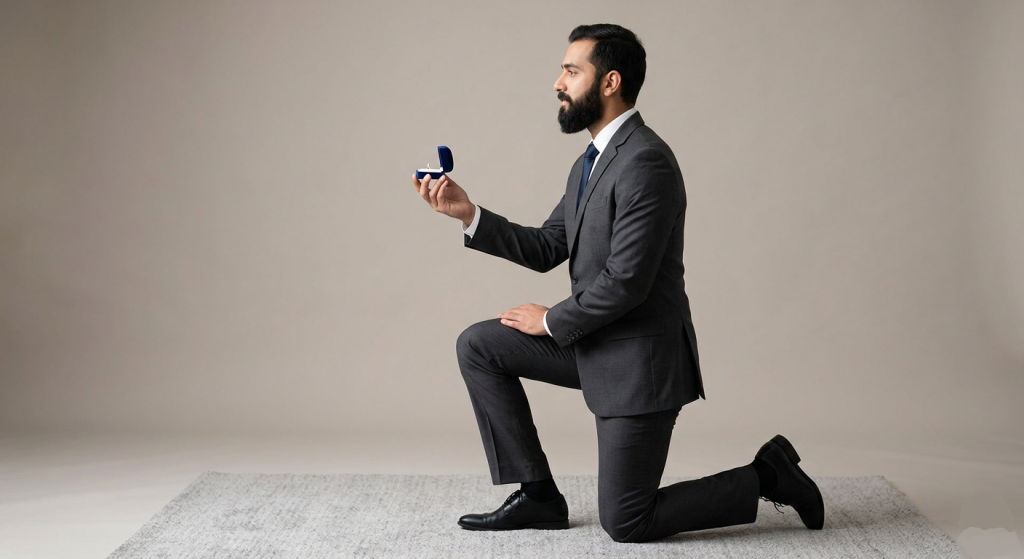
Tradition says you get down on your left knee, with your right knee up. The custom traces back to medieval knights, and for most right-handed people, kneeling on the left keeps you steady while your stronger hand manages the ring box. That said, it truly does not matter — your partner will be watching your face, not your knees.
You’ve picked the ring, you’ve planned the spot, and now you’re stuck on a detail you didn’t see coming: which knee. The short version is that the traditional answer is your left knee, but the honest answer is that it makes almost no difference. Here’s the full picture, plus the one practical rule that actually matters when you’re down there.
The traditional answer: your left knee
By the book, you kneel on your left knee, keeping your right knee up. The origin story you’ll hear repeated everywhere ties this back to medieval knights, who knelt on the left knee as a gesture of respect and loyalty — to a monarch, at a knighting ceremony, or before going into service. Over the centuries that image of devotion got romanticized into the proposal we picture today: one knee down, ring box in hand, a question that changes everything.
It’s a lovely piece of lore, and it’s the reason the left knee is treated as the “correct” one in most etiquette write-ups. But it’s a custom, not a law. There’s no governing body checking your form, and there’s certainly no version of this where you’ve done it wrong because you chose the other side.
Does it actually matter?
No. I’ll be the first to tell you that. The left-knee tradition is the kind of thing that feels enormous when you’re rehearsing it in your head and completely vanishes in the actual moment. In my planning experience, the person being proposed to is processing a wave of emotion — they are not running a checklist on your kneeling technique.
So if you forget which knee, or you go down on the “wrong” one, or you skip the precision entirely because your hands are shaking — none of that registers. What registers is that you asked, and how you asked. The knee is choreography. The question is the moment.
The one practical rule (the no-fumble version)
If you want a reason to pick one knee over the other, make it a practical one rather than a ceremonial one. The only thing that genuinely helps is this: keep your dominant hand free to manage the ring box. That’s where proposals get clumsy — fumbling the lid, dropping the box, wrestling it out of a tight pocket.
Here’s where even the wedding sources disagree slightly, which tells you how little it matters. Some say right-handed people should kneel on the left so the right hand stays free; others point out that since most of us are right-side dominant, going down on the right knee can actually feel steadier. Both are fine. Don’t overthink the geometry — just run it once or twice so your stronger hand is the one opening the box and presenting the ring.
- Right-handed? Pick whichever knee lets your right hand handle the box smoothly. Many people find the left knee down works well, but test it.
- Left-handed? Go down on your right knee so your dominant left hand is free. The tradition was built around right-handed people, so flip it without a second thought.
- Either way: keep the box in your non-dominant hand and open it with your dominant one. That single habit prevents 90% of the fumbles I’ve watched on proposal footage.
Madison’s note
“I’ve helped coordinate more surprise proposals than I can count, and not once has the person saying yes mentioned the knee afterward. What they remember is the look on your face and what you said. Kneel on whichever side keeps you balanced, and put your attention there instead.”
— Madison Cole, Certified Wedding Planner

When kneeling isn’t the move at all
Getting down on one knee is the classic image, but it’s optional, and plenty of couples skip it for reasons that have nothing to do with romance. If you have a knee injury or any mobility limitation, there is no obligation to kneel — a standing proposal, a sit-down side by side, or simply asking face to face carries every bit of the same weight.
The setting can make the decision for you, too. I’ve seen proposers commit to the full kneel on wet sand, a snowy overlook, or a steep trail and instantly regret it. If the ground is going to fight you, don’t kneel for the sake of the picture. And if the gesture just doesn’t feel like you as a couple, that’s reason enough. Some people find a shared, eye-level moment more honest than one person looking up at the other. Choose what actually fits the two of you.
What I’d focus on instead
Once you’ve stopped worrying about the knee, put that energy where it pays off. The details that make a proposal land are the ones around the question, not the posture: a private moment that isn’t rushed, a setting that means something to you both, the box within easy reach, and a clear idea of what you want to say. If someone is photographing it, the only spatial thing worth planning is the camera angle — face roughly toward where the photographer is hidden so the shot catches both of you, not the back of your head.
If you want the full game plan, I walk through the whole sequence in my guide on how to propose, and if you’re still shaping the moment itself, these proposal ideas are a good place to borrow from. It’s also worth being clear on the ring in your hand — here’s the difference between an engagement ring and a wedding ring so you’re presenting the right one. And the second they say yes? You’ll both start using a new word — here’s fiancé vs. fiancée, sorted.

Frequently asked questions
Which knee do you propose on if you’re left-handed?
Go down on your right knee so your dominant left hand is free to hold and open the ring box. There’s no etiquette penalty — the left-knee tradition was built around right-handed people, so flipping it to suit you is exactly right.
Does it really matter what knee you propose on?
No. Tradition points to the left knee, but no one is keeping score. Your partner won’t notice which knee in the moment, and there’s no rule that makes one side correct. Pick whichever keeps you steady.
Do you have to get down on one knee to propose?
Not anymore. Kneeling is the classic image, but plenty of couples skip it for a standing proposal, a sit-down side by side, or simply asking face to face. If you have a mobility limitation or the gesture just isn’t you, leave it out — the question carries the moment, not the posture.
Which hand do you hold the ring with when proposing?
Hold the box in your non-dominant hand and open it with your dominant one — that’s the smoothest combination. For most right-handed people that means box in the left hand, lid flipped with the right. It’s the single habit that prevents most proposal fumbles.
The bottom line
Kneel on your left knee if you want the tradition, your right if you’re left-handed or it simply feels steadier, and skip the kneel entirely if that’s more honest for you. Any of those is right. Spend your nerves on the question and the setting, not the choreography — that’s the part you’ll both remember.
Written by Madison Cole, Certified Wedding Planner
Sources
- The Knot — Should You Get Down on One Knee to Propose? theknot.com
- Zola Expert Advice — Which Knee Should You Propose On? zola.com