I’ve planned more than 200 weddings out of Charleston since 2015, and almost every one of them started the same way: with a proposal that someone spent weeks quietly stressing over. By the time a couple lands in front of me, the ring is already on and the story is polished. But I’ve heard the behind-the-scenes version hundreds of times, and I’ve helped plenty of clients’ friends pull off the moment itself.
Here’s the part most guides skip: a good proposal is about 10% romance and 90% logistics. The romance you already have. What trips people up is everything around it: the ring timing, the backup plan, who’s in on it, and what happens in the five minutes after the “yes.”
A quick reality check before we start. About 47% of US couples get engaged between Thanksgiving and Valentine’s Day, with December as the runaway favorite, according to The Knot Real Weddings Study. If you’re proposing in peak season, ring shipping and photographer availability get tight, so the planning matters even more.
Below is the exact sequence I’d walk you through if you were sitting across from me, from “am I ready” to “we’re engaged, now what.”
How to propose, step by step
Settle the ring question
Decide ring or no ring, then get their size and taste before you order anything.
Loop in the people who matter
Family blessing if it fits your partner, plus anyone helping on the day.
Choose the moment and the place
Pick somewhere that means something, matched to your partner’s personality.
Plan it like a very small event
Timeline, weather backup, ring security, and a photographer if you want one.
Figure out what you’ll say
Three or four honest sentences you won’t blank on. Write them down if needed.
Make the ask and own the moment
Slow down, ask clearly, and stay down until the ring is on.
Have a plan for the yes
Decide who you call first and whether you’re celebrating or announcing tonight.
Before you start: make sure you both actually want this
The biggest myth about proposals is that the engagement itself should be a surprise. It usually isn’t. In The Knot’s research, 57% of couples said they’d talked about marriage more than a year before the proposal ever happened. The surprise is the moment, not the decision.
So before you plan anything, get honest about two things: that you’re ready to be married, not just engaged, and that your partner wants the same thing on roughly the same timeline. If you can’t answer both with a clear yes, that’s the work to do first. No amount of rose petals fixes a real mismatch on kids, money, or whether you’d move for a job.
Once you’re aligned, the surprise lives entirely in the how and the when. That’s a much easier thing to pull off, and it takes a lot of pressure off the moment itself.

Step 1: Settle the ring question
First decision: ring or no ring. Roughly 89% of proposers ask with a ring in hand, but it isn’t a rule. If your partner is particular about jewelry, a placeholder ring or a ring box with a note saying you’ll choose together is a smart move. I’ve watched more than one bride quietly resize or swap a ring after the fact, so don’t treat the stone as make-or-break.
If you do want a ring ready, you need two pieces of intel: their size and their taste. Size you can get from a ring they already wear by borrowing it for a day or tracing the inside circle. Taste you can read from their saved photos, their current jewelry (gold or silver, dainty or bold), or a casual window-shopping walk months earlier.
If you’re fuzzy on what you’re actually buying, my breakdown of the difference between an engagement ring and a wedding ring sorts it out. And if you want to mark the commitment without a diamond yet, here’s what a promise ring is and when to give one.
Order early. In December, resizing and custom settings back up for weeks. National jewelers like Brilliant Earth, James Allen, and Blue Nile all ship across the US, but build in a real cushion so you’re not tracking a package the night before.
Step 2: Loop in the people who matter
Asking a parent’s blessing is still common: nearly 70% of proposers asked for a parent’s permission or blessing, per The Knot. I’d reframe “permission” as inclusion. You’re not asking anyone to approve an adult relationship; you’re giving the people who raised your partner a heads-up and a moment to feel part of it.
Skip it if the family relationship is strained or if your partner would hate the gesture. You know the dynamics better than any guide does. The goal is to make the proposal feel good to your partner, not to perform a tradition for its own sake.
If you want help on the day, whether that’s a photographer, a friend hiding with flowers, or a restaurant holding a table, those people need to be looped in early and given one clear job each.
Step 3: Choose the moment and the place
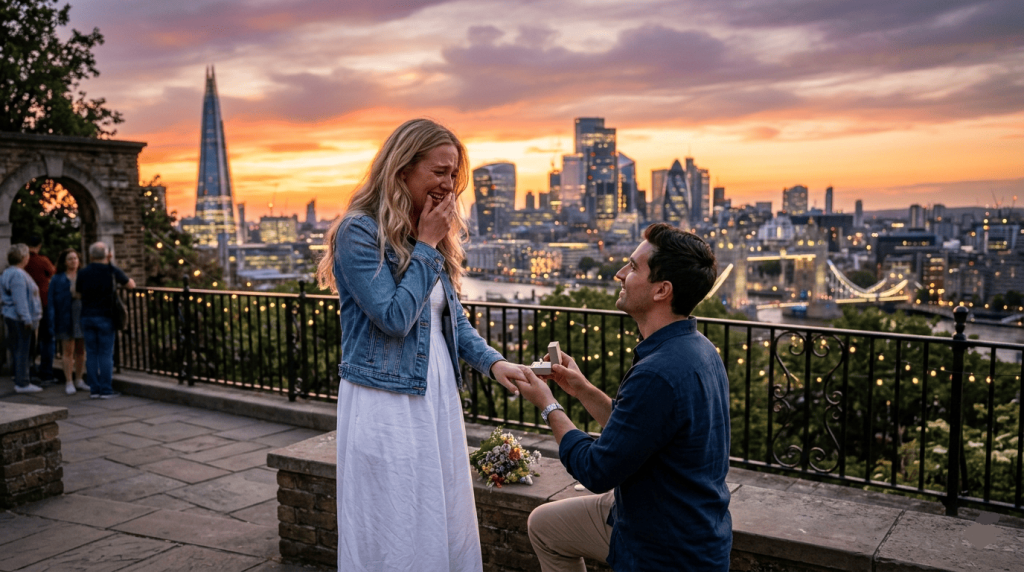
You’ll both remember where this happened for the rest of your lives, so choose a place that means something over a place that looks impressive. The overlook where you had your first real talk beats a generic “scenic” spot every time.
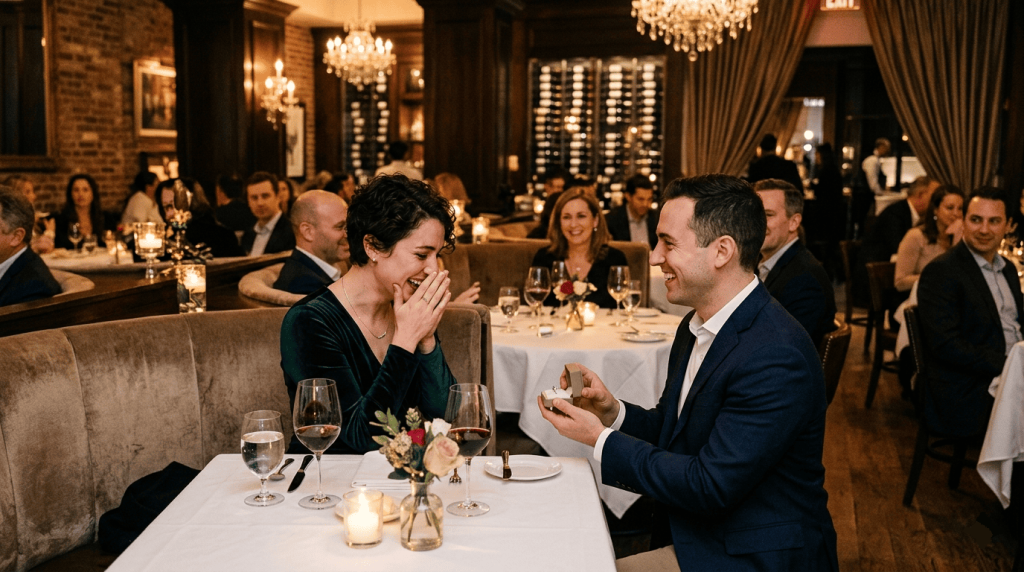
Match the setting to your partner, not to your own comfort. If they’re private, a crowded restaurant or a flash-mob moment can feel like an ambush. If they love an audience, a quiet living-room proposal might underwhelm. When you’re unsure, smaller and more personal almost always wins.
Time it for when they’re relaxed and not rushed, hungry, or buried in a work week. The mood of the day matters more than the calendar date.
Madison’s tip
“I tell people to scout the exact spot at the exact time of day they plan to propose. A beach that’s empty at 9 a.m. is packed at sunset, and the rooftop with the perfect view closes for a private event on Saturdays. A 20-minute dry run a week before saves the whole thing.”
— Madison Cole, Certified Wedding Planner
Step 4: Plan it like a very small event
This is where my job and your proposal overlap. Treat it like a tiny wedding: it needs a timeline, a backup, and one person in charge of logistics so you can actually be present.
Build a weather backup if you’re outdoors. Confirm any reservation or permit, since some parks and rooftops require them. Decide exactly where the ring lives until the moment, and keep the box closed and oriented the right way so the ring doesn’t tumble out when you open it, especially near water.
If you’re hiring a photographer, book early. Roughly 1 in 5 couples now bring in a vendor to capture the proposal, and the good ones get reserved fast in proposal season. Give yours the location, the signal you’ll use, and a plan to stay hidden until the moment lands.
Step 5: Figure out what you’ll say
You don’t need a script. You need a few honest sentences you won’t blank on. Most people I’ve talked to say the moment moved faster than they expected and the speech evaporated, so keep it to three or four lines you actually mean.
A simple frame works: when you knew, what you love, what you’re asking. That’s it. If words aren’t your strength, write them on a card and read them. No one has ever regretted reading a heartfelt note out loud.
If you’re already thinking ahead to the words you’ll say at the altar, my guide to writing wedding vows that sound like you uses the same honest, un-scripted approach.
Step 6: Make the ask and own the moment
When it’s time, slow down. About 84% of proposers still go down on one knee, and whether you do or not, the instinct to rush past the actual question is the thing to fight. Get the words out, then ask clearly and let them answer.
Stay down until the ring is on their finger. Don’t pop up for a hug mid-sentence and leave the ring sitting in the box. Let the moment breathe for a few seconds before the celebration takes over.
Madison’s note
“The proposals I’ve heard go sideways almost never fail on the question. They fail on the logistics: a dead phone, a photographer who couldn’t find the spot, a ring left in a coat that went to coat check. Put one trusted friend in charge of the moving parts and you’ll remember the moment instead of managing it.”
— Madison Cole, Certified Wedding Planner
Step 7: Have a plan for the yes
The five minutes after “yes” are the ones people forget to plan. Decide in advance: who do you call first, do you want a celebration waiting, and are you announcing tonight or sitting with it privately for a day.
Over 90% of couples share the news on social media, but there’s no rush. Tell your closest people by phone before anyone learns it from a post. A parent or best friend finding out through Instagram is the one regret I hear most often.
When you’re ready for what comes next, my step-by-step guide to planning a wedding picks up exactly where the proposal ends, from setting a budget to booking the first vendors.
Common mistakes and how to avoid them
1. Proposing before you’ve ever talked about marriage
If the conversation about a shared future hasn’t happened, a ring doesn’t start it, it short-circuits it. Have the honest talk first, then plan the surprise around a decision you’ve both already made.
2. Guessing the ring with zero intel
Buying blind on size and style is how rings end up resized, returned, or quietly swapped. Spend the time to learn their taste, or build in a clear plan to choose together after the proposal.
3. Skipping the backup plan
Outdoor proposals live and die by weather and crowds. A rained-out overlook with no plan B turns a once-imagined moment into a scramble. Always have a second option ready.
4. Making the moment about the audience
A proposal staged for a crowd, or for the camera, can leave a private person feeling cornered. Build the moment around how your partner likes to be celebrated, not around the reaction you imagine getting.
5. Forgetting everything after “yes”
No photos, no champagne, no plan for who to tell, just a quiet drive home. Plan the celebration and the first few calls the way you planned the question.
Real planner tips
- Order the ring before anything with a date attached. Resizing and shipping are the bottleneck, especially November through February.
- Hand off the logistics. One trusted person on flowers, timing, or the photographer signal frees you to be present.
- Keep the ring on your body, not in a jacket you might check or set down. I’ve heard too many coat-check stories.
- Give the photographer one signal, not a paragraph of instructions. A hand on the back, a specific phrase, something they can’t miss.
- Be careful with shared holidays. Proposing on a birthday or Christmas can blur two memories into one, unless your partner specifically loves that idea.
- Charge your phone and theirs. The “yes” is the start of an hour of calls and photos, and a dead battery is a small tragedy.
A few things worth lining up first
You don’t need a planner for a proposal, but a short list helps: the ring (or your plan to choose together), the location confirmed and scouted, the people who need a job, a backup for weather, and your few sentences. Get those five locked and the rest falls into place.
If you’re still deciding how you want to do it, my roundup of romantic proposal ideas has dozens of low-key and big-gesture options to steal from.
Frequently asked questions
The questions I get most from people about to propose, answered quickly.
How far in advance should I plan a proposal?
Most proposers start planning one to three months out, and that’s a comfortable window. The ring is usually the long pole: ordering, sizing, and any custom work can take several weeks, and they back up further during proposal season from November to February. If you have a specific date in mind, work backward from the ring, not the other way around.
Do I need a ring to propose?
No. Around 89% of proposers ask with a ring in hand, but plenty don’t. If your partner is particular about jewelry, propose with a placeholder ring or a note promising to choose together. That often leads to a ring they truly love, and it removes the pressure of guessing a once-in-a-lifetime purchase blind.
Should I ask her parents first?
It’s still common: nearly 70% of proposers ask a parent for their blessing. But it’s a personal call, not a requirement. Frame it as including the family rather than seeking permission, and skip it entirely if the relationship is strained or your partner would dislike the gesture. The only opinion that has to be a yes is your partner’s.
Is a public or private proposal better?
Neither is better in the abstract; it depends entirely on your partner. Outgoing people who love attention often adore a public moment, while private people can feel put on the spot in front of a crowd. If you’re unsure, go private. It’s far easier to celebrate publicly afterward than to undo a moment that felt like an ambush.
What should I say when I propose?
Keep it to three or four honest sentences: when you knew they were the one, what you love about them, and the question itself. Don’t over-script it; the moment moves fast and most people forget half of what they planned. Writing it on a card and reading it is completely fine, and often more moving than a memorized speech.
Should I hire a photographer for the proposal?
It’s increasingly popular, with roughly 1 in 5 couples bringing in a vendor for the moment. If candid photos of the reaction matter to you, it’s worth it, and many proposal shoots roll straight into engagement portraits. If a hidden camera would make you self-conscious, skip it. The memory lives in both of you either way.
Get the decision settled, the ring sorted, and the logistics handed off, and the proposal itself takes care of you. The couples who relax into it are the ones who planned everything around the moment so they could be fully in it.
Sources
- The Knot Real Weddings Study. theknot.com
- The Knot, “This Was the Most Popular Day to Get Engaged.” theknot.com
- The Knot 2021 Jewelry & Engagement Study. theknotww.com
- Vogue, “How to Propose Like a Pro.” vogue.com
Written by Madison Cole, Certified Wedding Planner.