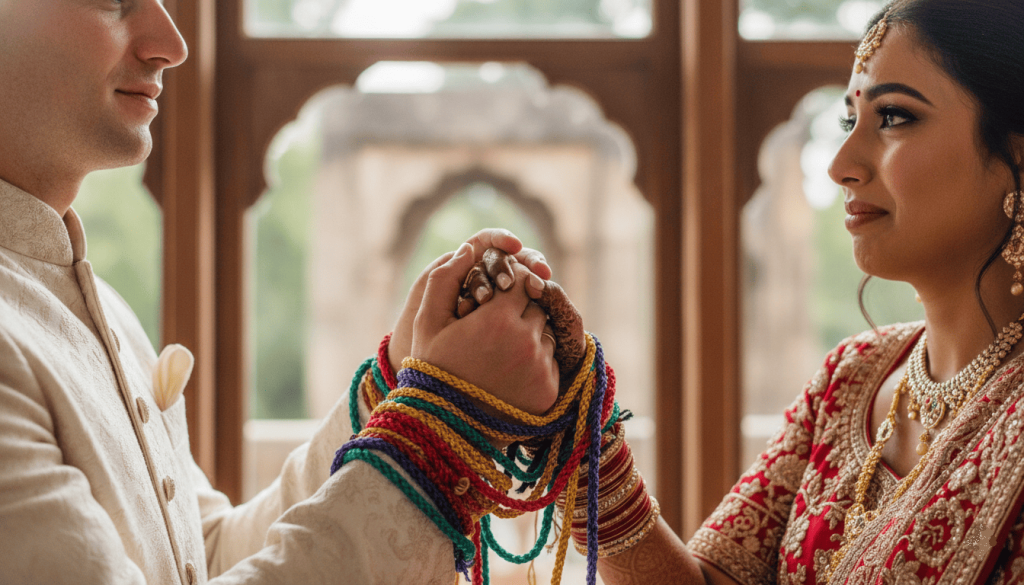
A handfasting ceremony is a unity ritual in which a couple’s hands are tied together with cord or ribbon to symbolize their commitment to each other. It has deep roots in Celtic and pre-Christian European tradition, and it is widely believed to be the origin of the phrase “tying the knot.” Today it shows up in Pagan and Wiccan weddings, but also in secular, interfaith, and Christian-leaning ceremonies, as well as vow renewals. I’ve coordinated handfastings for couples honoring Scottish or Irish heritage and for couples who just wanted one beautiful, visible moment of connection during their vows — here’s everything worth knowing before you add one to your day.
Quick definition
A handfasting is an ancient Celtic unity ritual where a couple’s joined hands are bound with cords or ribbons while vows or blessings are spoken. It symbolizes two lives becoming one, and it’s where the expression “tying the knot” is thought to come from. On its own it’s symbolic, not a legal marriage.
What is a handfasting ceremony, exactly?
At its simplest, a handfasting is the act of binding a couple’s hands together during a wedding to represent their union. The officiant drapes or wraps a cord, ribbon, or piece of cloth around the clasped hands while words are spoken, then ties a knot. That knot is the centerpiece of the ritual — a tangible, visible symbol that the two people are now bound to one another.
The Irish name for the practice, ceangal na lámh, translates literally as “binding of the hands,” and the Scottish Gaelic term pòsadh-bliadhna means “year-marriage” — a nod to its older role as a betrothal. What I love about it as a planner is how flexible it is: a handfasting can take thirty seconds or several minutes, use one ribbon or a dozen, and carry as much or as little spiritual weight as the couple wants. It’s one of the most adaptable unity rituals out there, which is exactly why it has outlived its original culture and spread so widely.
Where does handfasting come from?
Handfasting is generally traced to pre-Christian times in the British Isles, with strong associations to Celtic culture in Ireland and Scotland. Honest answer: the very earliest history is thin and not well documented, so be skeptical of any source that hands you a precise “this started in year X” figure. What we can say more confidently is that hand-binding rituals were common across parts of medieval Europe — including Scotland, Ireland, and Germany — at a time when most marriages weren’t consecrated in a church at all. Couples often simply joined hands over an anvil, in a field, or in a grove, and that was the wedding.
In the Middle Ages, handfasting frequently functioned as a betrothal or a kind of common-law marriage by consent. You’ll also hear the romantic story that a handfasting created a “trial marriage” lasting a year and a day, after which the couple could either commit permanently or walk away. It’s a lovely idea, and it’s repeated everywhere — but according to Humanists UK, that specific “year and a day” framing was largely popularized as a misconception by Sir Walter Scott in his 1820 novel The Monastery. The practice fell out of fashion, then resurfaced in the late 18th century, and was revived again in the 20th century through Wiccan and Pagan wedding traditions, which is how many modern couples first encounter it.
Did you know
The everyday phrase “tying the knot” is widely believed to trace back to the handfasting cord. When you say a couple is tying the knot, you’re echoing a literal hand-binding ritual that’s thousands of years old.
What happens during a handfasting ceremony?
While there’s no single fixed script, most handfastings I’ve seen follow the same basic flow. If you’re picturing how it would play out in your own ceremony, here’s the order it usually takes:
- Introduction. The officiant explains what handfasting is and what it means to the couple — often with a short reading, blessing, or note about the family heritage behind the ritual.
- Joining hands. The couple clasps hands. Some join right hand to right hand, some cross both sets of hands, some simply hold hands side by side. There’s no wrong way — pick whatever feels comfortable.
- The binding. As vows, promises, or blessings are spoken, the officiant drapes and wraps the cord or ribbon around the joined hands. In many versions, each ribbon is added with its own line or intention.
- Tying the knot. The officiant secures the binding with a knot. Some couples slip their hands free so the knot holds its shape as a keepsake; others untie it at the end.
Vows are a natural pairing here — many couples speak their promises while their hands are being bound, which makes the moment land harder. If you’re writing your own, my guide to writing wedding vows walks you through how to keep them personal without rambling.
What the handfasting cords and colors mean
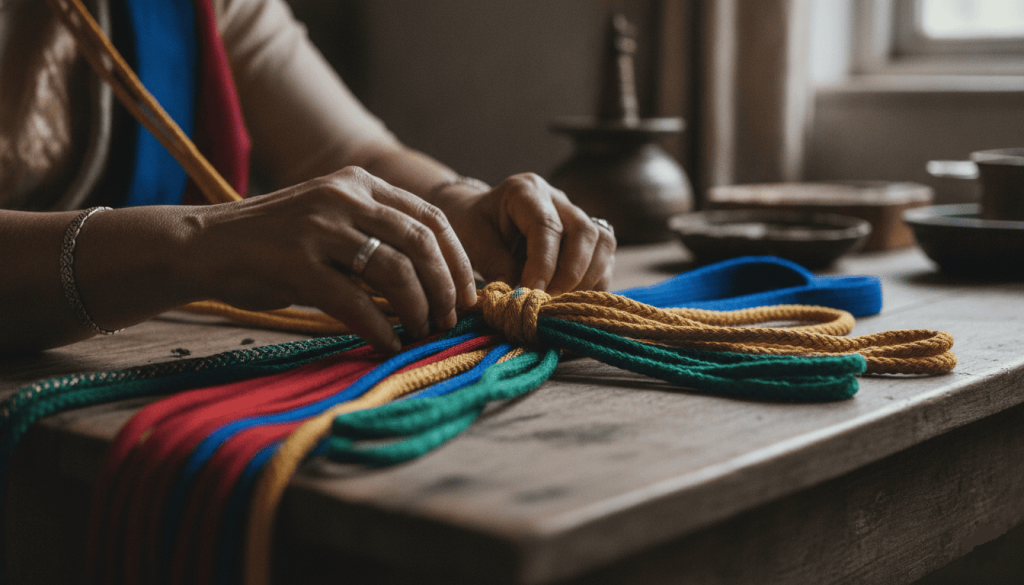
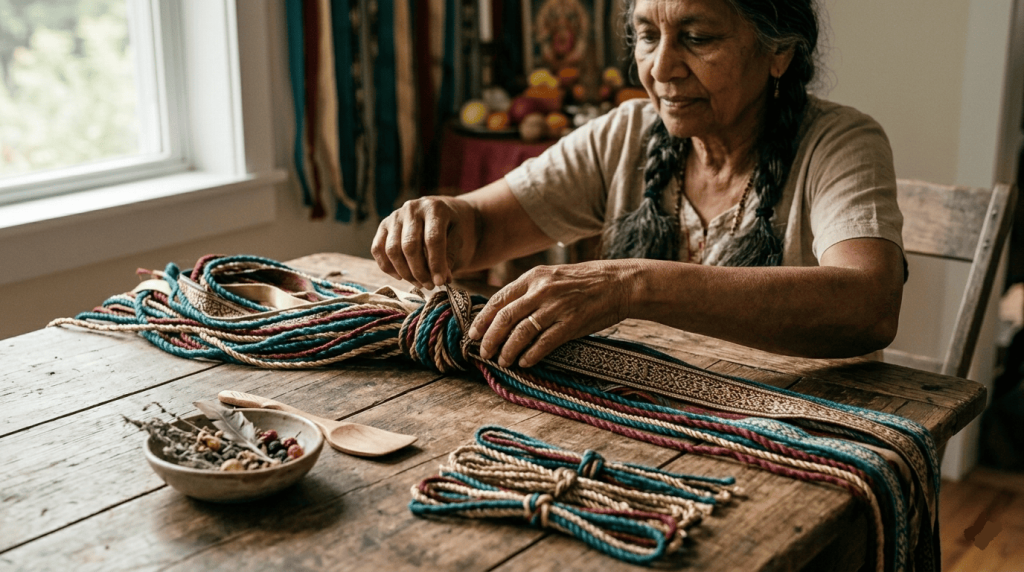
The handfasting cords are the heart of the ritual, and almost every part of them can be personalized. Couples choose the number of cords, the materials, and the colors to reflect their own story. Some use a single cord; others use several, sometimes one tied by each member of the wedding party or family.
Color carries meaning in many handfasting traditions. While there’s no universal rulebook, a few associations come up again and again:
- Red — passion, strength, and love.
- White — purity, peace, and new beginnings.
- Blue — loyalty, trust, and devotion.
- Green — growth, fertility, and prosperity.
- Gold — unity, longevity, and good fortune.
- Purple — wisdom, dignity, and spiritual strength.
The knot itself can be symbolic too. A simple overhand knot is often read as everlasting love, while more intricate weaves can stand for family ties, spiritual connection, or the blending of two lives. Couples with heritage roots sometimes weave in tartan to honor a Scottish line, or natural fibers for an eco-conscious wedding. There’s no “correct” cord — the meaning is whatever you assign to it.
Cultural variation
In Scottish and Irish Celtic tradition: tartan ribbons are common, with the cords often representing the joining of two families and clans. In Wiccan and Pagan ceremonies: handfasting is a core rite, frequently tied to the language of the seasons and to blessings spoken in “perfect love and perfect trust.” In Norse-inspired weddings: the binding echoes older European betrothal customs. In modern secular and Christian-leaning weddings: couples keep the cord and knot but swap in their own readings, prayers, or vows, treating it as a unity ritual rather than a religious rite.
Is a handfasting ceremony legal?
This is the question I get most often, so let me be direct: in the United States, a handfasting on its own is not a legal marriage. No state treats the binding of hands as a substitute for the paperwork. The ritual carries real cultural and emotional weight, but it doesn’t make you legally married by itself.
To make your marriage legal, you’ll still need the three standard pieces, the same as any other wedding, per The Knot:
- A valid marriage license from your local county clerk, applied for before the wedding (fees typically run from about $20 to $110, and many licenses expire within 30 to 90 days if unused).
- An authorized officiant — a judge, justice of the peace, or ordained or otherwise qualified clergy member recognized by your state.
- The signed license filed back with the issuing office to be recorded.
The good news is that none of this stops you from having a handfasting. The common approach is simple: hire an officiant who is legally qualified to perform marriages in your state, and have them lead the handfasting as part of a ceremony that also includes the legal elements. Some couples even do a brief legal ceremony separately, then fold the handfasting into the bigger celebration. Just make sure everyone — especially your officiant — is clear on which part is the legally binding piece. I’m a wedding planner, not an attorney, so confirm the exact requirements with your county clerk, since the details vary by state.
How couples weave handfasting into a modern wedding
In my planning experience, handfasting works best when it’s placed right around the vows — the binding and the promises reinforce each other, and it gives photographers a gorgeous, unmistakable shot. It rarely adds much time, either; most handfastings run just a few minutes, so they slot neatly into your overall ceremony without throwing off the schedule. If you’re mapping out your timing, my breakdown of how long a wedding ceremony usually runs will help you see where it fits.
What I see most often with cross-cultural couples is using the cords to honor more than one heritage at once — a tartan ribbon for one side, a meaningful color or fabric for the other. If a handfasting feels right but you’re still weighing your options, it’s worth browsing a few other unity ritual and ceremony ideas before you commit, so the moment you choose actually reflects the two of you.
One small but meaningful detail: decide in advance what happens to the cord. Plenty of couples keep theirs tied, frame it, or display it at home as a keepsake. It’s a lovely, low-cost piece of your day that you’ll actually hold onto.
Frequently asked questions
Is handfasting only for Pagan or Wiccan weddings?
No. Handfasting has deep roots in Celtic, Pagan, and Norse traditions, and it’s a core rite in many Wiccan ceremonies. But today it’s embraced by couples of all beliefs — secular, interfaith, and Christian-leaning weddings all use it, often as a unity ritual with the couple’s own readings and vows.
How long does a handfasting ceremony take?
Usually just a few minutes. The binding and knot-tying happen within your larger ceremony, often right around the vows. You can keep it to a quick single-cord version or stretch it out with multiple ribbons and readings, but it rarely adds meaningful time to your schedule.
Do you say vows during a handfasting?
Often, yes. In many versions the officiant wraps the cord around your joined hands while you speak your vows, promises, or blessings — sometimes adding one ribbon per intention. Vows aren’t strictly required, but pairing them with the binding is one of the most popular and moving ways to do it.
What do you do with the handfasting cords afterward?
That’s up to you. Many couples slip their hands free so the knot holds its shape, then keep the bound cord as a keepsake — framed, displayed at home, or tucked away with other wedding mementos. Others simply untie it at the end of the ritual. There’s no rule, so do whatever feels meaningful.
Sources
- The Knot — What Is a Handfasting Ceremony? (meaning, ritual, and US legality)
- Humanists UK — A Guide to Handfasting (medieval history and the Sir Walter Scott misconception)
- The Celebrant Directory — The Art of Handfasting (cord colors, knots, and personalization)
- Handfasting — overview and native terminology (Irish and Scottish Gaelic names)
— Madison Cole, Certified Wedding Planner