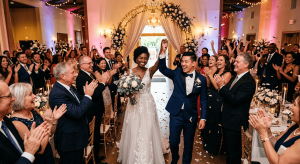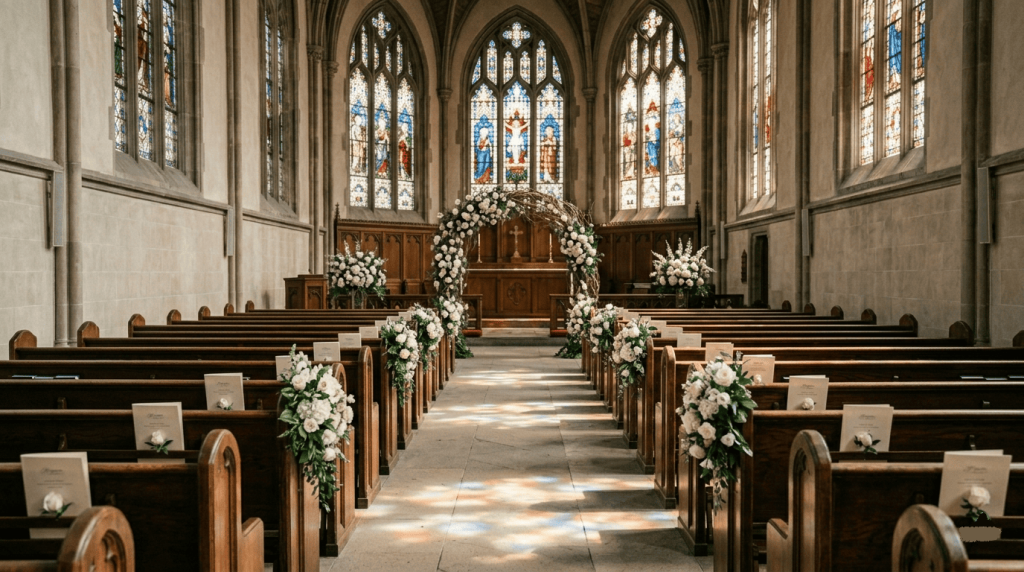
In a traditional US wedding, you walk down the aisle in this order: the officiant, the grandparents, the parents, the wedding party (groomsmen and bridesmaids), the maid of honor and best man, the ring bearer and flower girl, and finally the bride with her father. That is the classic Christian and nondenominational lineup most of my couples start from.
But “traditional” bends to your faith, your family, and what actually feels right to you. After more than 200 weddings on the East Coast, I can tell you the couples who stress least about the processional order treat it as a template, not a rulebook. Here is the full lineup, who walks down the aisle and when, and how it shifts for Catholic, Jewish, same-sex, and blended-family ceremonies.
Quick answer
In a classic US processional, people walk in this order: the officiant, the grandparents, the groom’s parents, the mother of the bride, the groom and best man, the bridesmaids and groomsmen, the maid of honor, the ring bearer and flower girl, and finally the bride with her father. Your faith and family can reshuffle that lineup, and that is completely fine.
The traditional wedding processional order, step by step
Here is the traditional wedding processional I set up most often for Christian and nondenominational ceremonies. Think of it as a steady build, from the people who set the scene to the person everyone is waiting for.
The traditional processional order, step by step
The officiant
Takes their place at the front to signal that the ceremony is starting.
The grandparents
Escorted in and seated in the front row, usually both sets, often starting with the bride’s side.
The groom’s parents
Walk in together and take the front row on the right.
The mother of the bride
Escorted in last and seated front row on the left. Her seating is the cue that the bride is moments away.
The groom and best man
Often enter from the side and wait at the altar, though the groom can also process down the aisle.
The bridesmaids and groomsmen
Walk in pairs or one at a time, in the order they’ll stand, with the outermost spots going first.
The maid of honor
Walks alone, just before the bride. The best man is already up front (or came in with the groomsmen).
The ring bearer, flower girl, then the bride
The little ones go first (together or back to back), then the bride enters last, traditionally on her father’s right arm.
Done well, the whole sequence takes about five minutes. In my planning experience, the order matters less than the spacing: leave a real gap between each person so your photographer can actually catch them and the aisle never looks like a traffic jam.
Who walks down the aisle, and when
The lineup above answers the “what order” question, but the “when” is what trips people up at rehearsals. A few roles deserve their own note.
The officiant goes first because their arrival at the front is the visual signal that the ceremony is on. Grandparents and parents follow as honored guests, not as part of the wedding party, which is why they are seated rather than left standing at the altar.
The mother of the bride (MOB) is the linchpin. She is the last person escorted in, and the moment she sits, the ushers stop seating guests and the wedding party is cleared to go. If you remember one timing rule, make it that one. (There is a lot more to the mother of the bride’s full role than this single cue.)
Then comes the wedding party. Bridesmaids and groomsmen walk in the order they’ll stand, starting with whoever ends up farthest from the couple, so nobody has to shuffle past anyone once they reach the front. The maid of honor (MOH) walks last among the attendants, right ahead of the bride.
One myth I correct at almost every rehearsal: the MOH does not walk arm-in-arm with the best man. She walks alone, and the best man is already standing up front with the groom. If you are still sorting out who holds which title, here is the difference between a maid of honor and a matron of honor.
Did you know
The average wedding processional takes no more than about five minutes, according to planners interviewed by The Knot. A Hindu processional, by contrast, can run an hour or longer. Source: The Knot.
Madison’s note
“At every rehearsal I run, I tell the ushers the same thing: once the mother of the bride is in her seat, stop seating guests and don’t let anyone else down that aisle until the wedding party starts. Her seat is the go button for the whole processional. Get that one cue right and the rest takes care of itself.”
— Madison Cole, Certified Wedding Planner
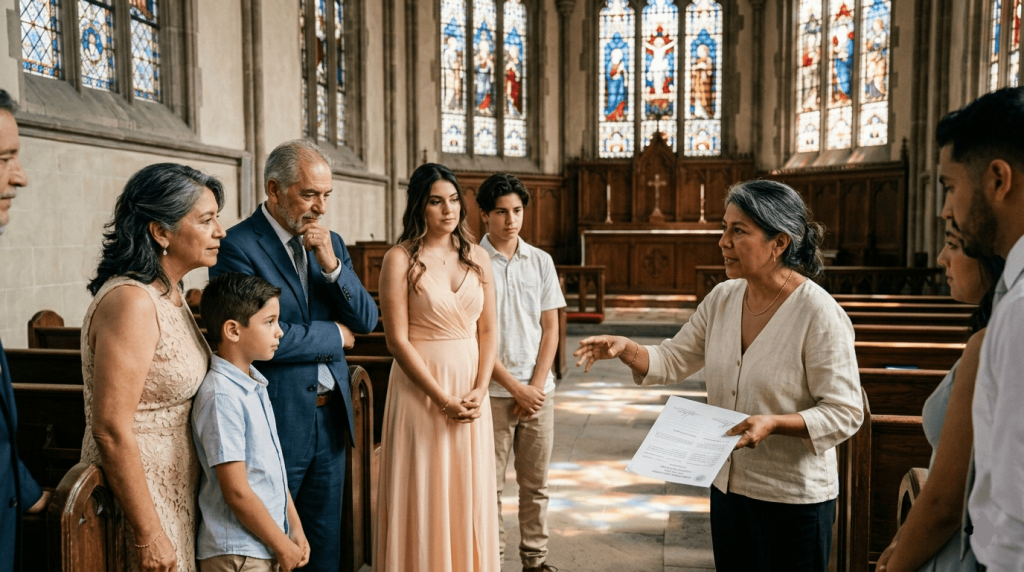
How the order changes by faith and culture
“Traditional” is not one fixed thing. Here is how the processional order shifts across the ceremonies I plan most.
Catholic ceremonies
In a Catholic processional, the priest, the groom, and the best man usually enter from the side and take their places at the altar, so the groom is already waiting. The bridesmaids and groomsmen then walk down the aisle in pairs, men on the right and women on the left, beginning with the attendants who’ll stand farthest from the couple. The ring bearer and flower girl follow, and the bride comes last on her father’s arm. One thing worth checking with your parish: some churches have rules about ceremony music and which traditions belong inside the Mass, so confirm your order with your priest early.
Jewish ceremonies
A Jewish processional differs in a few meaningful ways. The rabbi and cantor lead, followed by the grandparents. Then, unlike the Christian lineup, both partners are escorted by both of their parents: the groom walks in with his mother and father, and the bride walks in with hers. The wedding party, best man, and maid of honor fall in between. Both sets of parents typically stand under the chuppah with the couple and the rabbi rather than taking front-row seats, and the families are seated on the opposite sides from a Christian ceremony, with the bride’s side on the right.
Same-sex and nondenominational ceremonies
When there isn’t a default bride-and-groom split, the processional opens up. The couples I plan for usually pick one of three paths: both partners process separately from opposite ends and meet in the middle, both walk in together, or one waits at the front while the other comes down the aisle. Attendants don’t have to be sorted by gender either, so honor attendants of any gender can stand on either side. The order above still works as a skeleton; you just swap the roles to fit your family.
Blended families and second weddings
If you have children, they can have a real role: walking a parent down the aisle, standing up as attendants, or joining a short family blessing once everyone is at the front. For a second wedding, plenty of my couples skip the giving-away moment entirely. The bride might walk alone, with her kids, or with both parents. None of that breaks etiquette, and honestly it usually reads as more personal.
The processional mix-ups I see at every rehearsal
The order is the easy part. These are the snags that actually cause a day-of scramble, and every one of them is avoidable.
- Pairing the MOH with the best man. She walks solo down the aisle. Pair them in the recessional instead, on the way back out.
- Seating the wrong family on the wrong side. In a Christian ceremony the groom’s family sits on the right and the bride’s on the left; a Jewish ceremony flips it. Mark the front rows at the rehearsal so nobody has to guess.
- Spacing too tight. When everyone bunches up, the photos look rushed and the aisle gets congested. I count a slow “one-one-thousand, two-one-thousand, three” before I send the next person.
- Very young flower girls and ring bearers. Under about age four, plan for them to lose their nerve. Have a parent waiting at the front, or let them walk with an older attendant, and keep a treat ready at the end.
- Leaving the MOB escort unassigned. Decide in advance whether a son, an usher, or another relative walks her in. It is a tiny detail that holds up the whole start when nobody knows whose job it is.
Once the bride reaches the altar and her father takes his seat, the processional is over and the ceremony begins, which is the moment to have your ceremony vows ready to go.

Frequently asked questions
The questions my couples and their families ask me most about walking down the aisle.
Who walks down the aisle first?
The officiant walks in (or takes their place) first to signal that the ceremony is starting. In the traditional US order, grandparents and parents follow, then the wedding party, then the bride. If your officiant is already standing at the front, the grandparents are usually the first ones escorted down the aisle.
Does the maid of honor walk with the best man?
No. The maid of honor walks down the aisle alone, just before the bride. The best man is already standing at the altar with the groom, or he walks in with the groomsmen. The two are commonly paired in the recessional, on the way back out, not in the processional.
What’s the difference between the processional and the recessional?
The processional is everyone walking in before the ceremony, in the order covered here. The recessional is the walk back out after you’re married, led by the newlyweds, then the wedding party in pairs, then the parents and grandparents.
Who walks the mother of the groom down the aisle?
Traditionally the father of the groom escorts her, and they’re seated together in the front row on the right, before the mother of the bride is seated. If the father of the groom isn’t part of the day, a son, an usher, or another close relative can walk her in.
Can you change the traditional processional order?
Absolutely. There’s no single authority setting a “correct” order anymore, so the lineup is yours to adjust. Walk in with both parents, skip the giving-away moment, add stepchildren, or have your partner meet you halfway down the aisle. Use the traditional order as a starting point and reshape it around your family.
Sources
- The Knot — Wedding Processional Order. theknot.com
- Brides — Wedding Processional Order Guide. brides.com
- WeddingWire — Wedding Processional Order. weddingwire.com
- Zola — Wedding Processional Order Walkthrough. zola.com
- Emily Post Institute — Wedding Etiquette. emilypost.com
The bottom line
So, what order do you walk down the aisle? Start with the traditional lineup, officiant, grandparents, parents, wedding party, maid of honor, the kids, then the bride, and adjust it to your faith and your family without apology. Get the spacing right at the rehearsal and the whole thing runs itself.
If you’re mapping the rest of the day around this moment, my month-by-month wedding day timeline shows exactly where the ceremony fits, and if you’re earlier in the process, here is how to plan your wedding from the start. A companion piece on the recessional order is on the way: [LIEN A CREER vers /wedding-recessional-order/ une fois la page publiee].
Written by Madison Cole, Certified Wedding Planner