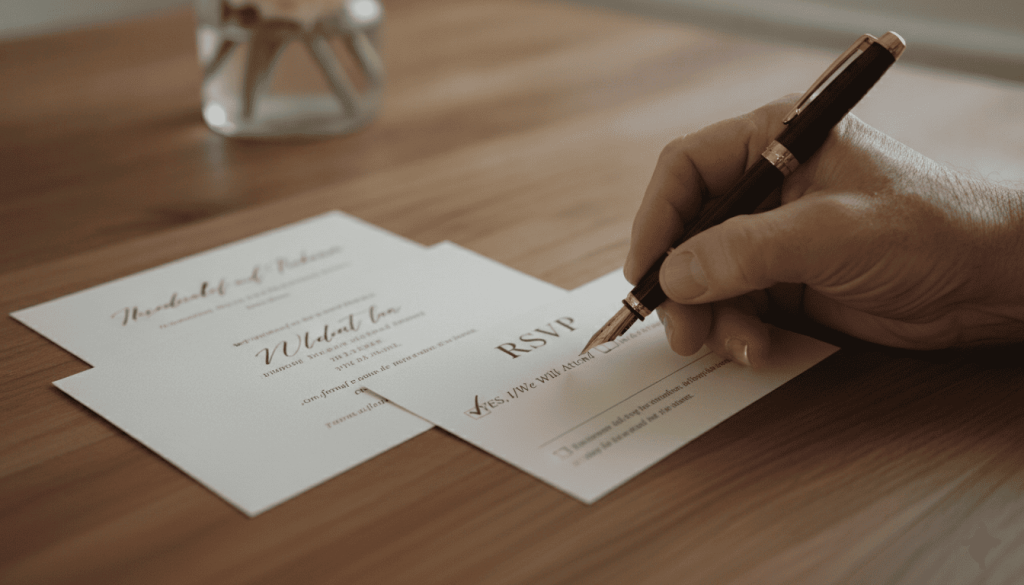
RSVP stands for the French phrase répondez s’il vous plaît — literally, please respond. When you spot it on an invitation, the host is asking you to confirm whether or not you’re coming. That’s the whole job: a clear yes or no, sent back by the date on the card. Here’s where it comes from and exactly how to handle it.
Definition
RSVP — an abbreviation of the French phrase répondez s’il vous plaît, meaning “please respond,” printed on an invitation to ask guests to confirm whether they’ll attend.
What RSVP stands for (and where it comes from)
RSVP is a French initialism — four letters pulled from répondez s’il vous plaît. Word for word, it means “respond if it pleases you.” In everyday English we shorten that to “please reply” or “please respond,” which is exactly what the host wants you to do.
If you’ve ever seen SVP on its own, that’s the same phrase trimmed down — s’il vous plaît simply means “please.” It shows up on plenty of stationery, right alongside other little bits of shorthand like the XOXO sign-off you’ll find at the bottom of a card.
Here’s the part most people don’t know: RSVP isn’t really used in France anymore. It reads as formal and old-fashioned there, though it’s still common in French-speaking Canada, like Quebec. The acronym stuck around in American invitation culture long after its home country moved on.
One small irony — writing “please RSVP” technically means “please please respond,” since the s’il vous plaît is already baked in. It’s redundant, but it’s so common now that nobody blinks. I certainly don’t correct my couples on it.
What RSVP means on an invitation
On an invitation, RSVP is a direct request: tell the host whether you’re attending, by the date listed. You’ll usually do that one of two ways — by mailing back the reply card tucked into the envelope, or by responding through the couple’s wedding website.
On a formal reply card, you’ll often see a line that starts with “M_____”. That’s not a typo — it’s the lead-in for your title and name (Mr., Mrs., Ms., or Miss), so you fill in something like “Mr. and Mrs. Carter.” Then you check “accepts” or “declines” and note your headcount.
The reason hosts care so much is purely practical. Your answer drives the headcount, and the headcount drives the catering order, the table count, the rental chairs, and the seating chart. One unanswered card isn’t a crisis — fifty of them is. If you need the full walkthrough, here’s how to address and assemble a wedding invitation suite so the reply card actually makes it home with the guest.
Etiquette note
Reply as soon as you know — don’t sit on the card. The standard wedding rhythm is invitations out about 6 to 8 weeks before the date, with an RSVP deadline 3 to 4 weeks before. That gap exists so the couple can give a firm count to the caterer. Replying late, or not at all, is the single most common headache I see land on a host’s plate.
For the timing side from the host’s angle, I break down exactly when to send wedding invitations so your reply deadline lands in the right place.

RSVP vs. “regrets only” and the lines you’ll actually see
Not every invitation handles the reply the same way. The wording changes what’s expected of you, so it’s worth knowing the difference.
- Standard RSVP: reply either way — yes or no. If you stay silent, many hosts will assume you’re not coming.
- RSVP, regrets only (or just “Regrets only”): only reply if you can’t make it. No response is read as a yes. Hosts use this when they expect most guests to attend.
- “The favor of a reply is requested” or “Kindly respond”: these are just softer, more formal ways of saying RSVP. Same ask.
The one that trips people up is “regrets only.” Read it backwards and you’ll get it wrong — under that wording, silence means you’re showing up, so if you can’t attend, you have to say so.
What a missing RSVP costs the couple
In my planning years out of Charleston, the reply-card week was always the one that separated calm weddings from frantic ones. The couples who stayed sane were the ones who chased every blank card a week before the deadline instead of hoping they’d trickle in.
Here’s the math nobody sees from the guest side. A caterer needs a firm headcount, usually about two weeks out. Every guest who hasn’t replied is a guess — and you pay per plate for guesses. I’ve watched a couple budget for ten “maybes,” then have all ten skip the reception, which is real money set on fire for chairs and meals nobody used.
So when I tell guests to send the card back fast, it isn’t about manners for manners’ sake. Your yes or no is a line item on someone’s budget.
Madison’s note
“If a card asks a question you can’t answer — a plus-one you’re unsure about, or a meal choice — don’t leave it blank and stall. Reply with what you know and add a quick note. A host can work with ‘yes, plus-one TBD.’ What costs them money is silence.”
— Madison Cole, Certified Wedding Planner
RSVP questions I hear all the time
A few quick ones that come up every season, answered the way I’d answer a guest standing in front of me with the card in hand.
What does RSVP stand for in English?
RSVP stands for the French phrase répondez s’il vous plaît, which translates to “please respond.” There’s no English-word version behind the letters — it’s a French abbreviation that English speakers borrowed for invitations.
Is it rude to say “please RSVP”?
Not at all — it’s just technically redundant, since the phrase already contains “please” (s’il vous plaît). It’s so widely used that it reads as completely normal. Say it without a second thought.
What does “RSVP, regrets only” mean?
It means you only need to reply if you can’t attend. With “regrets only,” no response is taken as a yes, so silence assumes you’re coming. If you can’t make it, you must let the host know.
Do you have to RSVP if you’re not going?
Yes. A standard RSVP asks for a reply either way, and a clear “no” is far more useful to a host than an unreturned card. Declining promptly lets the couple adjust their headcount and, often, invite someone from the wait list.
The short version
RSVP means répondez s’il vous plaît — please respond — and on an invitation it’s a request to confirm whether you’re attending by the date given. Reply early, reply either way, and read the exact wording so you know if “regrets only” applies. For the step-by-step on actually filling it out and sending it back, here’s my full guide to RSVPing to a wedding.
Sources
- Merriam-Webster Dictionary — RSVP. merriam-webster.com
- Cambridge Dictionary — RSVP. dictionary.cambridge.org
- Wikipedia — RSVP. en.wikipedia.org
- Emily Post Institute — Wedding Etiquette. emilypost.com
Written by Madison Cole, Certified Wedding Planner. I planned 200+ weddings out of Charleston before turning to writing, and the reply-card pile-up was a problem at nearly every one — which is why I’m a little evangelical about sending yours back on time.