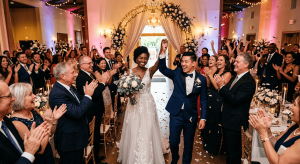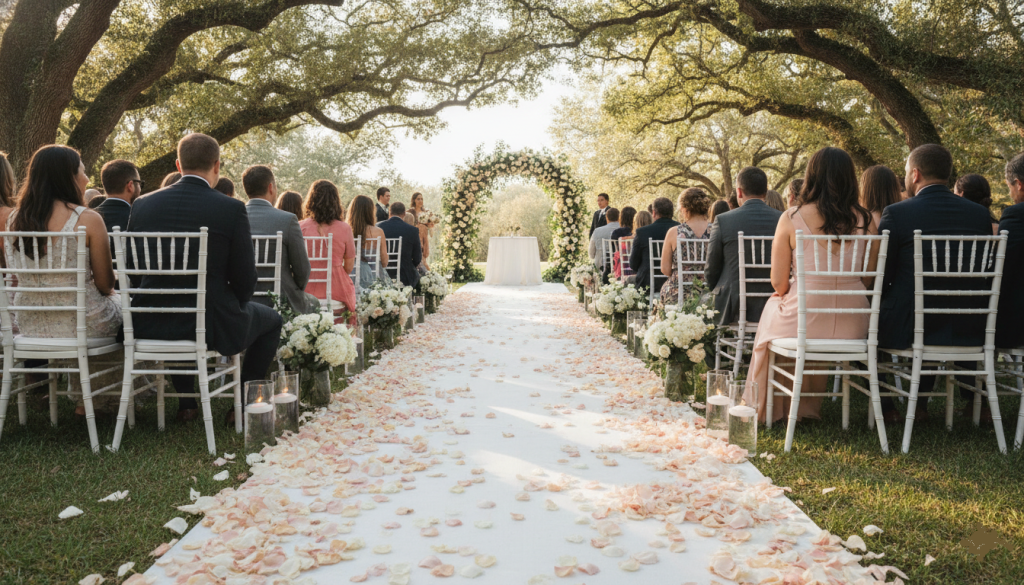
A wedding processional is the formal walk down the aisle that opens your ceremony, in a set order that usually ends with the bride. The officiant, close family, and the wedding party enter first, and the bride goes last. I’ve planned more than 200 weddings across the East Coast, and the processional is the part couples overthink and under-rehearse. Here is exactly who walks, in what order, and how to make it your own.
Definition
Wedding processional — the order in which the officiant, family, and wedding party walk down the aisle to open a ceremony, ending with the bride’s entrance.
The short answer: who walks, and why the bride goes last
The processional is the opening scene of your ceremony. Before you and your partner say a word, your guests watch the people who matter most take their places at the front. That sequence is the wedding processional order, and it builds toward one moment: the bride’s entrance.
The reason the bride walks last is mostly about anticipation. Each entrance raises the temperature in the room a little, so the order moves from grandparents and parents, to the wedding party, to the bride. It is the same logic a good wedding day timeline uses everywhere: pace the moments so the biggest one lands at the right time.
Once the processional ends, the ceremony itself begins: readings, the officiant’s words, and your wedding vows. The processional is the runway. Everything after it is the flight.
The traditional wedding processional order
There is no single national authority that sets a “correct” order, which is why every list you find online looks slightly different. That said, the traditional Christian and Western order is the backbone most US couples start from and then adjust. Here is the standard sequence, first to last.
Traditional processional order, in sequence
Officiant
Takes their place at the altar first, signaling that the ceremony is starting.
Grandparents
Both sets are seated in the front rows, often escorted by an usher.
The groom’s parents
Walk in together and take their seats on the right side.
The mother of the bride
Her entrance is the cue that the main processional is about to begin. She sits last, on the left.
The groom and best man
Either walk the aisle or, more often, enter from a side door and wait at the altar.
Bridesmaids and groomsmen
Enter in pairs, or the bridesmaids walk solo while the groomsmen wait up front.
Maid of honor, then ring bearer and flower girl
The Maid of Honor (MOH) goes just ahead of the kids, who walk right before the bride.
The bride and her escort
Traditionally her father, though both parents, a sibling, or no escort at all are all common now.
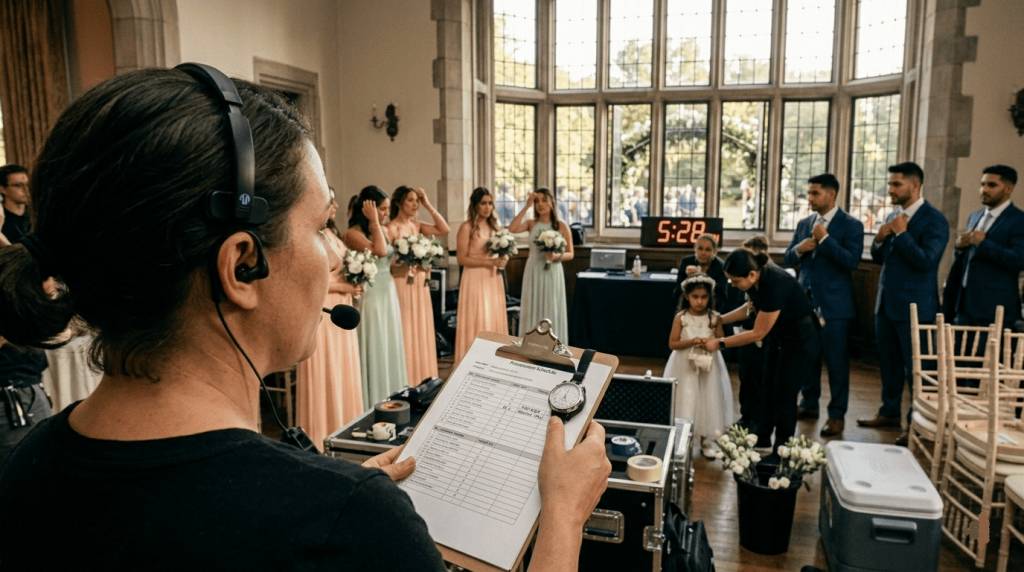
One thing online lists rarely tell you: the groom, best man, and groomsmen usually do not walk the aisle at all. At most of the Christian and civil ceremonies I’ve coordinated, they enter from a side door and stand at the altar, so the aisle walk really begins with the grandparents and parents. If you’ve been picturing the groom marching down the center, that is more the exception than the rule.
The order is also genuinely flexible. The flower girl and ring bearer can swap, very young kids can be walked by an older sibling, and the maid or matron of honor can carry the bride’s train instead of leading the kids. None of this breaks etiquette.
Madison’s note
“The processional is the one thing couples skip at the rehearsal and regret on the day. Five minutes of practice tells you who pauses too long, who walks too fast, and where the kids will freeze. Run it twice the night before, in real shoes.”
— Madison Cole, Certified Wedding Planner
Processional vs. recessional: what’s the difference
People mix these two up constantly, so here is the clean version. The processional is the entrance at the start of the ceremony. The recessional is the exit at the end, right after you are pronounced married.
The recessional order is the processional in reverse, with one big change: the newlyweds lead. You walk out first and fastest, followed by the flower girl and ring bearer, then the wedding party in pairs, then the parents, with the officiant often staying put. The mood flips too. The processional is slow and building; the recessional is quick and celebratory.
Everything that can make a ceremony memorable happens in the stretch between those two walks, including the rare moment couples worry about most. If you’ve ever wondered what actually happens if someone objects mid-ceremony, that falls squarely in this window, between the processional and the recessional.
Processional order by religion and culture
The “traditional” order above is really the Christian Western default. Plenty of faiths and cultures have their own sequence, and the differences are meaningful, not cosmetic. Two of the most common variations I plan around:
Cultural variation
In a Jewish ceremony: both partners are typically escorted down the aisle by both of their parents, and those parents stay standing under the chuppah throughout the ceremony. The rabbi or cantor leads, grandparents follow, and the emphasis is on family walking together rather than the bride entering alone.
In a Catholic ceremony: the order closely follows the Christian Western sequence, with the bride usually escorted by her father. The main difference is what follows the processional: a fuller liturgy, and often a nuptial Mass, rather than a short service.
Other traditions reshape the entrance entirely. In many Hindu weddings, the groom’s arrival is its own celebration, the Baraat, with music, dancing, and family, before the bride’s entrance. Nondenominational and modern ceremonies tend to keep only the parts that feel right, often skipping the side that doesn’t apply to them.
For LGBTQ+ couples, there is no default at all, and that is freeing. Some walk in together to signal a partnership that already exists, some enter from opposite sides and meet in the middle, and some each get their own escorted entrance. If a parent has strong feelings about a specific order, the mother of the bride’s role is usually where those conversations start.
Wedding processional songs
Your processional songs do real work: they set the pace and tell guests when to stand. Most couples use one piece for the wedding party and a second, bigger one for the bride’s entrance.
The classic instrumental choices are Pachelbel’s Canon in D for the party walking in, and Wagner’s “Bridal Chorus” (the “Here Comes the Bride” melody) for the bride. Modern couples often swap those for instrumental covers of a meaningful song, which keeps the build without the lyrics competing with the moment. If you want a longer shortlist to pull from, start with my roundup of the best wedding songs and look for the slower, build-up tracks.
How long does the wedding processional take?
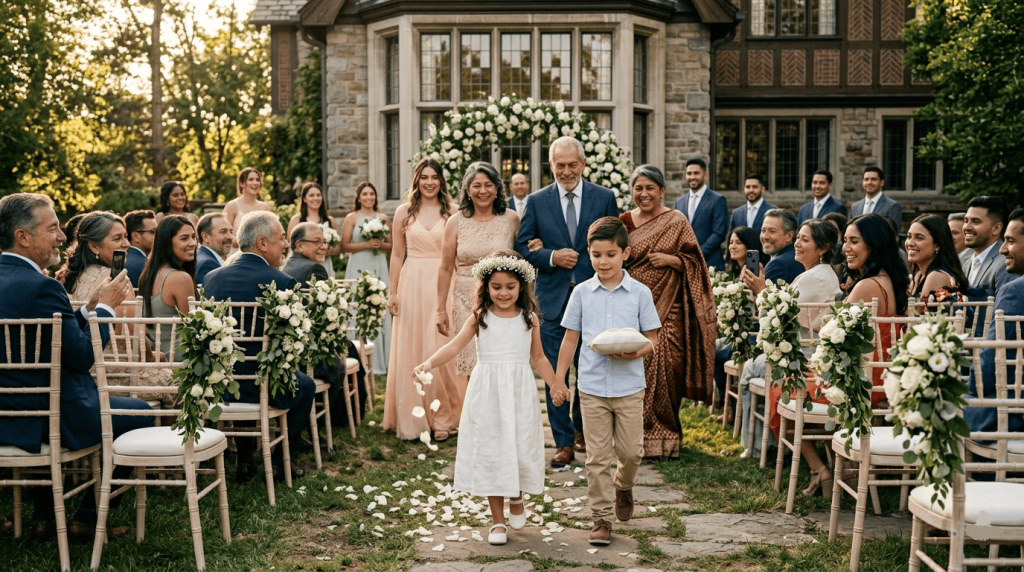
Shorter than couples expect. A wedding processional runs about two minutes on average, and should take no more than five minutes even with a large party, according to Zola’s planning guidance. The real variables are your party size, the length of the aisle, and how long your processional music runs.
My practical rule: match your song length to your party. If you have a twelve-person wedding party and a thirty-second instrumental, you will run out of music before the bride is halfway down. Time the walk at rehearsal and pick the track to fit.
Frequently asked questions
Who walks down the aisle first in a wedding?
The officiant usually takes their place first, followed by grandparents and parents being seated. In the main aisle walk, the mother of the bride’s entrance is the traditional signal that the processional is starting.
Does the groom walk down the aisle?
Sometimes, but in most Christian and civil ceremonies the groom, best man, and groomsmen enter from a side door and wait at the altar. Walking the groom down the aisle is a perfectly valid choice if you prefer it, just decide in advance so your music and cues match.
Who walks the bride down the aisle if not her father?
Anyone who matters to you: both parents, your mother, a stepparent, a sibling, a grandparent, or a close friend. Many brides also walk in alone or enter alongside their partner. There is no etiquette rule that requires a father escort.
Can a couple walk down the aisle together?
Yes, and it is increasingly common, especially for couples who want to symbolize a partnership they already share. You can enter together from the back, or each walk in separately and meet at the altar.
Still mapping out the rest of your day? The processional is one piece of a much longer running order, and getting the full schedule on a single page is what keeps the morning calm.
So, what is a wedding processional? It is the ordered entrance that opens your ceremony, traditionally building to the bride, and entirely yours to reshape. Get the sequence on paper, run it once at rehearsal, and it will feel effortless on the day. When you’re ready to slot the ceremony into the rest of your schedule, my month-by-month wedding timeline picks up right where this leaves off.
Sources
- The Knot — Traditional Wedding Processional Order. theknot.com
- Zola — Wedding Processional Order Walkthrough. zola.com
- Brides — Wedding Ceremony Etiquette. brides.com
- Emily Post Institute — Wedding Etiquette. emilypost.com
— Madison Cole, Certified Wedding Planner
Written by Madison Cole, Certified Wedding Planner
Madison planned more than 200 weddings across the East Coast, from Charleston historic mansions to Outer Banks destination ceremonies, before founding One Stop Wedding Planner to share the playbook she handed her clients for nine years.