Most wedding ceremonies last about 20 to 30 minutes — and after planning more than 200 weddings up and down the East Coast, I can tell you the venues I work with almost always block 30 minutes for the whole thing, processional to recessional. That figure surprises a lot of my brides. They picture standing at the front for an hour, and the truth is that a clean, no-frills ceremony is over before the cocktail hour ice has melted. The number moves once you add a full religious service, multiple readings, or cultural rituals, so below I’ll break down where every minute goes, how length shifts by ceremony type, and how to keep yours from dragging.
Quick answer
A typical non-religious wedding ceremony runs 20 to 30 minutes, which most venues schedule as a flat 30-minute block from the first step of the processional to the recessional. A courthouse or civil ceremony can be as short as 5 to 15 minutes, while a Catholic Mass or a South Asian ceremony can run an hour or far longer.
The short answer: about 20 to 30 minutes
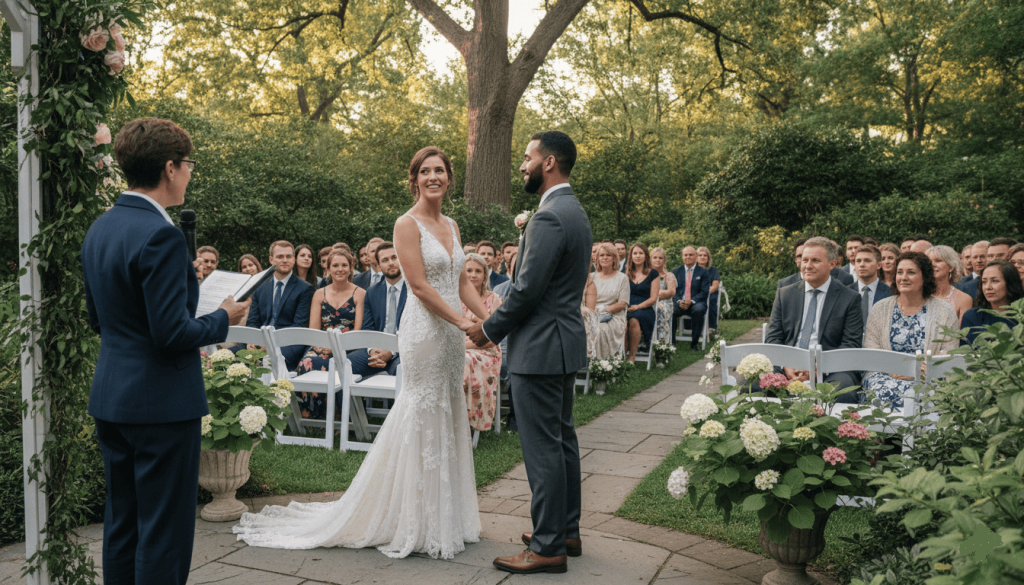
If you strip a ceremony down to what guests actually came to witness — the walk in, a welcome, a reading or two, the vows, the rings, the kiss, and the walk out — you land at roughly 20 to 30 minutes. That’s the range I quote my couples first, and it’s the slot most ceremony coordinators build their day-of schedule around.
Here’s what I tell my brides when they worry it sounds too short: 30 minutes is plenty of time to feel like something meaningful happened. I’ve seen couples cram in three readings, a unity candle, and personal vows and still wrap inside half an hour. I’ve also watched a four-minute courthouse ceremony move a room to tears. Length and meaning are not the same thing, and your guests — sitting, often outdoors, sometimes in heels on grass — feel every minute past the 30-minute mark.
The honest answer is that ceremony length is one of the most flexible parts of your entire day. A single 15-minute reading can do as much damage to your timeline as adding a whole extra section. So the real question isn’t “how long should it be,” it’s “what do you want in it” — and the minutes follow from there.
What’s actually happening in those 20 to 30 minutes
Once you see the ceremony broken into parts, the math gets simple. Each piece has a fairly predictable length, and you build your total by deciding which ones to keep. Here’s the breakdown I use when I’m mapping out a couple’s ceremony, with the timing I plan against for each section.
Where the minutes go in a typical ceremony
| Part of the ceremony | Typical length | What’s happening |
|---|---|---|
| Processional | 3–5 min | Wedding party and the couple walk in |
| Welcome & opening | 2–4 min | Officiant greets guests and sets the tone |
| Readings | 2–3 min each | Usually one to three poems, passages, or scripture |
| Officiant’s message | 3–5 min | The couple’s story and a few words on marriage |
| Vows | 2–5 min | Traditional or personal — personal runs longer |
| Ring exchange | 1–2 min | Rings on, a line of promise each |
| Unity ritual (optional) | 3–5 min | Candle, sand, handfasting, or a wine ritual |
| Pronouncement & kiss | 1 min | The line everyone’s waiting for |
| Recessional | 2–3 min | The couple and party walk back out |
Add it up: a secular ceremony with one or two readings lands right around 20–30 minutes.
The two sections that quietly stretch a ceremony are readings and personal vows. Three long readings can add 10 minutes on their own, and personal vows have a way of running double what couples rehearsed because nerves slow everyone down. If you want to keep things tight, those are the first two levers to pull — and the music between sections is the easiest place to buy back a minute or two. If you’re still choosing your processional and recessional tracks, my roundup of the best wedding songs for every part of the day is a good place to start.
How ceremony length varies by type
The 20-to-30-minute figure is the secular default. The moment you add a religious service or a cultural tradition, the range opens up — sometimes dramatically. Here’s how the main types break down based on what I’ve coordinated and what officiants consistently tell me.
Civil and courthouse ceremonies (5–20 minutes)
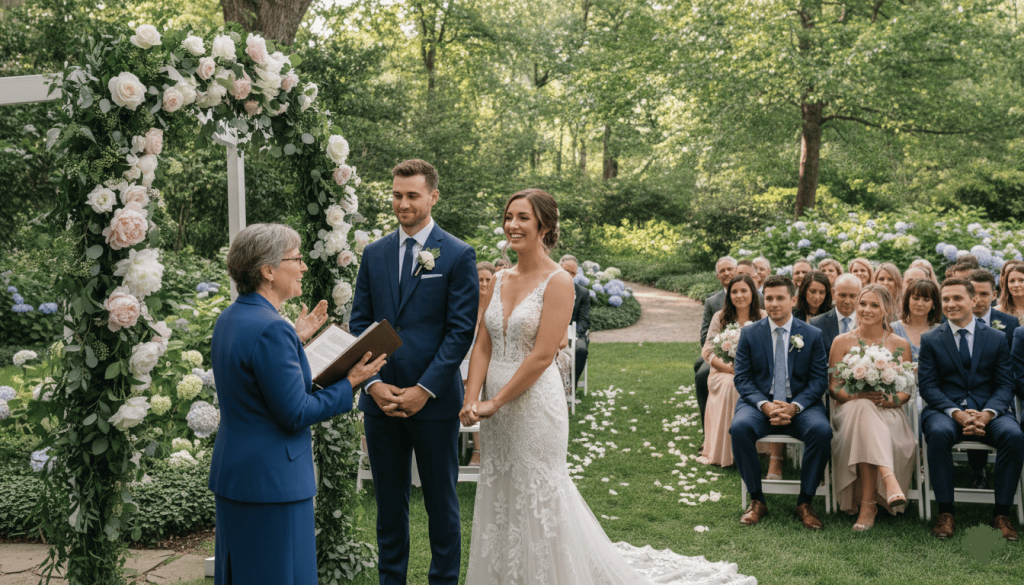
A courthouse or city-hall ceremony is the shortest there is. The legal core of a marriage is small: the couple has to consent, and the officiant has to pronounce them married. Strip away everything else and you’re looking at 5 to 15 minutes. An independent officiant doing a simple outdoor civil ceremony usually lands around 15 to 20 minutes once you add a short welcome and a personal touch or two. Elopements are shorter still — often closer to 5 minutes of actual ceremony.
Religious ceremonies (30–90 minutes)
Religious services are where the clock really moves, and the spread is wide:
- A Protestant or non-denominational Christian ceremony without communion usually runs 30 to 45 minutes.
- A Catholic wedding with a full Mass typically runs 60 to 90 minutes; without the Mass, closer to 30 to 45.
- A Jewish ceremony under the chuppah is often around 30 minutes, though the signing of the ketubah and other elements happen before guests are seated.
If your faith tradition has required readings or rites, your officiant or clergy is the right person to give you an exact number — that’s not something to guess at.
Cultural and multi-day ceremonies (1–3+ hours)
Cultural ceremonies can run the longest of all, and many aren’t a single event at all. A Hindu or South Asian wedding ceremony commonly lasts 1.5 to 3 hours, with rituals sometimes spread across several days of celebrations. The length here isn’t padding — every segment carries meaning, and guests generally expect and plan for it.
Madison’s note
“If you’re having a longer religious or cultural ceremony, tell your guests on the invitation or website how long to expect, and build seating and shade into the plan. The complaints I hear are almost never about length itself — they’re about a 75-minute ceremony nobody warned a crowd standing in the July sun about.”
— Madison Cole, Certified Wedding Planner
How to keep your ceremony the right length
Most of my couples land in the 20-to-30-minute zone without much effort once they make a few decisions early. These are the levers I reach for when a ceremony is creeping long — or feeling thin and needing a little more:
- Cap your readings at two. One is intimate, two gives variety, three starts to feel like a service. Keep each under three minutes.
- Decide on traditional or personal vows — and rehearse out loud. Personal vows are worth the time, but read them aloud beforehand so you know the real length. If you want them to land, my guide to writing wedding vows that sound like you walks through structure and trimming.
- Brief your officiant on the message length. A warm, specific three-to-five-minute message beats a rambling ten. Give them your story and a target time.
- Pick one unity ritual, not three. A candle and a sand ceremony and a handfasting is one too many. Choose the one that means the most to you.
- Mind your processional pace. Coach your wedding party to walk at a calm, normal pace — too slow is what makes a processional drag.
- Check your venue’s time block. Many venues schedule a hard 30-minute ceremony window, and back-to-back events leave no wiggle room. Confirm yours when you’re choosing your wedding venue so the slot fits the ceremony you actually want.
What about the whole wedding day?
Plenty of people who ask “how long is a wedding ceremony” are really asking about the whole day, so it’s worth separating the two. The ceremony is the short part. After it comes a cocktail hour of roughly 45 to 60 minutes, then a reception that usually runs 4 to 5 hours — dinner, toasts, first dances, and the open dance floor. All in, a full US wedding day from the first guest seated to the send-off is commonly 5 to 6 hours, and that’s before counting getting-ready time in the morning.
If you’re trying to lay all of that out — when the ceremony starts, how much buffer to leave before cocktail hour, when dinner gets served — that’s a timeline question, not a ceremony-length one. I walk through building the entire day, hour by hour, in my month-by-month wedding timeline guide.
Frequently asked questions
How long does a wedding ceremony last on average?
A typical non-religious wedding ceremony lasts 20 to 30 minutes, including the processional and recessional. Most venues schedule a flat 30-minute block for it. That’s enough time for a welcome, one or two readings, vows, the ring exchange, and the kiss.
How long is a Catholic wedding ceremony?
A Catholic wedding with a full Mass usually runs 60 to 90 minutes. Without the Mass, it’s closer to 30 to 45 minutes. Your parish or clergy can confirm the required elements and the exact length for your service.
How long is a courthouse or civil ceremony?
Courthouse and civil ceremonies are the shortest, often 5 to 15 minutes. The legal core is brief: consent and the pronouncement. A simple outdoor civil ceremony with a short welcome usually lands around 15 to 20 minutes.
What time should the ceremony start?
Most US ceremonies begin between 3:00 and 5:00 PM. That gives guests time to arrive, flatters the light for photos, and flows naturally into cocktail hour and an evening reception. Always print a start time 15 minutes earlier than the real one to absorb stragglers.
How long should I tell guests the ceremony will take?
For a standard ceremony, you don’t need to tell guests anything — 20 to 30 minutes is what they expect. If yours will run past 45 minutes, or guests will be standing or in full sun, give them a heads-up on the website so they can plan and dress for it.
The bottom line
Plan for a 30-minute ceremony unless a religious or cultural tradition tells you otherwise, and spend your energy on what goes inside that half hour rather than on stretching it. If you’re ready to slot the ceremony into the rest of your day, my full step-by-step guide to planning a wedding picks up right where this leaves off.
Sources
- The Knot — Wedding Ceremony Order. theknot.com
- Brides — How Long Is a Wedding Ceremony. brides.com
- Emily Post Institute — Wedding Etiquette. emilypost.com
Written by Madison Cole, Certified Wedding Planner. Madison has planned more than 200 weddings across the East Coast — from Charleston historic mansions to Outer Banks beach ceremonies — and writes One Stop Wedding Planner to give brides, guests, and grooms the playbook she handed her clients for nine years.
FAQPage schema (paste into RankMath custom schema or an HTML block — not visible on the page):