Here is the question I get before almost any other one, usually within ten minutes of an engagement: how much is this going to cost, and how do I keep it from running away from us? I’ve planned more than 200 weddings on the East Coast, from $14,000 backyard ceremonies in the Lowcountry to $60,000 historic-mansion weekends, and the single thing that separated the couples who finished planning calm from the ones who finished planning stressed was almost never the size of the budget. It was whether they built one in the right order, early, before they fell in love with a venue they couldn’t afford.
So that’s what this guide does. I’ll walk you through what a wedding actually costs in 2026 using real data, how to set your number before you spend a dollar, a full wedding budget breakdown by category, where you can cut without anyone noticing, and the three budgeting mistakes I watch couples make every single season. There’s a sample breakdown at three real price points, plus the line items almost everyone forgets until the invoice lands.
One thing up front: a budget is not a cage. It’s the document that lets you say yes to the things you care about because you’ve already said no to the things you don’t. Let’s build yours.
The short version of wedding budgeting
- ✓ The average US wedding cost $34,200 in 2025, but real budgets run from under $10,000 to well past $60,000.
- ✓ Set your total before you tour a single venue: your savings, plus monthly contributions, plus any family help.
- ✓ Guest count is your biggest lever — couples spent about $292 per guest in 2025.
- ✓ The reception (venue, catering, bar, rentals) eats close to half of most budgets.
- ✓ Always hold back a 5 to 10% buffer: nearly half of couples find their first number comes up short.
What a wedding really costs in 2026
Let’s start with the number everyone quotes and almost no one understands. The average US wedding cost $34,200 in 2025, according to The Knot’s 2026 Real Weddings Study, which surveyed more than 10,000 couples. Couples spent roughly $292 per guest on a typical guest count of 117, and hired about 13 wedding professionals along the way.
That $34,200 is real, but it’s also a national average, and an average flattens an enormous spread. Where you marry moves it dramatically: weddings in New Jersey averaged around $57,000 while several states landed near $20,000. Your venue, your season, your guest list, and who’s paying all push the figure up or down.
The most useful way to read the data isn’t the headline at all. It’s the spending brackets. The Knot’s couples in the under-$15,000 range spent about $8,900 on average, those in the $15,000 to $40,000 range spent about $26,400, and those above $40,000 spent about $70,300. That tells you something the average can’t: there is a real, full wedding at almost every price point. The job is to figure out which one is yours, not to chase someone else’s.
Did you know
In 2025, 85% of couples said the economy affected their planning, but most adapted instead of shrinking the wedding. Among those who adjusted their budget, 77% actually increased their spend rather than cutting it. Source: The Knot 2026 Real Weddings Study.
Why the “average” is a trap
When a couple opens our first session by saying “we want to keep it around average,” I gently push back, because the average is not a target, it’s an accident of math. It’s the midpoint of a $9,000 courthouse-plus-restaurant wedding and a $70,000 black-tie weekend. Anchoring to $34,200 tells you nothing about what your wedding should cost. It only tells you what a statistically blended one did.
What I’d rather you anchor to is your own ceiling and your own priorities. Those two numbers, not the national figure, decide everything that follows.
The number that actually predicts your total: guest count
If you remember one thing from this guide, make it this. At roughly $292 per guest, your headcount is the lever that moves your total more than any other single decision. A 150-person wedding and a 90-person wedding at the same venue, with the same vendors and the same vision, are not 40% apart in vibe. They’re thousands of dollars apart in cost.
That’s also why the average cost of a wedding swings so hard by region and guest list. Before you fall for a chandelier, settle on a guest range. It quietly sets the budget for almost everything else.

How to set your number before you spend a dime
This is the part most couples skip, and it’s the part that decides whether your budget holds. Setting the number is three honest conversations, in order. Do them before you tour venues, not after.
1. Add up what you can actually spend
Start with two figures. First, what you’ve already saved and are willing to put toward the wedding. Second, what you can realistically save each month between now and the date, multiplied by the number of months you have. A couple banking $800 a month with an 18-month runway adds about $14,400 to whatever’s already in the account.
Be conservative here. The monthly number should be one you can hit on a bad month, not a perfect one. I’d rather you under-promise to yourselves and end with a cushion than build a budget on a savings rate you can only hit in theory.
2. Have the family contributions conversation early
The old script where the bride’s family pays for everything is mostly gone, and good riddance, because the modern reality is more honest: couples self-fund a large share, families chip in where they can, and nobody should be guessing. If a parent offers to help, get specific and get it early. “We’d love to help” is a feeling. “We’ll cover the catering” or “we can put in $10,000” is a budget line.
I always coach couples to ask whether a contributor wants to fund a dollar amount or a specific item, like the rehearsal dinner or the bar. It changes how you plan, and it heads off the awkward moment three months out when everyone assumed someone else had the flowers covered.
3. Lock your guest count before anything else
Once you know your total, set a guest range, because that range is what makes every other number real. I have couples draft an A-list and a B-list: the people you cannot imagine marrying without, and the people you’d love to have if the budget allows. You build the budget on the A-list. The B-list is what you add back if you come in under.
With your total, your contributions, and your guest count settled, you finally have a real ceiling. Now, and only now, you can break it into categories.
Your wedding budget breakdown, category by category
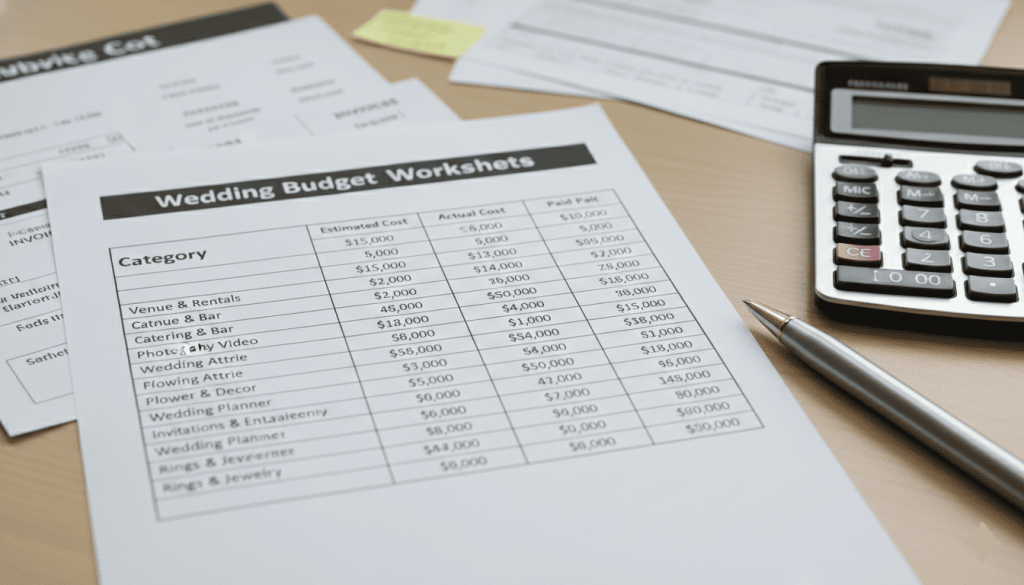
Here’s how I allocate a wedding budget for my couples. The table below uses a $34,000 budget as the worked example, since it’s close to the national average, but the percentages are what matter: slide them up or down to your own ceiling. Treat this as a starting frame, then shift dollars toward your one or two real priorities.
A wedding budget breakdown on a $34,000 budget
| Category | Share I allocate | On $34,000 |
|---|---|---|
| Reception (venue, catering, bar, rentals) | 47% | ~$16,000 |
| Photography & videography | 12% | ~$4,100 |
| Music & entertainment | 8% | ~$2,700 |
| Flowers & decor | 8% | ~$2,700 |
| Attire, hair & makeup | 7% | ~$2,400 |
| Planner or day-of coordinator | 6% | ~$2,000 |
| Stationery & postage | 2% | ~$680 |
| Cake & desserts | 2% | ~$680 |
| Transportation | 2% | ~$680 |
| Favors & gifts | 1% | ~$340 |
| Contingency buffer | 5% | ~$1,700 |
Percentages are my own planning framework. The $34,200 average, the ~$12,900 average venue, and the ~$2,900 average photographer figures come from The Knot 2026 Real Weddings Study. The honeymoon (averaging around $5,500) is usually budgeted separately from the wedding-day total.
The reception is roughly half your budget
The venue, catering, bar, and rentals are the heaviest cluster in every wedding I’ve planned, and the data agrees: 89% of couples book a venue and 85% hire a caterer, and together with the bar and rentals they swallow close to half the total. The average venue alone ran about $12,900 in 2025.
This is also where the per-guest math bites hardest, because catering and bar scale directly with headcount. If you’re feeling budget pressure, the reception is the first place to look, and the guest list is the dial. Our full guide to finding a wedding venue breaks down how to read a venue quote so you know what’s actually included before you sign.
Photography and video: the line that outlives the day
Photography is the one category where I tell couples to hold their ground. The flowers wilt, the cake gets eaten, the rentals go back. The photos are what you have in thirty years. About 88% of couples hire a photographer, and the average spend was around $2,900, though strong photographers in major markets price well above that.
Video is optional and roughly a third of couples add it. If your budget is tight, I’d fully fund the photographer first and treat video as the upgrade you make if money frees up elsewhere.
The line items almost everyone forgets
This is where budgets quietly blow up, because these costs aren’t on the splashy mood-board categories. The ones I see catch couples off guard, in order of how often they get missed:
- Alterations. The gown price is rarely the gown cost. Plan for alterations on top, sometimes several hundred dollars.
- Vendor tips and service charges. Gratuities and a catering service charge of 18 to 24% can add thousands you didn’t plan for.
- Overtime. If the dance floor’s still full at midnight, the photographer, band, and venue all bill for the extra time.
- Postage. Heavy or square invitations cost more to mail, and 117 guests adds up fast.
- Beauty trials, undergarments, and day-of essentials. Small on their own, real in aggregate.
When you pick your dress, the same rule applies. Budget the alterations and accessories alongside the gown, not after, which is exactly why my guide to choosing a wedding dress treats the total cost, not just the tag.
Etiquette note
Tipping isn’t mandatory, but it’s expected for many vendors and it belongs in your budget from day one, not as an afterthought the week of. A common range in the US: $50 to $100 per person for the photo and video team, $25 to $50 per musician, and $200 to $500 for a planner who went beyond the contract. Owners of their own business are often tipped less by convention, but a warm review and referral carries real weight.
How to plan a wedding on a budget without it showing
Planning a wedding on a budget isn’t about a hundred tiny sacrifices that leave the day feeling thin. It’s about a few large structural choices that move thousands at once, so the rest of the day can stay generous. Here’s where I send couples first.
Trim the guest list (your most powerful lever)
At about $292 a head, cutting 20 people from a 150-person list saves close to $5,800 across catering, bar, rentals, and seating. That’s a videographer, or a meaningful chunk of a honeymoon, freed up by one decision. A smaller wedding also tends to feel warmer, not lesser. Some of the most moving weddings I’ve planned had 45 guests.
Marry off-peak
Saturday in peak season is the most expensive slot on the calendar. A Friday, Sunday, or off-season date can drop venue and vendor pricing noticeably, and a brunch or early-afternoon wedding shortens the bar tab, which is often bigger than couples expect. If your date is flexible, this is the easiest money you’ll ever save.

Be strategic about DIY
DIY (do-it-yourself) saves money on the right things and costs you sanity on the wrong ones. Good candidates: favors, signage, and simple ceremony programs. Bad candidates: anything that has to happen flawlessly on a timeline you can’t control on the day, like florals for 15 tables. Spend your DIY energy where a mistake is invisible.
Where I tell couples NOT to cut
Here’s the counterintuitive part, and it’s the heart of how I budget. The percentage templates everyone copies online quietly assume a $34,000 wedding. Below about $20,000, those percentages break, because your fixed costs don’t shrink with your guest list. A photographer, an officiant, your dress, and the rings cost roughly the same whether you host 50 people or 150. So a $15,000 wedding is not a $34,000 wedding scaled down evenly across every line. It’s a wedding where the per-guest costs shrink hard and the fixed costs stay put, which means a smaller wedding spends a larger share on photography and attire, not a smaller one.
The practical takeaway: protect your one or two genuine priorities and cut everything else around them. The couples who regret their budget almost always cut the wrong line, the photographer or the coordinator, to save a guest list they were never willing to trim.
A budgeting tool that updates as you book beats a static spreadsheet every time. If you’d rather not build your own, a free planner with a budget tracker keeps your estimates and actuals side by side.
Start a free budget trackerWhat a $15K, $34K, and $60K wedding actually looks like
Numbers are easier to use when you can picture them. Here’s what each tier tends to mean in practice, drawn from real weddings I’ve planned and the spending brackets in The Knot’s data.
Around $15,000. A focused wedding, usually under 60 guests. Think a restaurant buyout or a park-and-tent combination, a single excellent photographer, a DJ instead of a band, and florals concentrated where guests actually look. Couples in the under-$15,000 bracket spent about $8,900 on average, so $15,000 is genuinely comfortable at a small headcount.
Around $34,000. The national average, typically 100 to 120 guests, a dedicated venue, full catering and bar, a strong photo team, and either a live band or a premium DJ. This is the tier where a day-of coordinator stops being a luxury and starts being the thing that lets you enjoy your own wedding.
Around $60,000 and up. A larger guest list or a higher cost-of-living market, often both. Live band, full floral design, video, premium bar, and frequently a full-service planner rather than day-of coordination. The top bracket in the data averaged around $70,300, so $60,000 sits squarely in real-wedding territory, not fantasy.
If you want to pressure-test your own number against your zip code and guest list, start with the average cost of a wedding by region and guest count before you set your ceiling.
Three budgeting mistakes I see every season
After 200-plus weddings, the same handful of budget missteps show up again and again. None of them are about being bad with money. They’re about doing the steps in the wrong order.
1. Setting the number after falling for a venue
The most expensive mistake on this list. Couples tour a stunning venue, fall hard, sign, and only then build a budget around a number they can’t really change. By then the venue has set the guest count, the season, and the catering minimum. Set your total first, then shop inside it. I’ve watched this one decision quietly add $10,000 to a budget more times than I can count.
2. Skipping the contingency buffer
Nearly half of couples find their initial budget falls short of what the wedding actually costs. That’s not bad planning, it’s the nature of an event with this many moving parts. A 5 to 10% buffer isn’t pessimism, it’s the line item that absorbs the alterations, the overtime, and the guest who RSVPs at the last minute. Build it in from the start and you’ll rarely touch it in a panic.
3. Treating the per-guest cost as fixed
Couples lock a guest list early, then try to cut their way to budget through small line items, when the headcount was the lever the whole time. Twenty fewer guests does more for your bottom line than skipping favors, downgrading the cake, and printing your own programs combined. Look at the list before you look at the extras.
Real planner tips for staying on budget
A few things I tell every couple, the kind of advice that doesn’t fit neatly into a category but saves the most stress.
I tell my couples to open a separate checking account for the wedding the week they get engaged. Every contribution and every deposit flows through it, which means you can see your real balance at a glance instead of hunting through a shared account. It also makes the family-contribution money feel earmarked rather than absorbed.
I always have couples track actuals against estimates as they book, not at the end. When the music came in $600 under what you budgeted, you can consciously move that money to the dress or the bar, instead of letting it leak into the general fund and disappear.
I push hard on reading the contract before the brochure. The service charge, the overtime rate, the cake-cutting fee, the corkage: those clauses decide your real cost far more than the headline package price. If a number isn’t in writing, it isn’t in your budget.
And I remind couples that the budget is allowed to change, as long as it changes on purpose. Reallocating is planning. Overspending is what happens when you stop looking. To put the whole picture together with the rest of your timeline, my complete guide to planning a wedding and the printable wedding planning checklist walk you through when each of these decisions should land.
Wedding budget questions I get asked the most
How much should I budget for a wedding?
Budget what you can actually fund: your savings, plus what you can save monthly until the date, plus any committed family contributions. The US average was $34,200 in 2025, but full weddings happen at every tier from under $10,000 to $70,000-plus. Your guest count and location matter far more than the national average.
What percentage of a wedding budget goes to the venue and food?
The reception cluster, meaning venue, catering, bar, and rentals, typically takes close to half of the total. The average venue alone ran about $12,900 in 2025. Because catering and bar scale with headcount, this is the cluster most affected by your guest list.
How can I have a wedding on a budget under $15,000?
Keep the guest list under about 60, choose a non-traditional or all-in venue like a restaurant or park, marry off-peak, and hire selectively. Couples in the under-$15,000 bracket spent about $8,900 on average, so $15,000 leaves real room when the headcount stays small.
What costs do couples forget to budget for?
The usual culprits are alterations, vendor tips and the catering service charge, overtime, invitation postage, and beauty trials. Together they can add thousands. A 5 to 10% contingency buffer is the single best protection, since nearly half of couples find their first budget comes up short.
Who pays for the wedding these days?
The old rule that the bride’s family covers everything is mostly gone. Today most couples self-fund a large share while families contribute where they can. The key is to get specific early: ask any contributor whether they want to fund a set dollar amount or a specific item, so nothing is left to assumption.
How far in advance should I set my wedding budget?
Before you tour a single venue. The venue sets your guest count, season, and catering minimum, so signing one before you have a number is how budgets run away. Settle your total, contributions, and guest range first, then shop inside that ceiling.
Keep planning with confidence
A wedding budget done right is boring in the best way: you set the number early, you protect the two things you care about, you hold a buffer, and you stop reacting to every shiny upgrade. Do that, and the money stops being the thing you dread and becomes the quiet structure that lets the day feel like you. If you want the next piece of the puzzle, walk through the full month-by-month wedding planning timeline so your budget and your calendar move together.
Related reads
Sources
- The Knot 2026 Real Weddings Study. theknotww.com
- The Knot — The Average Cost of a Wedding: A Full Breakdown. theknot.com
- The Knot — Wedding Budget Breakdown, Based on Real Couples’ Data. theknot.com
- The Knot — The Average Wedding Venue Cost. theknot.com
- Charles Schwab — How to Make a Wedding Budget. schwab.com
— Madison Cole, Certified Wedding Planner
This article contains affiliate links. If you make a purchase or sign up through these links, we may earn a small commission at no additional cost to you. I only recommend products and services I’d put in front of my own couples, and affiliate relationships never decide which tools I feature. For more, see our full affiliate disclosure and editorial policy.