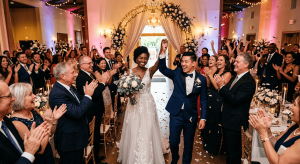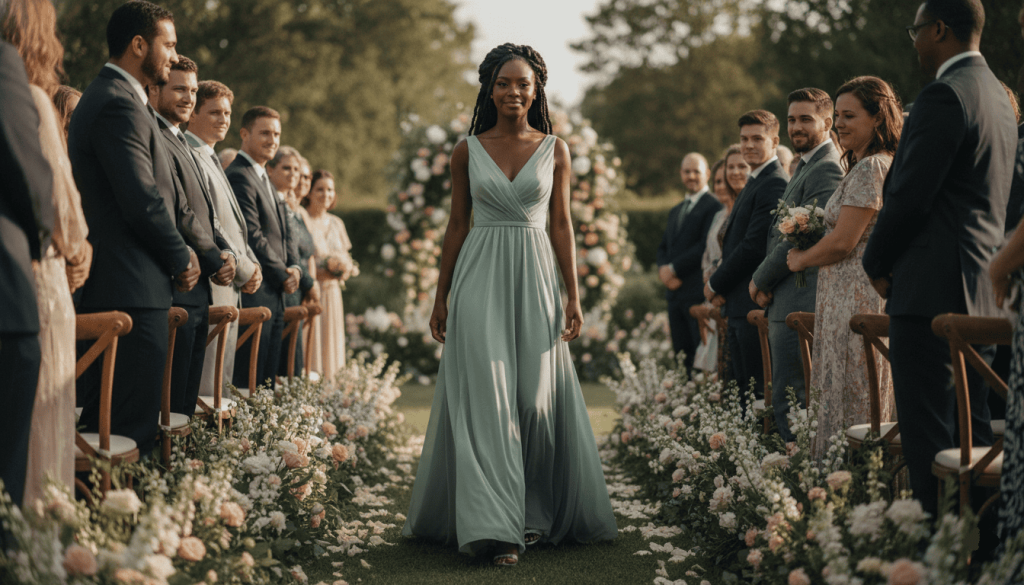
The short version: the officiant walks down the aisle first in a traditional ceremony, though plenty of officiants are simply standing at the altar before anyone moves. After more than 200 weddings, I can tell you the processional trips couples up more than almost any other piece of the ceremony. Here’s the order I hand my couples at the rehearsal, plus how it shifts by faith and by style.
Quick answer
In a traditional ceremony, the officiant walks down the aisle first, or is already standing at the altar before anyone walks. The groom and best man follow, then grandparents, then parents, with the mother of the bride seated last to signal that the wedding party is about to enter. The bride always walks last.
The short answer: officiant first, bride last
If you want the textbook order, the officiant goes first. They walk in, take their place at the altar, and that’s the signal for the music and the rest of the lineup to follow. The Knot frames it the same way in its traditional processional guide.
Here’s the honest caveat I give every couple: in real ceremonies, the officiant is very often already up front when guests sit down, and so is the groom. In that setup, nobody watches the officiant “walk” at all. The processional you actually see usually opens with grandparents or a parent. Both versions are correct, so pick the one that matches your space and your nerves.
The one fixed point in all of this: the bride walks last. Everything in the lineup builds toward her entrance, which is almost always timed to a change in music.
The traditional wedding processional order, step by step
This is the Christian and non-denominational order most American couples start from. Use it as your baseline, then adjust for your family and your faith.
The traditional processional order, in line
The officiant
Leads the processional or, just as often, is already in place at the altar before anyone walks.
The groom and best man
Walk in together and take their spot at the altar, or enter quietly from the side. Some grooms walk in escorted by both parents.
Grandparents
The groom’s grandparents go first, the bride’s follow. They take seats in the front rows.
Parents of the groom
Walk in together and take the front-right seats, from the guests’ point of view.
Mother of the bride
The last person seated. Her entrance is the cue that the formal processional is about to begin.
Bridesmaids and groomsmen
Enter in pairs or one at a time. The ones who will stand farthest from the couple walk first.
Maid of Honor
Walks last among the wedding party, so she ends up standing closest to the bride.
Ring bearer and flower girl
The final pair before the bride, and usually the crowd favorite.
The bride
Walks last, escorted by her father, both parents, another loved one, or on her own.
One spot that confuses couples is the best man. In the version above, he stands up front with the groom from the start, and only the Maid of Honor (MOH) walks at the honor-attendant slot. In the other common version, the groom enters from the side, the best man walks in last with the groomsmen, and the MOH walks last with the bridesmaids. Both are fine. Decide it at the rehearsal so nobody freezes at the back of the aisle.
How the processional order changes by religion and culture
The lineup above is a starting point, not a rule. Faith and family tradition reshape it, and the differences are worth knowing before you sketch your own order.
Catholic ceremonies
For a Catholic wedding, the priest, groom, and best man usually enter from the side and take their places at the altar. The wedding party then walks in pairs, with men on the right and women on the left, and the bride enters last with her father. Talk to your priest early, because some churches have rules about music and readings that affect timing. The Knot covers the Catholic specifics in its processional guide.
Jewish ceremonies
A Jewish processional looks meaningfully different. The rabbi or cantor typically leads, and then both sets of parents escort their child down the aisle to the chuppah, the canopy that stands for the home the couple is building. Both the groom and the bride are walked in by their parents, who stand under the chuppah rather than sit. In some traditions, the bride circles the groom seven times once she arrives.
Modern, secular, and same-sex ceremonies
If you are not tied to a religious script, you have real freedom. I have run ceremonies where each partner had their own processional from opposite sides, where both partners walked in together, and where the wedding party entered as one mixed group with no gender split at all. For LGBTQ+ couples especially, there is no default to fall back on, which I see as a gift rather than a gap. Escort whoever raised you, walk with the person you want beside you, and let the order say something about your two families joining.
What really happens before the music starts
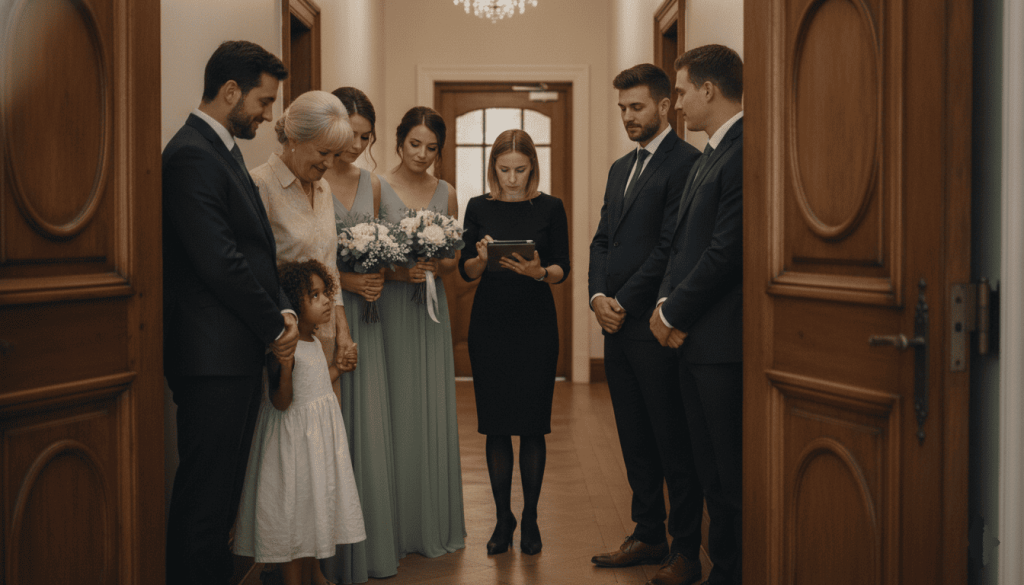
Here is the part most guides skip. By the time the processional music plays, a lot of people are already seated. Seating the grandparents and parents is its own quiet sequence that happens first, and it sets the tone for everything after.
Madison’s note
“On paper, the officiant walks first. In practice, at most of the weddings I run, the officiant and groom are already up front and the grandparents and parents are seated before the processional music even starts. So the first person your guests actually watch walk the aisle is usually a grandmother, not the officiant.”
— Madison Cole, Certified Wedding Planner
My one piece of rehearsal advice: leave three to five seconds of space between each person walking. Couples always bunch up because nerves make us walk fast, and a clumped processional reads as rushed in photos and on video. Slow spacing also gives your photographer a clean frame for every face. If you want a sense of how the whole ceremony fits together around this moment, I walk through it in my guide to how long a wedding ceremony actually runs.
A quick etiquette rule that settles most arguments
When families start debating the order, I point them to one principle that quietly governs the whole lineup.
Etiquette note
The people who stand closest to the couple walk last. That is why the mother of the bride is the final parent seated, and the Maid of Honor is the last attendant down the aisle, right before the flower girl and ring bearer. Classic Emily Post etiquette builds the lineup around closeness to the couple, not around who is most important, which is a useful thing to remember when feelings get involved.
That rule also explains where to slot a Mother of the Groom (MOG), a stepparent, or a child from a previous relationship. Ask who should be standing near you when you say your vows, and order the walk backward from there. For more on how the honor roles line up, see my breakdown of the difference between a matron of honor and a maid of honor, and the full mother of the bride guide if hers is the seat causing debate.
Frequently asked questions
Does the officiant walk down the aisle first?
Traditionally, yes. The officiant leads the processional and takes their place at the altar to start the ceremony. In a lot of real weddings, though, the officiant is already standing up front before guests are seated, so they never visibly walk at all. Both setups are correct.
Who walks down the aisle last?
The bride, almost without exception. Her entrance is the high point of the processional and is usually timed to a change in music. In ceremonies with two brides or two grooms, one partner may enter last, or both may walk in together at the end.
Who walks the bride down the aisle if her father isn’t there?
Anyone she chooses. Her mother, a grandparent, a sibling, a close friend, or both parents together are all common and entirely appropriate. Walking alone is a beautiful option too. The Emily Post Institute is clear that the decision is the bride’s, based on who makes her feel supported.
Do the groom’s parents walk down the aisle?
Yes. In the traditional order, the groom’s parents walk in together and take the front-right seats before the bride’s mother is seated. Alternatively, both parents can escort the groom down the aisle, which is common in Jewish ceremonies and increasingly popular in secular ones.
If you remember nothing else, hold onto this: officiant first or already in place, bride last, and everyone in between ordered by how close they will stand to you at the altar. Sort the rest at your rehearsal, where you can actually walk it, and it stops being abstract. For the bigger picture of how this slots into your schedule, my month-by-month wedding timeline shows where the ceremony details land.
Sources
- The Knot, traditional wedding processional order by culture and religion. theknot.com
- The Emily Post Institute, wedding ceremony aisle walk etiquette and who escorts the bride. emilypost.com
Written by Madison Cole, Certified Wedding Planner