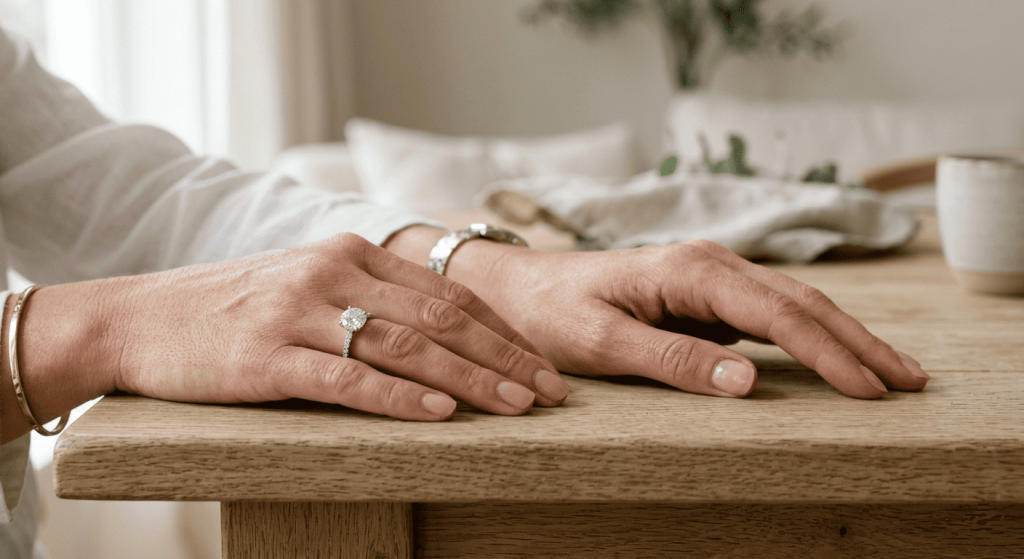
If you just got engaged, here’s the quick version: in the US, your engagement ring goes on the fourth finger of your left hand, the one we call the ring finger. I’ve planned more than 200 weddings, and this is one of the first questions a newly engaged bride texts me about. The honest answer is that the “rule” is really a tradition, and it changes depending on where you are in the world.
The short answer
In the US, an engagement ring goes on the fourth finger of your left hand, the one most people call the ring finger. The custom traces back to the Roman belief in a vein running from that finger straight to the heart. In some countries the ring sits on the right hand instead, so there’s no single rule that holds everywhere.
The short answer, a little fuller
In the United States, Canada, the UK, Australia, and most of Western Europe, the engagement ring goes on the left hand, fourth finger. Count from your thumb: thumb, index, middle, and the fourth is your ring finger. That’s the one.
It’s worth saying plainly: this is custom, not law. Nobody is going to stop you at the door of your own wedding for wearing your ring somewhere else. But because nearly everyone around you reads the left ring finger as the engagement spot, that placement does a quiet job for you, signaling that you’re engaged without you having to say a word.
Why the left ring finger?
The tradition is older than you’d guess. The ancient Egyptians exchanged rings of woven reeds, and the Romans later formalized the idea, believing a vein ran directly from the fourth finger of the left hand to the heart. They called it the vena amoris, the “vein of love.”
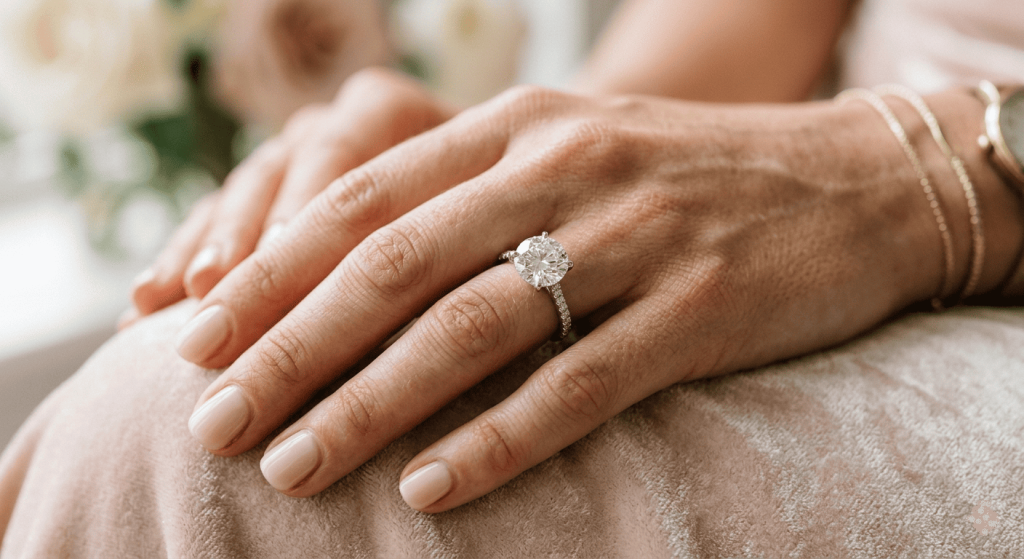
Anatomy eventually proved there’s no special vein there, but the symbolism stuck for thousands of years, carried through European custom and reinforced by Christian wedding traditions. So when someone tells you the left ring finger connects to your heart, they’re repeating a beautiful idea that’s romantic rather than medical, and that’s perfectly fine. The meaning is real even if the vein isn’t.
Madison’s note
“For the ceremony itself, I tell my brides to move the engagement ring to the right hand or hand it to the maid of honor beforehand. That keeps the left ring finger clear so the officiant can slide the wedding band on first, closest to the heart. You stack the engagement ring back on top once you’re married. I’ve watched a ring get fumbled mid-vows more than once, so plan the handoff in advance.”
— Madison Cole, Certified Wedding Planner
What hand around the world
The left hand isn’t universal. If you’re planning a wedding with family overseas, or you grew up with a different custom, the “correct” hand shifts. Here’s the broad map I keep in my head.
Around the world
Left hand: the US, UK, Canada, Australia, France, Ireland, and Mexico wear the engagement ring on the left ring finger. Right hand: Germany, India, Spain, Switzerland, and parts of Central and Eastern Europe traditionally favor the right. In some of these places the ring starts on one hand and moves to the other after the wedding ceremony, so the hand can change as your marriage does.
None of this is rigid. Couples blend customs all the time, especially in cross-cultural weddings, and plenty of people simply wear the ring on whichever hand feels right to them. If your tradition says right and your fiancé’s says left, you get to choose together. There’s no wrong answer here, only the one that means the most to the two of you.
Engagement ring and wedding band: same finger?
Yes. The engagement ring and the wedding band share a finger, which is why people who wear their engagement ring on the left also wear the band there. After the wedding, most brides stack the two, with the wedding band sitting below the engagement ring, closer to the heart, and the engagement ring riding on top.
If you’re still sorting out which piece is which and how they pair, I break it down in my guide to the difference between an engagement ring and a wedding ring. And if you want the full story on the band specifically, here’s which finger a wedding ring goes on. The short version is that both live on the same finger, just layered in a particular order.
A few practical things I tell my brides
Get your ring sized properly before you start wearing it everywhere. Fingers swell in heat and shrink in cold, and a ring that’s loose in January can feel snug by July. I’ve seen a bride lose a stunning solitaire in the ocean on her honeymoon because the band was a touch too big. If yours spins or slides, get it adjusted.
If you work with your hands, cook a lot, or hit the gym daily, it’s completely normal to take the ring off for those stretches and keep it on the left ring finger the rest of the time. Wearing it less doesn’t make your engagement count for less. And if you received a ring before a formal proposal or as a placeholder, the same finger logic still applies, much like a promise ring, which often sits on the left ring finger too until an engagement ring takes its place.

Frequently asked questions
Which finger is the engagement ring finger?
It’s the fourth finger, counting from the thumb. In the US and most Western countries that’s the fourth finger of the left hand, commonly called the ring finger. The choice comes from the old Roman belief that a vein ran from that finger to the heart.
Do you wear the engagement ring above or below the wedding band?
Most brides wear the wedding band below the engagement ring, closer to the heart, with the engagement ring stacked on top. That’s why the band goes on first during the ceremony. It’s a custom, though, not a rule, so stack them in whatever order feels comfortable to you.
Can you wear your engagement ring on your right hand?
Absolutely. In countries like Germany, Spain, and India the right hand is the traditional choice, and many people switch hands for comfort, work, or personal preference. The left ring finger is the US default, but it’s a convention, not a requirement.
What hand does a man’s wedding ring go on?
In the US, a man’s wedding ring goes on the left ring finger, the same finger as a bride’s. Men don’t traditionally wear an engagement ring, so the wedding band is usually the only ring exchanged, and it follows the same left-hand custom.
The bottom line
For almost anyone reading this in the US, your engagement ring goes on the fourth finger of your left hand, and your wedding band will join it there. Beyond that, the “right” hand is whatever fits your traditions, your family, and your comfort. If you’re still in the early glow of it all, my roundup of proposal ideas is a fun place to dream a little before the planning begins.
— Madison Cole, Certified Wedding Planner