The average engagement ring in the US costs about $4,600 today, according to The Knot’s most recent survey of more than 10,000 married couples. After helping plan over 200 weddings, I can tell you that number surprises people in both directions. Some expected to spend twice as much. Others assumed a “real” ring started at $10,000. Neither is true. What you actually pay comes down to a handful of choices, and most of them are yours to make. Below I break down where the money goes, how lab-grown stones have pulled the average down, and the budget I’d suggest if you were one of my couples sitting across the table from me.
Quick answer
The average engagement ring in the US runs about $4,600, based on The Knot’s most recent survey of more than 10,000 couples married in 2025. That figure has dropped from $5,200 a year earlier and around $6,000 in 2021, mostly because 61% of couples now choose a lab-grown center stone. About a third of buyers spend under $3,000.
The short answer: about $4,600 for the average ring
The $4,600 figure comes from The Knot’s annual study of couples who married in 2025, and it reflects what proposers actually spent, not what jewelers suggest you should. A year earlier the average was $5,200; in 2021 it sat closer to $6,000. The line has been sliding down for one main reason, and I’ll get to it in a minute: lab-grown diamonds.
That average folds in everything from a $1,000 plain solitaire to a $20,000 custom piece, which is why I never treat it as a target. About a third of buyers spend under $3,000, and roughly two-thirds come in below $6,000. The average is a midpoint, not a finish line.
When a newly engaged couple asks me what’s “normal,” I tell them the honest range I see on my brides’ hands: most rings fall between $2,000 and $8,000, and the ones that get the most compliments are rarely the most expensive. If you want the longer view of where a ring sits in your overall spending, my breakdown of how much a wedding costs puts the number in context.
What actually drives the price of an engagement ring
An engagement ring has four cost buckets, and they’re wildly uneven. The center stone usually eats 60 to 80% of the total, which is why your stone choice matters more than anything else. With a natural diamond, the price tracks the four Cs graded by the GIA: cut, color, clarity, and carat. A one-carat natural diamond can run anywhere from $2,000 to $16,000 depending on those grades alone.
The metal band is the next line item, then the setting and labor (a plain solitaire is the cheapest mount; halo and pavé designs add small stones and bench time), and finally minor finishing like sizing and engraving. This is the proposal ring specifically; if you’re trying to sort out how it relates to the band you exchange at the altar, see my guide to the difference between an engagement ring and a wedding ring.
Where the money goes in an engagement ring
| Component | Typical cost | Share of the ring | Notes |
|---|---|---|---|
| Center stone | $850 to $10,000+ | 60 to 80% | Biggest single cost; a lab-grown diamond runs 50 to 70% less than a comparable natural one |
| Metal band | $500 to $2,500 | 15 to 30% | Platinum is priciest; 14k or 18k gold costs less |
| Setting and labor | $300 to $1,500 | 10 to 20% | A plain solitaire is cheapest; halo and pavé designs add stones and bench time |
| Sizing and finishing | $50 to $150 | Small | Resizing and engraving; often bundled into the purchase |
Ranges reflect typical US pricing as of June 2026. Stone and metal figures from The Knot and Synchrony.
How the price swings: stone type, metal, and where you live
The averages above hide a lot of range. The same $4,600 buys a tiny natural solitaire or a showy two-carat lab-grown halo. Here are the four levers that move the number most.
Lab-grown vs natural diamonds
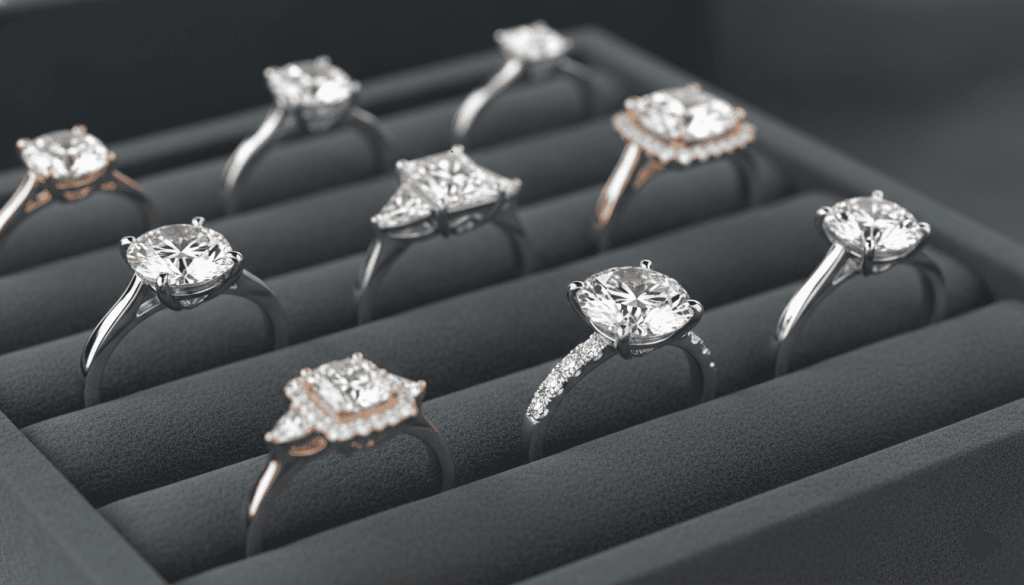
This is the single biggest lever, and it’s why the average keeps falling. Lab-grown diamonds are chemically identical to mined ones but cost a fraction of the price. In early 2025, a round one-carat lab-grown diamond averaged about $845, while a comparable natural stone ran roughly $3,895, according to industry analyst Paul Zimnisky. Couples have noticed: 61% now pick a lab-grown center stone, up from 12% in 2019. Many use the savings to size up, which is how the average carat weight has crept to 1.9 carats even as spending drops.
Did you know
Lab-grown center stones now account for 61% of all engagement ring purchases, up from just 12% in 2019. A round one-carat lab-grown diamond averaged about $845 in early 2025, versus roughly $3,895 for a comparable natural stone. Sources: The Knot Real Weddings Study; Paul Zimnisky via CNBC.
Non-diamond center stones
If a diamond isn’t a must, the price floor drops sharply. Moissanite, a lab-created stone with diamond-like sparkle, runs about $400 to $1,500 for a one-carat center. Sapphires are the most popular colored alternative I see, and they pair beautifully with both gold and platinum. These aren’t “budget” choices so much as different ones. I’ve planned weddings where the sapphire ring got more attention than any diamond in the room.
Metal and setting
The band quietly shapes your total. A platinum band runs about $1,000 to $2,500 on its own, while 14k or 18k gold lands closer to $500 to $2,000. Yellow gold has come roaring back, chosen by 39% of couples last year. The setting matters too: a solitaire is the most affordable mount, and every extra accent stone adds up. Whichever metal you pick, it’s worth matching it to the band you’ll stack later, and knowing which finger each ring goes on before you size anything. If you’re weighing finishes, my comparison of white gold vs silver covers durability, not just looks.
Where you live
Region nudges the number more than people expect. Couples in the Mid-Atlantic tend to spend more, averaging around $6,900, while buyers in much of the Midwest and rural states come in well under the national figure. None of that should set your budget, but it explains why the “average” your friends quote may not match what you see locally.
What I tell couples about setting a ring budget
The data is useful, but it doesn’t decide anything for you. Here’s the advice I give my couples when the ring conversation comes up, usually months before anyone’s looking at how to actually propose.
- Pick a number before you shop. Walking into a jeweler without a ceiling is how budgets blow up. Decide the most you can spend without touching the wedding fund or your savings cushion.
- Buy the stone you can grade, not the one you can brag about. A well-cut $4,000 lab-grown diamond outshines a poorly cut $9,000 natural one in person.
- Prioritize cut over carat. Cut is what makes a stone sparkle. A smaller, brilliant diamond reads bigger than a dull larger one.
- Ask your partner before you assume. Most people being proposed to have some input on the ring now, and the proposal can still be a surprise.
- Skip the “salary rule” entirely. More on that below, but it has no bearing on what you should spend.
Madison’s note
“The couples I see with the fewest regrets pick a number first, then shop. Treat it as the ceiling, not the goal, and protect the wedding budget and your savings before anything else. In nine years of planning, I have never once heard a bride say she wished her partner had spent more on the ring.”
— Madison Cole, Certified Wedding Planner
The “months’ salary” rule, and why I tell couples to skip it
If you’ve heard you should spend two or three months’ salary on a ring, know that it isn’t a financial principle. It’s an advertising slogan. De Beers hired an ad agency in the late 1930s to sell more diamonds during the Depression, first suggesting one month’s salary, then doubling it to two months by the 1980s (“How else could two months’ salary last forever?”). The number was designed to feel significant and to scale with any income. It was never tied to what a couple could actually afford.
Here’s the part most cost guides skip: the rule didn’t just inflate spending, it reframed the ring as a test of devotion. That framing still makes good people anxious about a purchase that should feel joyful. The Knot now flatly advises couples to disregard the three-month guideline, and I agree. Your budget is a personal call based on your finances and your partner’s taste, full stop. For the bigger financial picture, my walkthrough on how to budget for a wedding is the better place to anchor your numbers.
Where these numbers come from
The headline averages here come from The Knot’s Real Weddings Study, which surveys tens of thousands of recently married US couples each year and is the most-cited source in the industry. Stone-by-stone pricing draws on data from diamond analyst Paul Zimnisky (via CNBC) and from Synchrony’s jewelry pricing breakdowns, with diamond grading framed around the GIA’s four Cs. Methodologies differ, so you’ll see slightly different averages depending on who’s counting and which couples answered. I’ve leaned on the largest, most transparent surveys and flagged the figures that are estimates rather than hard counts.
Frequently asked questions
How much should I spend on an engagement ring?
Spend what you can comfortably afford without dipping into your wedding fund or emergency savings. The US average is about $4,600, and roughly a third of buyers spend under $3,000. There is no rule that ties the figure to your salary, despite what older guides claim.
Is $5,000 a good budget for an engagement ring?
Yes. At $5,000 you’re right around the national average, and with a lab-grown center stone that budget can buy a one- to two-carat ring in a quality setting. The same amount in a natural diamond buys a smaller stone but the same craftsmanship.
How much does a 1-carat engagement ring cost?
It depends entirely on the stone. A one-carat natural diamond ranges from about $2,000 to $16,000 based on its cut, color, and clarity. A one-carat lab-grown diamond often starts under $1,000 for the stone, plus the band and setting.
Are lab-grown diamonds cheaper than natural ones?
Significantly. A lab-grown diamond typically costs 50 to 70% less than a natural diamond of the same size and quality, and the two are chemically identical. That price gap is why 61% of couples now choose lab-grown center stones.
Sources
- The Knot Real Weddings Study, average engagement ring cost. theknot.com
- CNBC, lab-grown vs natural diamond pricing (Paul Zimnisky data). cnbc.com
- Synchrony, average engagement ring cost by stone and metal. synchrony.com
- American Express, how much to spend and regional averages. americanexpress.com
- GIA, the 4 Cs of diamond quality. 4cs.gia.edu
— Madison Cole, Certified Wedding Planner