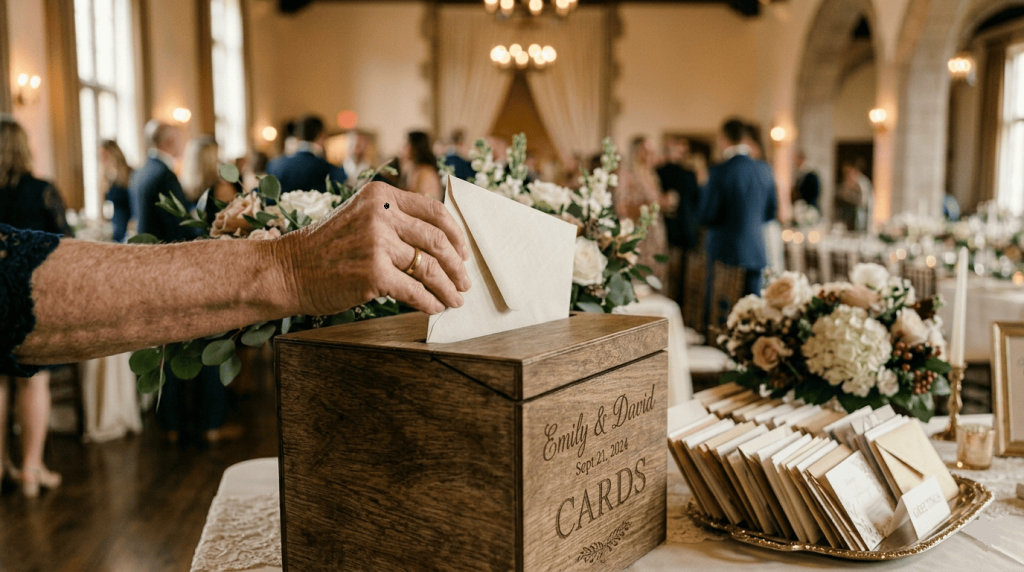
The average wedding guest gave $150 in 2024, according to The Knot’s most recent Guest Study, and that number has held steady for two years running. But the honest answer to how much cash to give at a wedding is that $150 is a starting line, not a rule. After planning more than 200 weddings out of Charleston, I’ve watched couples open envelopes holding everything from a $25 bill to a $1,000 check, and almost none of it tracked to some secret etiquette code. It tracked to three things: how close you are to the couple, what your budget actually allows, and how much you’ve already spent to be there. Here’s exactly what I tell my guests when they ask me this in a quiet panic the week before the wedding.
Quick answer
Most US wedding guests give between $100 and $150 in cash, with the 2024 national average landing at $150 (The Knot Guest Study). Scale it to your relationship: $50 to $100 for a coworker or casual friend, $100 to $150 for a close friend, and $150 to $250 for close family. Give what fits your budget, not what “covers your plate.”
The short answer: $150 is the national average, but your relationship sets the real number
That $150 average comes from The Knot’s 2024 Guest Study, which surveys thousands of real US wedding guests every year. It was the same figure in 2023, so it’s about as stable a benchmark as wedding numbers get. Treat it the way I do with my couples: as the middle of the road, not the finish line you’re graded against.
Cash is now the mainstream choice, not the awkward one. The Knot found that 40% of guests gave cash in 2024, with about 50% giving a physical gift and the rest choosing gift cards. So if you’re worried that handing over an envelope reads as lazy, it doesn’t. A check or a contribution to a couple’s cash fund is as warmly received today as a boxed blender, and plenty of couples quietly prefer it.
One number that should shape your decision is what it costs you just to show up. Fidelity reports that guests spent roughly $610 on average to attend a wedding in 2024 once you fold in travel, attire, and the gift itself. The more you’re spending to be in the room, the more reasonable it is to keep the gift modest. Nobody worth celebrating wants you in debt over their reception.
What to give based on your relationship to the couple
This is the variable that does the heavy lifting. The closer your tie to the couple, the higher the expectation, and the data backs that up cleanly. Here’s how the standard ranges break down, pulled from The Knot’s Guest Study and the etiquette experts I trust.
Coworkers and acquaintances: $50 to $100
For a coworker or a casual acquaintance, The Knot puts the sweet spot at $50 to $100. If you’ve sat next to them for years, lean toward the top of that band. If it’s a polite plus-one-of-a-plus-one situation where you barely know the couple, $50 is genuinely fine and no one is counting.
Friends: $75 to $150
A solid friend generally lands between $75 and $150, with $100 to $150 being the comfortable middle for someone you actually spend time with. This is the range that hugs the national average, so if you want a number that will never look off, this is it.

Close family and the wedding party: $150 to $250
For close family (siblings, aunts and uncles, grandparents) and for members of the wedding party, the expectation climbs to $150 to $250. The Knot’s data shows guests giving close friends and family an average near $160, and wedding party members gave about the same. If you’re standing up at the altar, factor in that you’ve likely already spent on the shower and the bachelorette, which legitimately counts toward your total contribution.| Your relationship | Typical cash gift | Good to know |
|---|---|---|
| Coworker or acquaintance | $50–$100 | Lean to $100 if you’ve worked together more than a year |
| Casual friend | $75–$100 | Solo-guest territory; sits just under the average |
| Close friend | $100–$150 | Right around the $150 national average |
| Close family (sibling, aunt, grandparent) | $150–$250 | The Knot puts close family near a $160 average |
| Wedding party member | $150+ | Count what you already spent on the shower and bachelorette |
| Attending with a plus-one | Roughly double your solo number | Two guests, two meals, one envelope |
What actually moves the number up or down
Relationship sets the baseline, but four other factors push the final figure around more than people expect. I walk every guest who asks me through these before they write the check.
Where the wedding is. Geography matters. A wedding in a high-cost city like New York or San Francisco tends to carry a higher unspoken expectation than a hometown wedding in a lower-cost region. It’s not a hard rule, but if you’re local to an expensive market and close to the couple, the top of your range is the safer read.
Whether you’re attending solo or with a date. If you bring a plus-one, the couple is feeding and seating two of you, so a single gift that roughly doubles your solo number is the courteous move. WeddingWire pegs a solo guest around $50 to $75 and a couple closer to $150, which lines up with what I see at the receptions I run.
What you’ve already spent on them. This is the one most guests forget. If you flew in for the bachelorette, bought a shower gift, and chipped in on the group present, all of that is part of your generosity. A close friend who already dropped $400 across the wedding season is not obligated to put $250 cash in the card on top. Add it up honestly and give what completes a number you feel good about.
How much it cost you to get there. Destination weddings flip the math. When travel and a hotel run you several hundred dollars, a smaller gift is not just acceptable, it’s expected by any couple with their head on straight. Your presence is the present when getting there is the expensive part.
Madison’s note
“At a Charleston wedding last fall, my couple opened about 60 cards the morning after. The most thoughtful gift in the pile was $75 from a college friend who’d driven nine hours and slept on someone’s couch to be there. The couple remembered the drive, not the dollar figure. Give within your means and stop second-guessing it.”
— Madison Cole, Certified Wedding Planner
Is the “cover your plate” rule still a thing?
You’ve probably heard the old line that your gift should at least cover the cost of your plate at the reception. I’m going to be blunt about this one, because it’s the rule that causes the most guest anxiety: it’s outdated, and the etiquette world has moved on from it.
The The Knot and the Emily Post Institute both treat “cover your plate” as a formula past its prime. The logic is simple: the couple chose to host the reception, and the catering bill is their responsibility, not an invoice they’re quietly handing you. Your gift is an expression of joy for them, not reimbursement for your chicken or fish.
For context, The Knot’s 2025 Weddings Study put the couple’s cost per guest at around $284. If you ran with the cover-your-plate rule at a wedding like that, you’d feel pressured to hand over nearly $300 per person, which is well above what etiquette actually asks. Let the couple’s budget be the couple’s business. Anchor your gift to your relationship and your means instead.
How to give cash without it feeling awkward
Once you’ve landed on a number, the delivery is easy. A few practical notes from the gift tables I’ve watched fill up over the years.
- A check is the safest vehicle. Tuck it inside a card and you’ve got a paper trail if it goes missing, which the occasional envelope does at a busy reception. Make it out to one partner if you’re unsure of a new shared last name.
- A cash fund counts as cash. If the couple has a honeymoon or cash fund on their registry through a platform like Zola or The Knot, contributing there is exactly the same as handing over an envelope, minus the risk of it walking off the gift table.
- Timing is generous, not strict. You can send a gift up to about two weeks before the wedding so it doesn’t get lost in the shuffle, bring it on the day, or send it within two to three months after. Couples are not clock-watching the mail.
- Can’t make it? Still send something. If you were invited but can’t attend, a smaller gift is still the warm move: roughly $25 for a coworker, $50 for a friend, and $100 or more for close family.
Common questions about wedding cash gifts
Is $100 enough for a wedding gift?
Yes. It sits just below the $150 national average, but it’s a perfectly appropriate gift for a friend or coworker. The right amount depends on your relationship and what you can comfortably afford, not on hitting an exact figure.
How much should I give if I can’t attend the wedding?
A smaller gift is still appropriate if you were invited. A common guideline is around $25 for a coworker, $50 for a friend, and $100 or more for close family. Send it within a couple of months of the wedding and include a warm note.
Should I give cash or buy from the registry?
Either is correct, so follow the couple’s lead and your own preference. Cash and cash funds are now mainstream, with about 40% of guests giving money in 2024. If the couple built a detailed registry, picking something from it is just as thoughtful.
How much do my partner and I give as a couple?
Plan on roughly double what one person would give, since the couple is hosting both of you. For most pairs attending a friend’s wedding, that lands somewhere around $150 to $250 in a single envelope.
Do I still give a gift if there’s a cash fund?
Yes. A cash fund is simply how the couple prefers to receive your gift, not a request for something extra. Contribute the same amount you’d otherwise put in a card, and you’re done.
The last thing I tell every guest
The figure that actually matters is the one you can write without wincing. I’ve never once heard a couple replay the dollar amounts after the honeymoon, but I’ve heard plenty of them talk about who showed up, who danced, and who drove through the night to be there. If you want the deeper math on registry versus cash and a few more relationship scenarios, you can read my full guide to how much to give for a wedding gift. And if you’re still pulling your outfit together, my notes on whether you can wear black to a wedding and the broader question of what a wedding actually costs the couple will round out the picture. Heading to the shower too? Here are my favorite bridal shower gifts to pair with whatever you decide for the big day.
— Madison Cole, Certified Wedding Planner
Sources
- The Knot 2024 Guest Study — How Much to Spend on a Wedding Gift. theknot.com
- Fidelity — How Much to Give at a Wedding. fidelity.com
- U.S. News — How Much Money Should You Give for a Wedding Gift? money.usnews.com
- WeddingWire — How Much Money to Give as a Wedding Gift. weddingwire.com
- Emily Post Institute — Wedding Gift Etiquette. emilypost.com