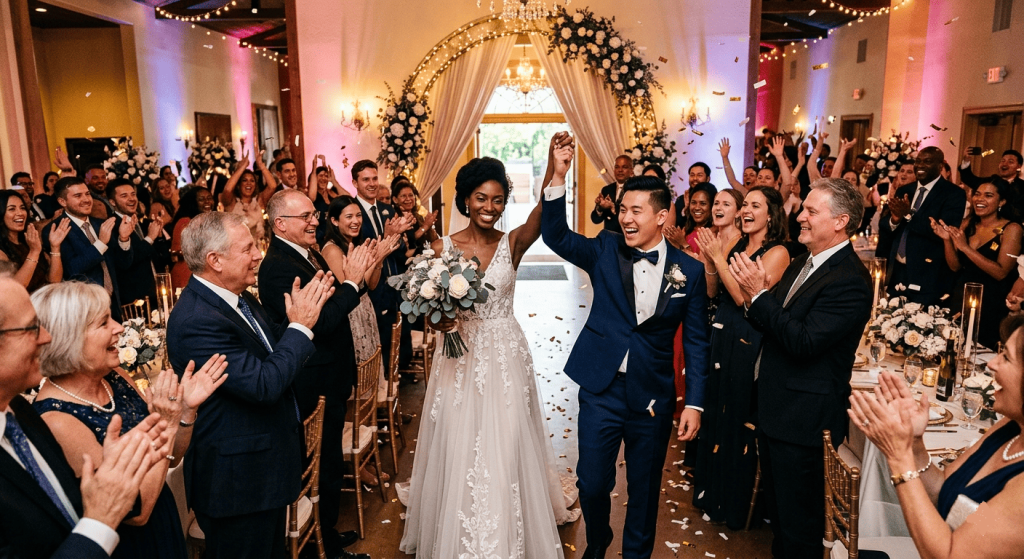
A grand entrance is the moment you and your new spouse are formally announced into your reception, usually with your wedding party walking in ahead of you. The DJ or emcee says your names, the music comes up, your guests cheer, and the party officially starts. I’ve run this moment at well over a hundred receptions, and here’s everything that actually goes into making it land.
Quick answer
A grand entrance — also called a grand march — is when the newlyweds, and often the wedding party, are formally introduced as they walk into the reception while guests are seated. A DJ or emcee announces each person, music plays, and the couple’s entrance signals that dinner and dancing are about to begin.
The short answer: what a grand entrance really is
Your grand entrance is the bridge from the ceremony and cocktail hour into the reception itself. Most couples step away for photos during cocktail hour, so this is often the first time many guests see you as a married couple in the reception room. The announcement turns a quiet, seated room into a celebration in about ninety seconds.
You’ll hear it called a grand march too. That’s just the older term for the same event, and plenty of DJs and family members still use it. In a few regions, “grand march” can also mean a led group procession around the floor, but for your reception, treat the two names as the same thing.
One thing worth saying up front: this is a tradition, not a rule. The Knot’s reception timeline points out that you can do a full wedding-party entrance, a couple’s entrance only, or skip the announcement altogether. None of those choices is wrong.
When the grand entrance happens in your reception timeline
The grand entrance lands right after cocktail hour, once guests have moved into the reception space and found their seats, and just before either dinner service or your first dance.
The sequence I run most often looks like this: cocktail hour wraps, the DJ invites everyone to sit, the wedding party lines up outside the doors in order, and then the introductions begin. Timing matters more than couples expect. A half-empty room kills the entrance: if guests are still drifting to their tables, the cheering falls flat and the energy never builds.
If you want to see exactly where this slots into the rest of the day, I map the full evening in my month-by-month wedding planning timeline.
The grand entrance order: who walks in and when
There’s a standard grand entrance order, and it mirrors your ceremony processional. Everyone is introduced in pairs, building toward the newlyweds, who always go last. Here’s the order I set up at most receptions:
- Grandparents, if you’re including them (often seated already and introduced from their tables)
- Parents of one partner, then parents of the other
- Bridesmaids and groomsmen, paired off
- The maid or matron of honor and the best man
- The flower kids and ring bearer, if they’re still awake
- The newlyweds, the last and biggest introduction of the night
If you’re still deciding who carries which title, here’s my breakdown of the difference between a matron of honor and a maid of honor. And don’t stress about uneven sides: when the numbers don’t match, I just send three people in together. Divorced parents can be escorted by a partner, a grown child, or another family member.
Etiquette note
The reliable order is parents first, then the wedding party in pairs, then the honor attendants, then the couple last. There’s no hard etiquette rule on whose parents enter first, so most planners simply alternate sides. Hand your DJ a printed, phonetic name list the week of the wedding — mispronounced names are the single most common entrance mistake I see, and it’s completely avoidable.
Grand entrance songs: one track or many?
Most couples pick one upbeat song for the whole wedding party, then a second, bigger song for just the two of you. The DJ fades from your entrance track straight into your first-dance song if you’re heading to the floor right away.
Here’s where I push back on a popular idea: a separate song snippet for every single pairing. I’ve watched eleven fifteen-second clips stretch a punchy ninety-second moment into a five-minute slog, and you can feel the room cool off. One song for the party, one for the couple — that’s the version that keeps everyone on their feet.
For tracks that actually fill a floor, I keep a running list in my guide to the best wedding songs.
Wedding entrance ideas worth stealing
A grand entrance can be as simple or as theatrical as you are. These are the wedding entrance ideas I see work most reliably, drawn from both my own receptions and the range The Knot and BridalGuide round up:
- Straight into the first dance. My favorite segue: you’re announced, you walk to the floor, and the first dance flows right out of the entrance. No dead air.
- A choreographed group dance-in with the wedding party, if your crew is the performing type.
- A quiet, elegant walk to a slower song, which suits a black-tie or intimate room far better than a hype track.
- A welcome toast instead of a parade. Grab the mic, thank everyone, and raise a glass.
- A second entrance after an outfit change, if you’re swapping your ceremony look for a reception one.
Do you actually need a grand entrance?
The honest answer is no. Plenty of weddings I’ve planned skipped it entirely and nobody felt the absence. Your guests already watched you get married and saw you announced as a couple at the ceremony, so the reception entrance is a celebration, not a necessity.
I’d skip or shrink it if your wedding party dreads being the center of attention, if your timeline is genuinely tight, or if you spent cocktail hour mingling and already greeted everyone. It’s a small piece of a long day, the kind of reception detail that’s easy to leave until the last minute, right alongside the practical stuff couples forget, like getting your ring size right before the bands are ordered.
Madison’s note
“When a couple is on the fence, I tell them to keep the entrance short and skip the full party parade. The moment that gives me chills every time isn’t the eleven-pair march — it’s the two of them walking in alone and going straight into their first dance while the whole room is already on its feet.”
— Madison Cole, Certified Wedding Planner
Frequently asked questions
What is the difference between a grand entrance and a grand march?
For your reception, they’re the same thing. “Grand march” is the older term for the formal announcement of the couple and wedding party into the room. You may still hear DJs and older relatives use it interchangeably with “grand entrance.”
Who gets announced in the grand entrance?
Typically the wedding party in pairs, with the newlyweds introduced last. Parents and grandparents are optional — some couples include them as a thank-you, others keep the moment just for the two of them. It’s entirely your call.
How long does a grand entrance take?
A couple-only entrance runs under a minute. A full wedding-party entrance with one shared song takes about two to three minutes. Give each pairing its own song and it can stretch past five — which is exactly why I steer couples toward one track for the party.
Do you have to have a grand entrance?
No. It’s a tradition, not a requirement. You can walk in casually, do a welcome toast, or move straight into dinner. Skip it without a second thought if your wedding party isn’t comfortable being the center of attention.
However you choose to walk in, full parade or just the two of you, the grand entrance is simply your cue that the celebration has begun. Get the timing right and it sets the tone for the entire night. For the rest of the evening’s running order, my complete wedding planning guide walks you through every piece.
— Madison Cole, Certified Wedding Planner
Sources
- The Knot — The Complete Wedding Reception Timeline. theknot.com
- The Knot — 45 Wedding Entrance Ideas for Every Reception Vibe. theknot.com
- BridalGuide — Unexpected Ideas for Your Wedding Entrance. bridalguide.com