
An engagement party is a get-together that celebrates a couple who just got engaged, usually held within a few months of the proposal. It’s the first stop on the pre-wedding calendar, and its real job is simple: gather your people, share the news in person, and let both families start mixing before the planning rush begins. After 200+ weddings, here’s what I tell my couples when they ask whether to throw one.
The short answer
An engagement party is an informal celebration thrown soon after a couple gets engaged, traditionally hosted by the bride’s parents but more and more often by the couple themselves. There’s no set program: the point is to toast the news, introduce both sides of the family, and kick off the wedding season together. Gifts are welcome but never required.
What an engagement party actually is
Strip away the Pinterest boards and an engagement party is just the first celebration after you get engaged. It marks the milestone before the planning machine takes over, and it gives everyone a reason to gather while the news is still fresh. The Knot describes it as a celebration that brings friends and family together to toast the couple, often months before the wedding.
The party does two real jobs. The obvious one is celebrating the engagement in person, with the people who’ll fill your wedding guest list later. The quieter one matters more in my experience: it’s the first time both families and friend groups stand in the same room. I’ve watched a 20-minute conversation at an engagement party erase three awkward introductions on the wedding day.
These parties also fell out of fashion for a stretch and have come roaring back. The Knot has noted a resurgence in popularity, driven partly by social media and a general appetite for more celebrations leading up to the wedding itself. If yours kicks off the months of wedding planning that follow, even better.
Madison’s note
“The couples who skip every other pre-wedding event but keep the engagement party rarely regret it. It’s the one gathering that includes everyone, costs the least to pull off, and needs almost no planning. A backyard, a few bottles of something cold, and a planned toast will carry the whole night.”
Who hosts an engagement party?
Traditionally, the bride’s parents hosted the first engagement party, with the groom’s parents sometimes throwing a second one. That’s still common, but the rule has loosened. The Emily Post Institute now frames it as giving parents or parental figures the chance to host, rather than a duty that lands on one side.
Plenty of my couples host their own these days, especially when their parents live in different states or the two families have never met. There’s nothing awkward about hosting yourself, since gifts aren’t expected at this party in the first place. And if your family is scattered across the country, it’s fine to throw more than one: a small gathering in each hometown often beats forcing everyone onto a plane.
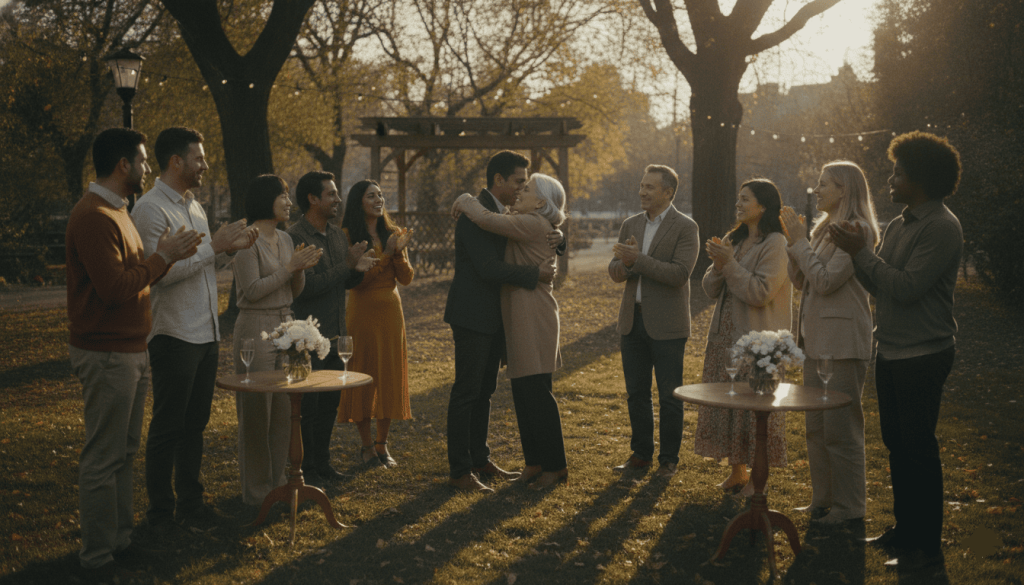
When to have an engagement party
Hold it close to the engagement, not the wedding. Emily Post puts this party nearer the proposal than the ceremony, even when the engagement itself only lasts a month or two. Most of my couples land somewhere in the first one to three months after they get engaged.
From a planning standpoint, there’s a reason to move quickly. The engagement party works best before the rest of the calendar fills up with showers, bachelor and bachelorette trips, and venue tours. Slot it early and it feels like a kickoff. Wait too long and it starts competing with the bridal shower, which dilutes both. If you want help mapping the months ahead, my wedding planning timeline lays out what lands when.
What actually happens at an engagement party
Here’s the relief for anyone picturing a rigid program: there isn’t one. Emily Post is clear that the party itself has no requirements. The most common ritual is a short toast or announcement, often from a parent, welcoming guests and raising a glass to the couple.
Beyond that, it looks like any good party. People eat, drink, and mingle. When the two families haven’t met, the couple and their parents sometimes form a loose receiving line near the start to handle introductions. The format is wide open: Emily Post lists everything from a clambake to a catered dinner to a picnic in the park as completely acceptable.
What you don’t need: a theme, a registry table, party games, or a printed program. The best ones I’ve seen were the simplest. A rooftop, good light, enough chairs for the grandparents, and a toast lined up in advance so nobody freezes at the mic.
Engagement party vs. bridal shower
These two get mixed up constantly, so here’s the clean split. An engagement party celebrates the couple and comes first. A bridal shower celebrates the bride (or the couple, for a co-ed shower), happens later, and is built around gifts.
The other big difference is gifts. A shower is explicitly a gift event, registry and all. An engagement party is not, even if some guests bring something anyway. More on that next.
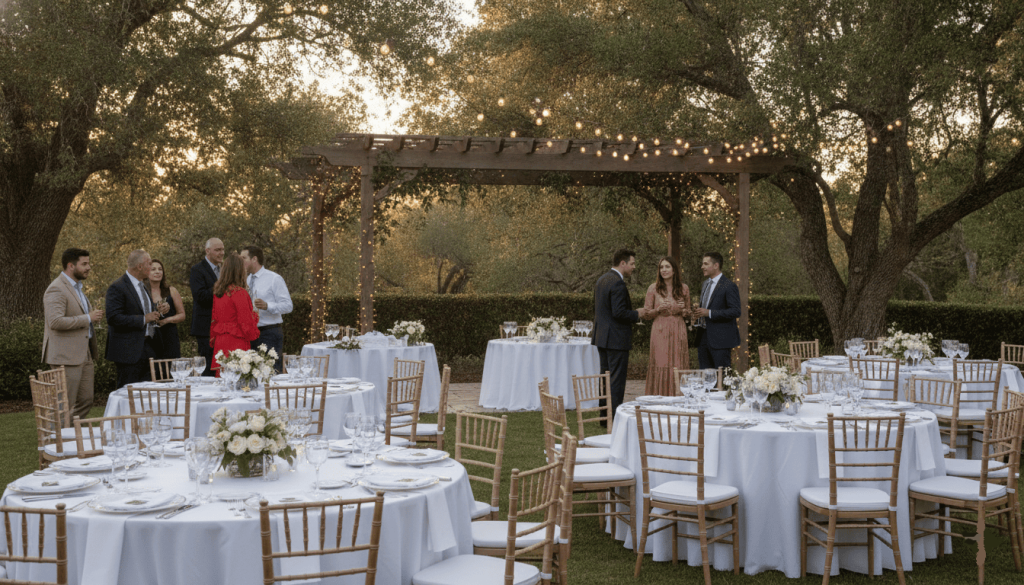
Do you bring a gift to an engagement party?
Short version: a gift is welcome but never required. Emily Post notes that engagement gifts weren’t expected at all in the past, though in many parts of the country bringing a small something has become customary. Think a bottle of wine, a cookbook, a picture frame: a goodhearted gesture, not an expense.
As a guest, if you genuinely can’t read what’s expected, ask the host rather than agonize over it. Customs shift by region and even by friend group. As a couple, if you’d rather nobody bring presents, it’s perfectly fine to have the host quietly spread the word. I walk through the full etiquette in my guide to whether you bring a gift to an engagement party.
Etiquette note
Whatever guests bring, an engagement party isn’t the moment for a big-ticket present. Engagement gifts are meant to be modest and heartfelt, a bottle of wine or a small keepsake. Save the registry items for the shower and the wedding, where they belong.
A short history of the engagement party
The engagement party is older than the white-dress wedding industry that surrounds it. Historically, these gatherings doubled as the moment the father of the bride formally announced the match to guests who often had no idea it was coming. That’s exactly why they weren’t gift occasions: nobody knew until they walked in the door.
The roots run deeper still. In ancient Greece, the betrothal was essentially an oral contract between the groom and the man giving the bride in marriage, and the bride herself wasn’t even present. Different cultures kept their own versions, and some are still very much alive today.
Cultural variation
In Ashkenazi Jewish tradition: the engagement celebration is called a vort. Breaking a ceramic plate at a vort is customary, symbolizing the permanence of the commitment and echoing the breaking of the glass at the wedding itself.
Frequently asked questions
Do you have to have an engagement party?
No. An engagement party is completely optional, and plenty of couples skip it to save the celebrating, and the budget, for the wedding. If you do want one, treat it as the easiest event on your calendar rather than a full production.
Who pays for an engagement party?
Whoever hosts. Traditionally that was the bride’s parents, but today the couple often pays and hosts themselves, or the two sets of parents split it. There’s no rule that any one person has to foot the bill.
How long after getting engaged should you have it?
Usually within one to three months of the proposal. Etiquette puts the party closer to the engagement than the wedding, so it reads as a kickoff rather than competing with later events like the bridal shower.
What do you wear to an engagement party?
Follow the formality the hosts set. A backyard barbecue calls for something casual, while a restaurant dinner leans cocktail. When the invitation doesn’t say, smart-casual or cocktail is a safe middle ground for guests.
If you take one thing from all this: an engagement party is the low-stakes, high-joy start to your wedding season, and the rules are far looser than the internet makes them sound. Keep it close to the proposal, hold the guest list to people you’ll actually invite to the wedding, and let the toast do the heavy lifting.
Once the celebrating settles, the real work begins. My 12-month planning checklist is where I’d point you next.
Sources
- The Knot. Engagement Party Planning 101. theknot.com
- The Emily Post Institute. Celebrating Your Engagement. emilypost.com
- The Emily Post Institute. Engagement Party Gifts. emilypost.com
- Engagement party: history and traditions. en.wikipedia.org
Written by Madison Cole, Certified Wedding Planner. I started planning weddings out of my apartment in Charleston in 2015 and spent the next nine years on 200+ celebrations, from backyard ceremonies to Outer Banks destination weekends, before turning my notes into One Stop Wedding Planner.