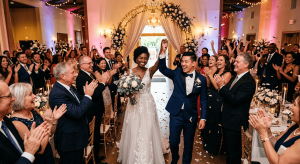
A wedding receiving line is an organized greeting where the newlyweds, and usually their parents, stand together right after the ceremony and meet each guest one by one to say hello and thank them for coming. It’s the most reliable way to make sure no one leaves your wedding without a real moment with you. Below, I’ll walk you through who stands where, when to hold it, how long it takes, and whether it’s even worth doing.
The short answer
A wedding receiving line is a set, single-file greeting where the couple (and often their parents) stand in order after the ceremony to meet and thank every guest individually. It’s completely optional, but it’s the surest way to personally connect with everyone who came.
What a receiving line actually is
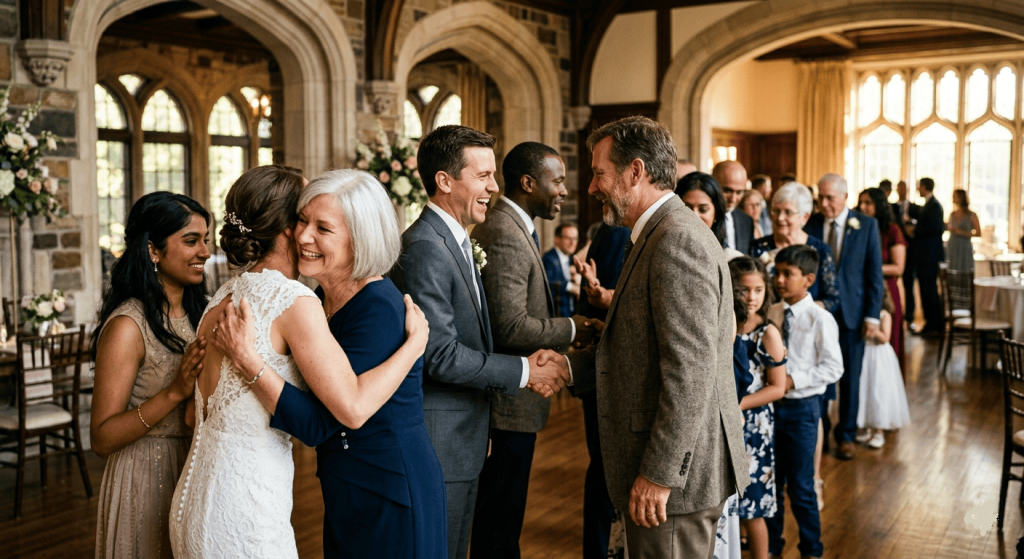
If you haven’t been to many weddings, the term can sound stiff and old-fashioned. In practice, a receiving line is just a structured way to greet people. Once the ceremony ends and you’ve made your walk back up the aisle, you and your partner take a spot near the exit, and your guests file past in a single line. Each person gets a quick hug, a thank-you, and a few words before the next one steps up.
The whole point is guaranteed face time. Your wedding day moves fast, and between photos, dinner, and the dance floor, it’s easy to realize at midnight that you never actually said hello to half the room. A receiving line solves that in one efficient pass. It’s also the perfect window for introductions, since plenty of guests will know one of you but have never met the other. If you’re still mapping out who walks in and out and in what order, my breakdown of the wedding processional and recessional order covers the steps that lead right into this moment.
Who stands in the receiving line, and in what order
This is the part couples overthink the most. There’s a traditional receiving line order, and there’s the modern reality, which is that you can shape it however you like. Historically, the hosts of the wedding anchored the line, and since the bride’s parents traditionally hosted, the mother of the bride went first.
Here’s the classic lineup, and who can quietly bow out.
Etiquette note
The classic order, per the Emily Post Institute: the host goes first (traditionally the bride’s mother), followed by the bride’s father, the groom’s mother, the groom’s father, the bride, the groom, the maid or matron of honor, and one or two bridesmaids. Fathers can skip the line and mingle with guests instead, but if one father stands, the other should too. Groomsmen are off the hook entirely.
Now the modern part. Most couples I work with plan and pay for their own weddings, which means you are the hosts, and you get to decide who joins you. I’ve seen this done beautifully three ways: just the two of you, the two of you plus both mothers, or the full wedding party lined up for a big, warm send-off. There’s no wrong answer. The only rule that still matters is that the line should be short enough to keep moving. The more people you add, the slower it goes for every guest.
When and where to hold your receiving line
You really have two natural windows for receiving line timing, plus a faster variation I love for church ceremonies.
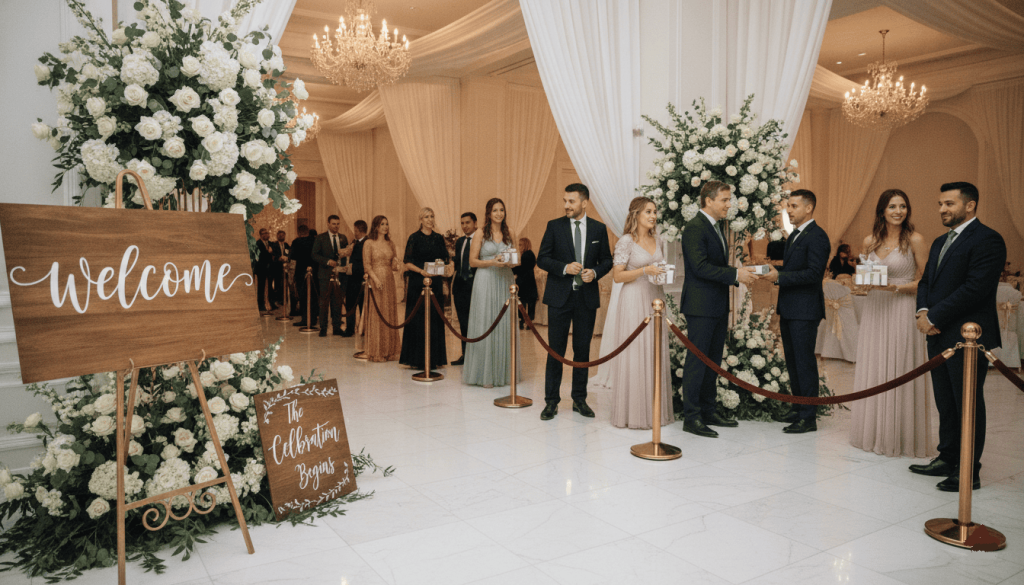
Right after the ceremony, at the exit. This is the most traditional spot. As guests stand to leave, they fall into line near the door and greet you on their way out. The advantage is that everyone is already in one place and the emotions of the ceremony are still fresh. The catch is that guests are funneled into a line before they’ve had a drink or a seat.
At the entrance to cocktail hour or the reception. Here you let guests move to the next space first, then greet them as they arrive. It feels more relaxed, but you can get bottlenecks as people trickle in at different speeds, so make sure the entry area is roomy and someone is helping the flow.
Row by row, before you exit the ceremony. Instead of walking to the back and forming a formal line, you greet guests pew by pew right where they’re seated. It’s quick, it still creates lovely little moments, and because everyone is waiting their turn in their row, the line naturally keeps moving. This is my go-to when a couple wants the greetings but doesn’t have a big gap between ceremony and reception.
Wherever you slot it in, the receiving line needs to live inside your day-of plan on purpose, not as an afterthought. I always pencil it into the wedding day timeline with a real start and end time so it doesn’t quietly eat your cocktail hour.
How long does a receiving line take?
Plan on roughly 20 to 30 seconds per guest. That sounds tiny until you multiply it. A 75-guest wedding lands around 30 to 40 minutes, and a 150-guest wedding can stretch to over an hour if you let conversations run long. As a rule of thumb, I tell couples to keep the line under 30 minutes total. Past that, people get thirsty, restless, and antsy to find their seats.
Madison’s note
“Do the math before you commit. At 30 seconds a guest, a 150-person wedding becomes a 75-minute line, and there goes your whole cocktail hour. For anything over about 100 guests, I’d rather build greetings into the reception than park you by a door for an hour.”
— Madison Cole, Certified Wedding Planner
Is a receiving line necessary?
No. A receiving line is not required, and the Emily Post Institute says so plainly. What you do owe your guests is a genuine hello and thank-you, since every one of them carved out their day, and many traveled, to be there for you. The receiving line is simply the most foolproof tool for delivering that at scale.
So here’s how I frame it for couples. If your guest count is on the larger side, say 75 or more, a receiving line is honestly the easiest way to be sure nobody slips through the cracks. If you’re hosting an intimate wedding of 50 or fewer, you can skip the formal line entirely and simply visit each table during dinner. It’s warmer, it’s lower pressure, and at that size you’ll easily reach everyone.
Receiving line alternatives
Plenty of couples want the connection without the formal lineup. These are the receiving line alternatives I reach for most.
- Table visits during dinner. Make a relaxed lap of the room while guests are seated and eating. You control the pace, and people love a one-on-one moment at their table.
- Mingling through cocktail hour. Do your couple portraits and family photos before the ceremony with a first look, which frees you to spend cocktail hour actually talking to people instead of posing.
- Row-by-row greetings. Greet each pew before you recess. Fast, sweet, and it keeps everyone moving.
- A send-off line at the end. Some couples flip the tradition and greet guests as they leave the reception, which doubles as a goodbye.
Any of these counts as doing right by your guests. The receiving line is one good option, not an obligation.
My tips for a line that doesn’t drag
If you do go with a formal line, a few small moves keep it pleasant for everyone.
- Keep it short. Three to six people in the line is the sweet spot. Every person you add multiplies the wait.
- Hand off the chatter. Have your best man or chief bridesmaid politely direct guests into the line and keep things flowing rather than standing in it.
- Set a hard cap on conversation. Warn your families ahead of time: a few warm words, then pass the guest along. The deep catch-ups happen later at the reception.
- Give guests something to do. If the line will run long, position it where people can grab a drink or a passed bite while they wait.

Frequently asked questions
A few quick answers to the questions I hear most about receiving lines.
How long should a wedding receiving line take?
Budget about 20 to 30 seconds per guest. That puts a 75-guest wedding at roughly 30 to 40 minutes. Try to keep the whole line under 30 minutes so guests don’t get restless waiting for cocktail hour or their seats.
Who stands first in the receiving line?
Traditionally the host goes first, which historically meant the bride’s mother. If you’re hosting your own wedding, you’re free to start the line with whoever makes sense, including just the two of you. The order is a guideline, not a rule.
Do the fathers and groomsmen have to stand in the line?
No. Groomsmen are excused from the receiving line completely. Fathers are optional too and often prefer to circulate among guests, though etiquette says if one father stands in line, the other should join him for balance.
Should you do a receiving line for a small wedding?
Usually not. For weddings of about 50 guests or fewer, visiting each table during dinner is warmer and easier than forming a formal line. Receiving lines earn their keep mostly at larger weddings of 75-plus, where it’s hard to reach everyone otherwise.
The bottom line
A receiving line is a tradition, not a requirement. It’s the cleanest way to personally greet and thank every guest, especially at a larger wedding, but table visits, cocktail-hour mingling, or a quick row-by-row hello get you there too. Pick the version that fits your guest count and your timeline, and you can’t go wrong. If you’re early in the process and piecing together how all of these moments connect, start with my full guide on how to plan a wedding from the first checklist to the last dance.
— Madison Cole, Certified Wedding Planner
Sources
- Emily Post Institute — All About the Receiving Line. emilypost.com
- The Knot — Receiving Line Etiquette, Options and Tips. theknot.com
Written by Madison Cole, Certified Wedding Planner
Madison planned more than 200 weddings out of Charleston, SC between 2015 and 2024, from backyard ceremonies to historic Lowcountry mansions and destination weddings in the Outer Banks and Hilton Head, before launching One Stop Wedding Planner to share the same playbook she handed her own couples. No fluff, just what works on the day.