
Ring sizing is one of those details nobody thinks about until it’s a problem. After more than 200 weddings, I’ve watched a perfect proposal stall because the ring spun loose on her finger, and I’ve seen a groom’s band stop dead at the second knuckle in the middle of the ceremony. None of that was a jewelry problem. It was a measuring problem, and it was completely avoidable.
The good news is that you can get a reliable ring size at home in about five minutes, with tools you already own. You don’t need a jeweler, an app, or anything you have to buy. You need a strip of paper or a piece of string, a ruler marked in millimeters, and a size chart to translate your number into a US size.
This guide walks through the four methods I actually trust: the string-or-paper method when you have nothing to go on, measuring a ring that already fits, ordering a free sizer, and getting professionally measured. I’ll also give you the millimeter-to-US-size chart, the mistakes that throw measurements off by a half size, and the things I tell couples that the standard guides skip, especially if you’re measuring someone’s finger without them knowing, or marrying in July heat. Let’s find your number.
The 4 ways to measure ring size at home, at a glance
String or paper method (no ring needed)
Wrap a strip around the base of the finger, mark the overlap, measure it in millimeters, and match the circumference to a chart.
Measure a ring that already fits
Measure the inside diameter of a ring worn on the right finger and match the millimeters to a size chart.
Order a free or printable ring sizer
Most jewelers mail a reusable plastic sizer for free, or you can print one in minutes for a quick estimate.
Get sized by a jeweler (most accurate)
A free in-store fitting with a metal sizing set is the gold standard, especially for an engagement ring you’ll wear daily.
Before you start: what you’ll need
Whichever method you pick, the setup is the same and you almost certainly have it in a drawer. Here’s the short list:
- A thin strip of paper (about 4 inches long, half an inch wide) or a piece of non-stretchy string. Skip elastic, yarn, or anything that gives.
- A ruler marked in millimeters. Ring sizing lives in millimeters, not inches, so this matters.
- A pen to mark the overlap point.
- A ring size chart to translate your measurement into a US size. There’s one further down this page.
One thing before you measure anything: timing changes the result. Fingers are smallest in the morning and after cold weather, and largest at the end of the day or after you’ve been warm and active. Measure in the late afternoon or evening, at room temperature, when your hands are relaxed. I’ve seen a half-size swing on the same finger between 8 a.m. and 8 p.m., which is enough to turn a comfortable ring into one that won’t come off.
Method 1: The string or paper method
This is the one to reach for when you have nothing else to go on, no ring, no sizer, no jewelry store nearby. It works because you’re measuring the circumference of your finger, which is exactly what a ring size is based on.
Here’s how to do it:
- Wrap the strip of paper or string snugly around the base of your finger, where the ring will actually sit. Snug means it can still slide over your knuckle, not cutting in.
- Mark the exact point where the end overlaps the rest of the strip with your pen.
- Lay the strip flat and measure the length from the start to your mark, in millimeters. That number is your finger’s circumference.
- Match that circumference to the chart below to find your US size.
A couple of details make or break this method. Don’t pull tight. String especially wants to stretch and dig in, and a too-tight wrap will read a half size small, which is the most common at-home error I see. And measure the knuckle too if it’s noticeably larger than the base of your finger, because the ring has to clear it. If your knuckle measures bigger, split the difference and size toward the larger reading so the ring goes on at all.
Madison’s note
“When a partner asks me how to size a surprise ring, the string method is my answer, but I tell them to trace a ring she already wears instead of measuring her hand while she’s asleep. I’ve watched people try the sleeping-hand trick and panic. Borrow a ring from the right finger, trace the inside circle on paper, and bring that to the jeweler. It keeps the secret and it’s far more accurate.”
Method 2: Measure a ring that already fits
If you already own a ring that sits well on the finger you’re sizing, this is faster and usually more accurate than wrapping string, because a ring can’t stretch the way string can. You’ll be measuring the ring’s inside diameter, the straight-line distance across the open center.
- Pick a ring that fits the same finger on the same hand you’re buying for. Your dominant hand often runs a touch larger, so don’t measure a right-hand ring for a left-hand band.
- Lay the ring on your ruler and measure straight across the inside of the band, edge to edge through the center, in millimeters. Measure the inner opening, not the outer edge of the metal.
- Match that diameter to the chart below.
This is also the discreet route for a surprise. Quietly borrow a ring the person already wears on the correct finger, measure the inside diameter, and slip it back. If you can’t measure it cleanly, trace the inner circle onto paper and a jeweler can read it from there.
One caveat worth knowing: the ring you’re copying should be a similar width to the one you’re buying. A thin band and a wide band that feel identically comfortable can be different sizes, which leads neatly into the chart.
Method 3: Order a free or printable ring sizer
Nearly every major online jeweler will mail you a free, reusable plastic ring sizer, and it’s the closest thing to a real fitting you can get at your kitchen table. You request it through the brand’s site, it arrives in a few days, and you slide your finger through until a size feels right, snug enough not to slip off, loose enough to clear the knuckle. Brilliant Earth and Blue Nile, among others, both offer this for free.
If you need a number today and can’t wait for shipping, a printable ring sizer is the backup. You download a PDF, print it at 100% scale (this part matters, “fit to page” will distort the measurements), and either wrap the paper strip around your finger or set an existing ring over the printed circles to find the match. Treat the printable as an estimate to confirm later, not a final answer.
Of the two, the mailed plastic sizer wins. It mimics the feel of an actual ring, so you’re judging real-world comfort, not just a measurement on paper.
Method 4: Get sized by a jeweler
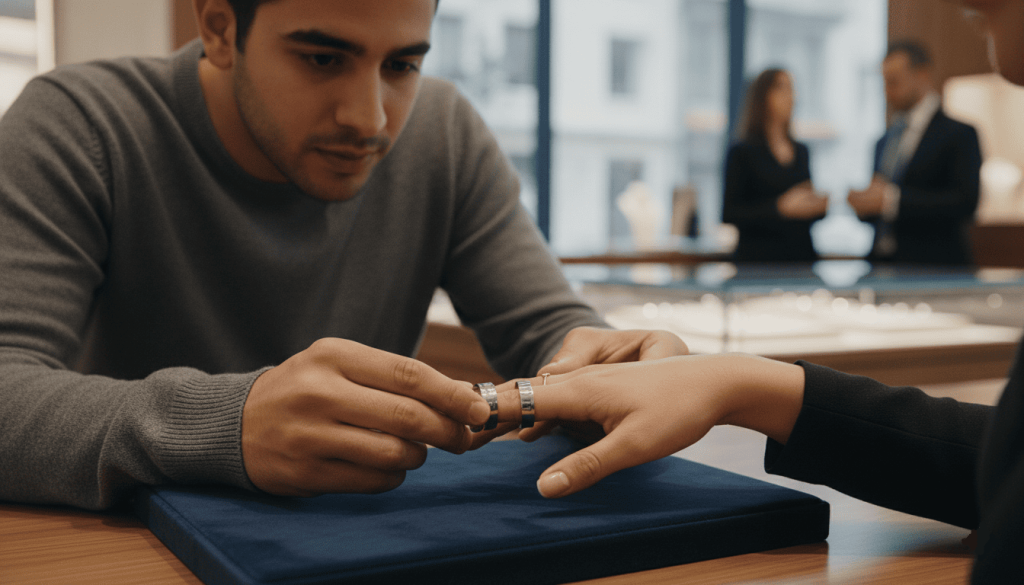
For an engagement ring or wedding band, something worn every day for decades, an in-person fitting is the gold standard, and most jewelers do it for free with no obligation to buy. They use a set of metal sizing rings, the same tool that defines the standard, so there’s no string stretch and no ruler guesswork.
I always nudge couples toward a quick fitting before they finalize a band, even if they’ve already measured at home, for two reasons. First, a professional can account for knuckle size and band width on the spot. Second, they’ll catch the in-between situations, where you measure as a 6.25 and need a human to decide whether you round to 6 or 6.5.
If you’re shopping online and can’t get to a store, combine methods: order the free plastic sizer, confirm with the string method, and lean on the brand’s resizing policy as your safety net. Most reputable jewelers offer at least one free resize within a set window, which takes a lot of the pressure off getting it perfect on the first try.
Ring size chart: millimeters to US size
Here’s where your measurement becomes a number you can order. Two things to know about reading this chart. If you measured your finger with string or paper, you have a circumference. If you measured an existing ring across the inside, you have a diameter. Both are in the chart, so use whichever column matches what you measured. (If you ever need to convert a circumference to a diameter yourself, divide it by 3.14.)
Diameter values per standard US ring sizing. Circumference = diameter x 3.14. Sizes fall between whole numbers too: if you measure between two rows, order the half size up.
If your measurement lands between two sizes, size up, not down. A ring that’s a hair loose is a minor annoyance; a ring that won’t pass your knuckle is unwearable. For reference, the most common women’s sizes in the US sit around 6 to 6.5, and men’s around 9 to 10.5, but these are starting points, not a substitute for measuring.
Common mistakes that throw off your measurement
These are the errors I see send couples back for a resize. Almost all of them are easy to dodge once you know they exist.
- Pulling the string too tight. This is the number one culprit. A tight wrap reads small, you order small, and the ring won’t go on. Snug but comfortable, every time.
- Measuring cold hands. Cold fingers shrink. Measuring first thing on a winter morning can cost you a half size. Warm up and measure later in the day.
- Ignoring the knuckle. If your knuckle is wider than the base of your finger, the ring has to clear it. Measure both and size for the bigger one.
- Forgetting band width. Wide bands sit tighter than thin ones at the same number. For a band 6mm or wider, many people go up a half size for the same comfort.
- Using inches instead of millimeters. Ring charts run in millimeters. An inch ruler forces a conversion step where errors creep in.
- Measuring the wrong hand. Your dominant hand is often slightly larger. Size the finger that will actually wear the ring.
Real planner tips most guides skip
Standard sizing guides get you to a number. Here’s what I’ve learned watching real rings go on real fingers across a couple hundred weddings.
- Don’t size during a summer outdoor wedding week. Heat and humidity swell fingers, and salty wedding-weekend food adds water retention. If your ceremony is in July in a hot climate, size for a relaxed, slightly roomy fit so the band glides on at the altar. I’ve had a best man working a ring off a swollen finger with hand lotion mid-reception. Once is enough.
- The engagement ring and wedding band don’t have to match sizes. A wide or detailed band can need a different size than a thin solitaire, even on the same finger. Size each piece for itself.
- Order both rings at the same size conversation. If you’re buying an engagement ring and band from the same jeweler, get sized once and order them together. It avoids the second-guessing that happens months later.
- Measure three times on different days. One reading is a snapshot. Three readings across a few days, at the end of the day, gives you your real, stable size rather than a fluke.
- Know the resizing window before you buy. Fingers change with weight, pregnancy, and age. A jeweler who offers a free resize within a set window is worth more than getting it perfect on day one.
- Once both rings are on, learn how to wear them. Stacking order and which finger goes where trips people up more than you’d think, and it’s worth sorting out early. Here’s how to wear your engagement ring and wedding band together.
If the ring in question is a promise ring rather than an engagement ring, the same measuring methods apply, though the finger you choose may differ. If that’s where you are, here’s what a promise ring means and when to give one.
Frequently asked questions
How can I measure my ring size at home without a ring?
Use the string or paper method. Wrap a non-stretchy strip around the base of your finger, mark where it overlaps, and measure the length in millimeters with a ruler. That circumference matches to a US size on a ring chart. Measure later in the day and don’t pull the strip tight, since both will skew your result.
What is the most accurate way to measure ring size?
An in-person fitting at a jeweler with a metal sizing set is the most accurate, and it’s usually free. At home, a mailed plastic ring sizer comes closest, because it mimics the feel of a real ring rather than relying on a flat measurement. For an everyday engagement ring, I’d confirm a home measurement against one of these before ordering.
What is the average ring size for men and women?
In the US, women’s ring sizes commonly land around 6 to 6.5 and men’s around 9 to 10.5. These are averages, not a shortcut, since finger size varies widely by build and the specific finger. Always measure rather than guessing from the average.
Should I size up or down if I’m between sizes?
Size up. A slightly loose ring is a small fix, but a ring that won’t clear your knuckle can’t be worn at all. Sizing up also helps if you have larger knuckles or a wider band, both of which need a touch more room than the base measurement suggests.
How do I measure someone’s ring size for a surprise proposal?
Borrow a ring they already wear on the correct finger, then measure its inside diameter or trace the inner circle onto paper and bring it to a jeweler. This is far more reliable than trying to measure their hand while they sleep, and it keeps the secret. If you can’t borrow a ring, a close friend or family member often knows their size.
The bottom line
Measuring your ring size at home takes a strip of paper, a millimeter ruler, and five quiet minutes at the end of the day. Use the string method when you have nothing, copy an existing ring when you do, order a free sizer to double-check, and get a professional fitting for anything you’ll wear every day. Size up when you’re between numbers, and remember that fingers change with heat, cold, and time. Get those right and the ring will do what it’s supposed to: go on easily and stay on for good.
— Madison Cole, Certified Wedding Planner