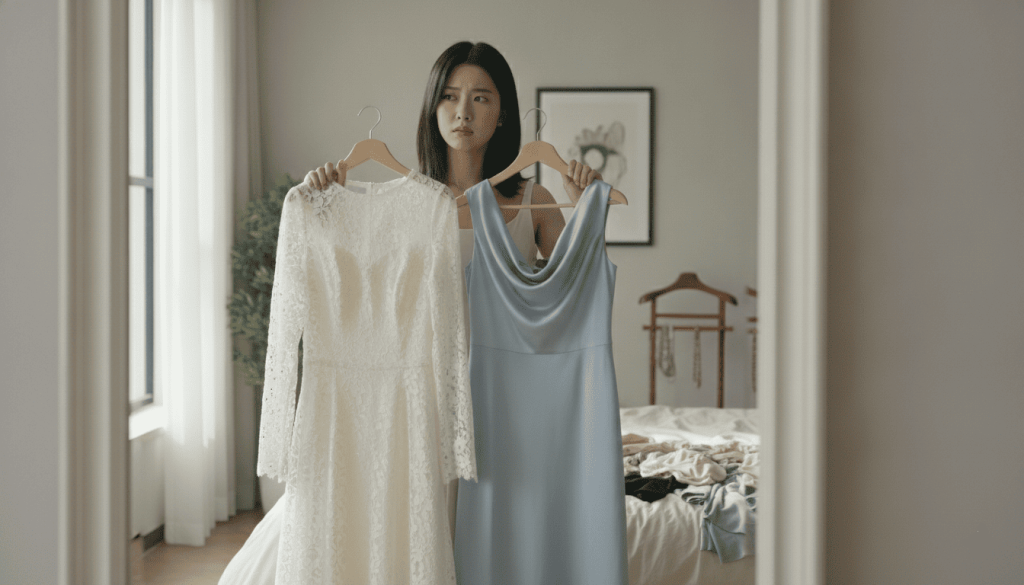
As a guest, the honest answer is no, you should still skip white at most American weddings, because the color reads as the bride’s no matter how you style it. There are a few real exceptions, and after planning more than 200 weddings I can tell you which ones hold up and which ones earn you side-eye in the photos. Here’s the cheat sheet I give my guests when they ask me this.
Quick answer
In general, wedding guests should skip white, ivory, cream, and anything that photographs bridal, because that color belongs to the bride for the day. White is only fair game when the couple asks for it on the invitation, the dress code calls for it, or a cultural tradition makes white non-bridal. Men can wear a white shirt under a jacket, but a full white suit is best left at home.
The short answer, and why the rule still sticks
The white-dress tradition traces back to Queen Victoria’s 1840 wedding, and ever since, white has been read as the bride’s color in Western weddings. It was never an actual law, just a strong social signal, which is exactly why it still trips people up.
Modern etiquette has loosened. The Emily Post Institute takes the position that a guest can technically wear white as long as the look doesn’t distract from the bride or read as bridal. The Knot lands in a similar place but leans more cautious, calling it generally not appropriate for guests and noting that the venue, the time of day, the season, and the couple themselves all change the math.
Here’s where my read differs from most guides. The pure-white gown is rarely the real problem, because most people already know not to show up looking like a second bride. What actually causes the arguments I’ve witnessed is champagne, ivory, and blush, the shades a guest swears are “not white” right up until the flash goes off.
When white is genuinely fine
There are a handful of situations where white is not just allowed but expected. The clearest one is when the couple asks for it, whether that’s an all-white dress code printed on the invitation or one of the newer themed requests where former brides are invited to re-wear their own wedding gowns.
White also stops being the bride’s exclusive color in certain cultural and religious ceremonies, where ivory or white carries its own meaning for guests and family. If you’re attending a wedding with those customs, follow the family’s lead rather than the Western default.
And white in small doses is usually a non-issue. A printed dress that’s mostly another color, with white as the background of the pattern rather than the body of the look, reads as a print, not a bridal moment, especially if it isn’t floor-length. When you’re unsure where a wedding sits, the safest move is to match the formality first: my complete cocktail attire guide and my semi-formal dress code guide both walk through what “fits in” looks like by event type.

When white will get you side-eye
The riskiest version is anything floor-length, lacy, or structured enough to read bridal in a lineup. Even in a real color, a sweeping gown next to the bride invites the wrong kind of comparison.
The sneakier trap is color that photographs white. Pale yellow, soft silver, light blush, and ivory all behave under camera flash and reception lighting in ways they never do in the store mirror. I’ve watched a dress the guest genuinely believed was butter-yellow turn up bone-white in every single reception photo, and once it’s in the album, no one remembers the in-person color.
Daytime garden and church ceremonies are less forgiving than a dim 8 p.m. reception, and traditional families hold the line hardest. I’m based in Charleston, and at Southern weddings in particular, the no-white expectation is closer to gospel than guideline.
If you love a white-ish dress, here’s how to wear it without the drama
I almost never tell a guest a dress is flatly forbidden, because there’s usually a way to make it work. If you’re set on something pale, these are the moves I’d give you:
- Choose a saturated print where white is the backdrop, not the main event, and keep it knee or midi length rather than floor-sweeping.
- Break up the white with a strong color you add yourself, like a bold blazer, a colored belt, or statement shoes, so the eye reads the accent first.
- Skip lace and bridal silhouettes entirely, even in off-white, since those are what get mistaken for the gown.
- Do a flash test before you commit. Have someone photograph you with your phone flash on, and if the dress reads white in the shot, it’ll read white all night.
- When you’re genuinely on the fence, ask the couple or pick another color. A clean question beats a tense receiving line.
Madison’s note
“The single most common version of this I see isn’t a guest in a wedding dress, it’s a guest in a champagne or pale-blush cocktail dress that looked clearly colored in the boutique and then photographed pure white under the venue lights. If a dress makes you pause for even a second, that pause is your answer. I’d rather you wear a color you never think about again than spend the reception worrying about the photos.”
— Madison Cole, Certified Wedding Planner
If you’d rather sidestep the whole question, a sharp suit in a real color is one of the most reliable guest looks going. I rounded up my favorites in my guide to dressy pant suits for wedding guests, and most of them photograph beautifully without going anywhere near the bride’s lane.
Can men wear white to a wedding?
For men, the rule is gentler but it still exists. A white dress shirt under a suit or tux is completely standard and nobody blinks at it. A white dinner jacket at a black-tie wedding, or a light-colored suit at a beach ceremony, can also work when it genuinely matches the dress code.
Where men get into trouble is the full white suit when they’re not in the wedding party. It tends to read as if you’re trying to line up with the groom, and it pulls focus the same way a white gown does on a guest. If you want to go lighter without the risk, gray, tan, or khaki give you that summery feel and stay safely in your lane.
What people will actually think
On paper, the etiquette has relaxed: Emily Post allows white when it isn’t bridal or distracting, and plenty of couples truly do not care. The trouble is that the social read in the room is stricter than the etiquette book, and you can’t poll the guest list in advance to find out which version you’re dealing with.
That’s why I frame this as risk, not morality. The downside isn’t a lecture, it’s the photos, which outlast the night and get passed around for years. When the cost of guessing wrong is that permanent and the cost of choosing another color is basically zero, the math makes itself.

Frequently asked questions
Is off-white, ivory, or cream OK for a wedding guest?
Treat them exactly like white. Off-white, ivory, cream, and champagne all photograph bridal under flash and reception lighting, even when they look clearly colored in person. If you want to be safe, pick a shade no one could mistake for the gown.
Can you wear white to a wedding if it’s part of a pattern?
Usually yes. A print where most of the dress is another color, with white as the background rather than the main shade, reads as a pattern and not a bridal look. Keep it knee or midi length and skip anything lacy to stay on the safe side.
Can you wear white if the bride isn’t wearing white?
It’s still risky. White is tied to the bride by association, regardless of what she actually chose, and guests and relatives will react to the color long before they know her plans. If you’re unsure, a quick text to the couple settles it.
Can the mother of the bride or groom wear white?
Generally no, unless the couple specifically approves it and the wedding party is coordinated around it. Mothers are in nearly every formal photo, so a white or near-white dress draws even more attention than it would on a regular guest. My complete mother of the bride guide covers color and role in detail.
When a guest asks me whether they can wear white, my real answer is a question back: is there any chance this reads white in a photo? If yes, wear something else and enjoy the night without a second thought. White is the loudest color rule at a wedding, but it isn’t the only one guests ask me about, and I make the full case for and against wearing black as a guest in a separate piece.
— Madison Cole, Certified Wedding Planner
Sources
- The Knot, Can You Wear White to a Wedding? Our Experts Weigh In
- Emily Post Institute, Wedding Guest Attire: What to Wear to a Wedding
- Bella Bridesmaids, Colors Guests Should Not Wear to Weddings