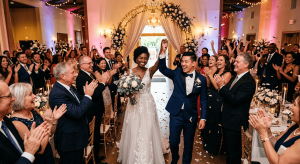
You opened the invitation, saw semi-formal printed under the date, and now you are standing in front of your closet with no real idea what that asks of you. I get this question more than almost any other, from guests trying to dress right and from the couples writing the invitations in the first place. Here is the short version, then the part most guides skip.
Definition
Semi-formal — a dress code that sits between casual and formal: polished and put-together, but short of a floor-length gown or a tuxedo.
Where semi-formal sits between casual and formal
Semi-formal is the middle setting on the dress-code dial. It is dressier than what you would wear to a backyard cookout, and a clear step below the gown-and-tuxedo world of formal and black-tie. The dictionary defines it as suitable for an occasion of moderate formality, which is accurate and completely useless when you are actually choosing an outfit.
The Knot frames it better for weddings: dressier than casual, not as dressy as formal, and sometimes labeled dressy casual. In plain terms, that means something intentional and pulled-together. No jeans, no gown, nothing you would describe as either “thrown on” or “show-stopping.”
Time of day shifts the target. Traditional etiquette splits semi-formal into a daytime version and a dressier evening version, with the line falling around dusk. Most couples today do not think in those terms, but the instinct still holds: an afternoon semi-formal event runs lighter and brighter, while an evening one runs darker and a little sleeker.
What couples actually mean when they write “semi-formal”
Here is what the brand style guides leave out. When a couple prints semi-formal on the invitation, nine times out of ten they are not quoting an etiquette manual. They mean something simpler: please look put-together, please no one in jeans, and please do not arrive in a full gown that pulls focus from the wedding party.
I have watched this play out at the door for years, and the guests who miss almost always miss in one of two directions. A few land too casual (a beachy sundress and flat sandals, or a polo and chinos), and one or two over-correct straight into black-tie territory with a floor-length sequined gown. Semi-formal lives comfortably in the wide lane between those two mistakes.
If you want one rule that works at any event, use the clock. For a ceremony starting before 4 p.m., lean lighter with softer colors and an optional tie. After 4 p.m., dress it up slightly with richer fabrics and deeper tones. That single habit will keep you correctly dressed far more reliably than memorizing definitions.
Etiquette note
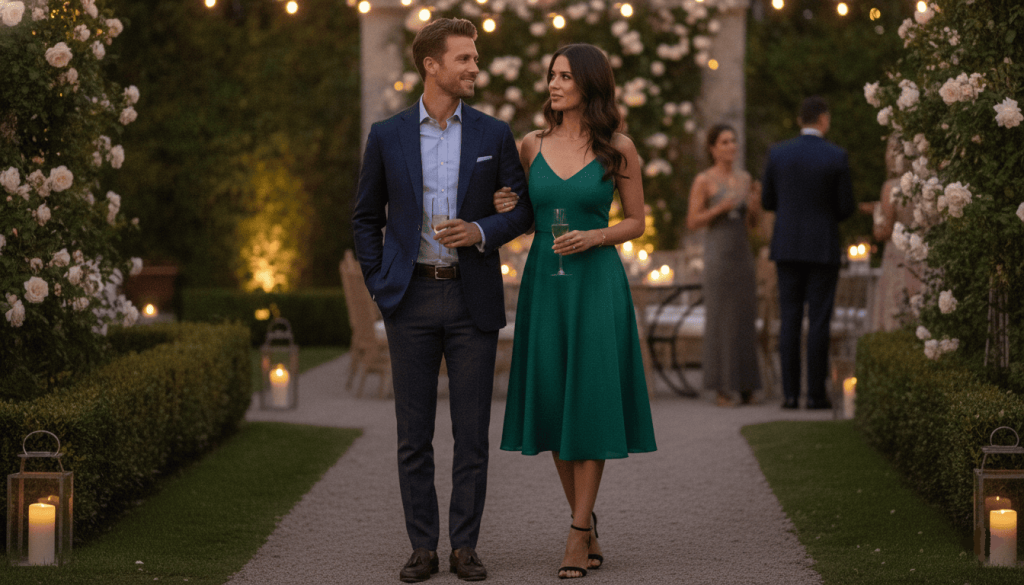
Use the clock as your guide. For an event starting before 4 p.m., go lighter: a midi dress, a softer color, a blazer without a tie. After 4 p.m., shift toward richer fabrics and darker tones. The earlier the start time, the more relaxed your semi-formal can read; the later it runs, the closer it moves toward cocktail attire.
What to wear to a semi-formal wedding or event
For women
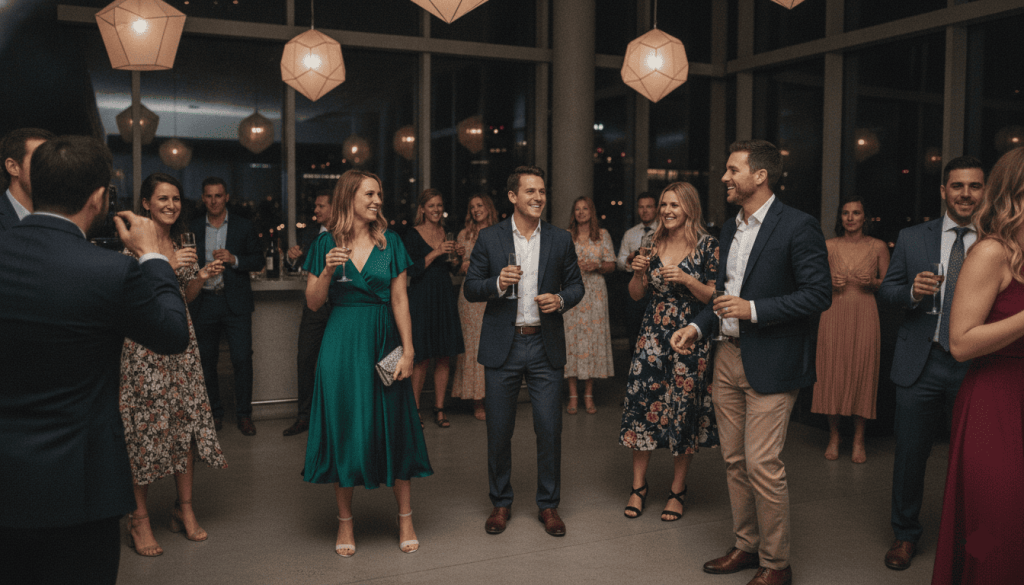
Your safest and most flattering choice is a knee-length or midi dress, a dressy jumpsuit, or tailored separates like a silk blouse with a midi skirt. A simple long dress works for an evening event as long as it reads refined rather than red-carpet. Heels, block heels, or dressy flats all fit the code. What to leave at home: a floor-length ball gown, anything strapless and heavily sequined that belongs at a black-tie gala, denim, and breezy sundresses.
For men
A tailored suit, or a blazer with dress trousers, a collared dress shirt, and leather shoes is the entire formula. A tie is optional for most daytime semi-formal weddings and a safe addition for evening. Skip the tuxedo, which is formal rather than semi-formal, and skip jeans, sneakers, and anything you would wear to the office on a casual Friday.
Madison’s note
“When a couple asks me to translate their own dress code, I tell them to picture the guest they would want in the photos: dressed up, comfortable enough to dance all night, and not competing with the wedding party. That picture, every single time, is semi-formal.”
— Madison Cole, Certified Wedding Planner
How semi-formal differs from cocktail and formal
Semi-formal is closest to cocktail attire, and the two get used almost interchangeably on modern invitations. The honest difference is one of mood: cocktail leans a little more festive and evening-driven, while semi-formal stays a touch more restrained and daytime-friendly. If you want the side-by-side, I break it down in my comparison of how semi-formal compares to cocktail attire, and I cover the cocktail code on its own in my full guide to cocktail attire.
On the dressier end, formal and black-tie ask for floor-length gowns and tuxedos, which is a genuine step up in polish and structure. I walk through exactly where that line falls in semi-formal vs formal. And if your invitation reads something like black-tie optional, that wording is its own puzzle, which is why I wrote a separate piece on what black-tie optional means.
Common semi-formal questions, answered
Is semi-formal the same as cocktail attire?
No, but they are close. Cocktail attire skews more festive and evening-leaning, while semi-formal is a touch more restrained and works well for daytime. For most weddings you can treat the two similarly, then dress up or down a notch based on the start time.
Can you wear jeans to a semi-formal event?
No. Even dark, dressed-up denim reads too casual for a semi-formal dress code. Reach for dress trousers, a tailored skirt, or a midi dress instead. If the invitation truly wanted denim, it would say casual or dressy casual.
Can a man skip the tie at a semi-formal wedding?
Yes. For most daytime semi-formal weddings a tie is optional, and a sharp blazer with an open collar looks intentional rather than underdressed. Add a tie for evening events or upscale venues, or slip in a pocket square as an easy middle ground.
Is a long dress okay for semi-formal?
Yes, a simple long dress works, especially for an evening event, as long as it reads elegant rather than full black-tie gown. Choose a clean silhouette in a flowing fabric and skip heavy beading, a dramatic train, or anything that would feel at home on a red carpet.
The takeaway
If you remember one thing, make it this: semi-formal means dressed up, not dressed to the nines. Aim for polished and comfortable, read the start time on the invitation, and you will never be the guest who walked in wrong. For the full breakdown by season, venue, and silhouette, see my complete semi-formal attire guide.
Sources
- Merriam-Webster Dictionary, “semiformal.” merriam-webster.com
- The Knot, “What Is Semi-Formal Wedding Attire? A Guide for Wedding Guests.” theknot.com
Written by Madison Cole, Certified Wedding Planner. After helping guests decode dress codes at 200+ weddings, I have learned that “semi-formal” causes more closet panic than any other line on an invitation, and that it almost never needs to.