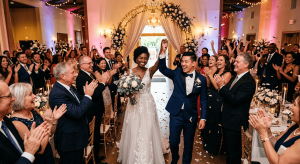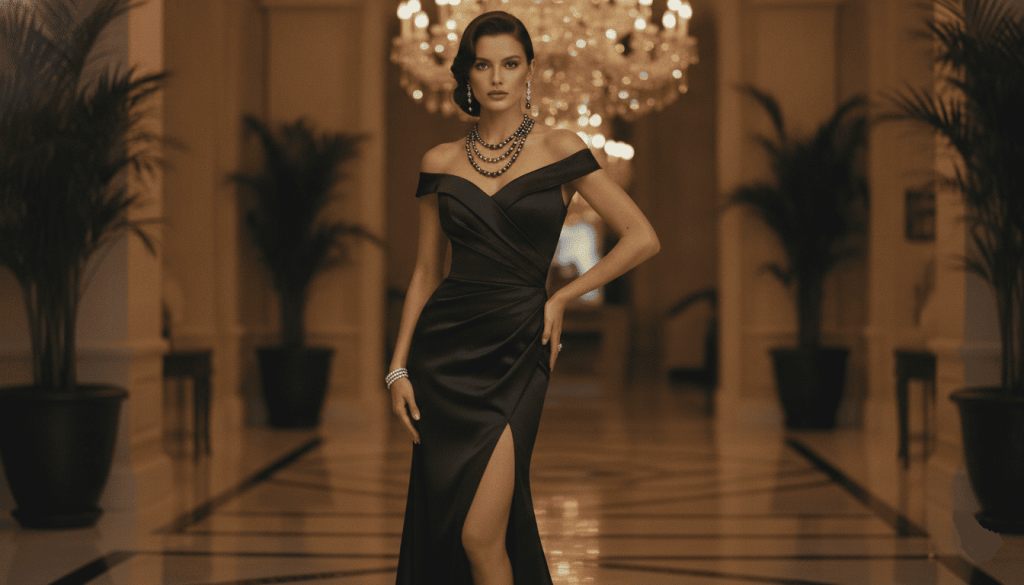
Black-tie attire for a woman means formal evening wear — most often a floor-length gown, though a polished midi dress or a sharp tailored jumpsuit absolutely works for the right room. It’s the dress code I get the most panicked texts about, usually the week before the wedding. After 200-plus weddings on the east coast, I can tell you the rules are friendlier than the name suggests, as long as you read the time of day and the formality of the venue. Below, I’ll walk you through exactly what black tie means for women, the looks that actually work, the dos and don’ts, and the missteps I see most.
Definition
Black-tie attire (for women) — a formal evening dress code, traditionally a floor-length gown, though elegant midi dresses and tailored jumpsuits now also count. Most often required for evening weddings, galas, and formal receptions starting after 5 p.m.
What black-tie attire actually means
Black tie started in the late 1800s as a slightly less formal alternative to white tie — for men, that meant the tuxedo instead of the tailcoat. For women, it settled into the formal evening gown, and that’s still the anchor of the dress code today. When a host writes “black tie” on an invitation, they’re signaling a polished, dressed-up evening and asking you to match it.
The good news is that the modern interpretation has loosened. The Emily Post Institute defines black tie for women as a formal evening gown or a short, dressy cocktail dress, and fashion editors at Vogue now treat an impeccably cut midi or evening jumpsuit as fair game too. So you have more room than the name implies — what stays non-negotiable is the level of formality, not the exact silhouette.
Madison’s note
“When the invitation says black tie, the host is asking you to match the formality of the room, not to outspend it. A well-cut gown you already own beats a brand-new dress that doesn’t fit right every single time.”
— Madison Cole, Certified Wedding Planner
Types of black-tie looks for women
Here are the five looks I rotate my guests through, depending on their comfort, their budget, and the specific wedding.
The floor-length gown
The classic and the safest choice. A floor-length gown in a luxe fabric reads as black tie from across the room, no interpretation required. If you’re nervous about getting the dress code right, this is where I’d start.
A formal cocktail or midi dress
A knee-length or midi dress works for black tie when the fabric and construction do the heavy lifting — think structured silk, beading, or a sculptural silhouette rather than a simple day dress. This is the move for a black-tie wedding that’s a touch younger or in a warmer climate.
An elegant jumpsuit
A tailored evening jumpsuit in crepe or satin is one of my favorite modern black-tie options. It photographs beautifully, lets you dance without managing a train, and still reads as formal when it’s cut well and paired with statement jewelry.
Dressy separates and two-pieces
A floor-length skirt with a silk blouse, or a beaded top with tailored evening trousers, can absolutely hit black tie. Keep the fabrics rich and the lines clean — this is where polish matters more than anywhere else.
Creative black tie
If the invitation specifies “creative black tie,” you keep the formality but get to play with color, texture, and bolder accessories. Same evening foundation — more personality.

When black-tie applies (and how it differs from black-tie optional)
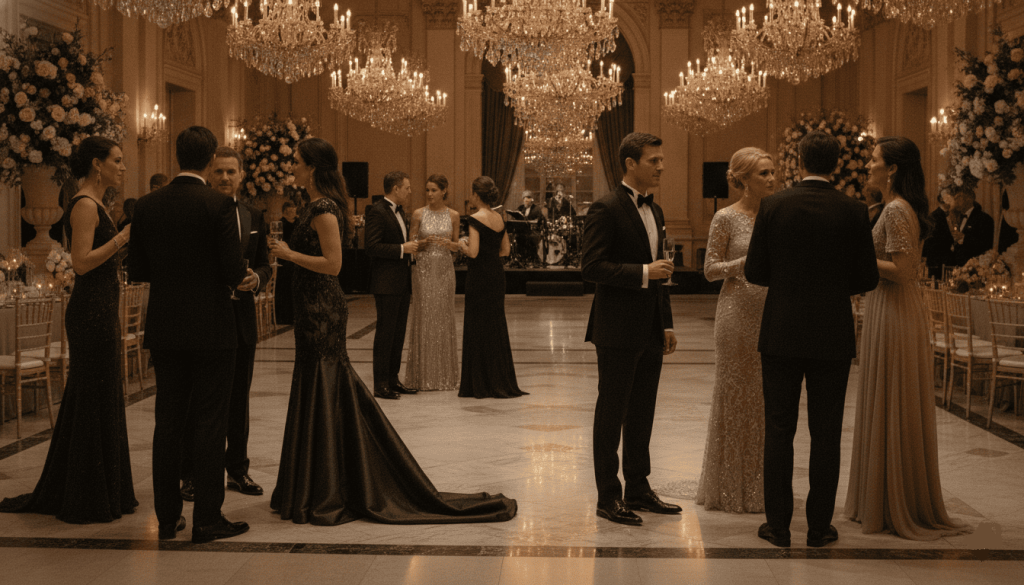
Black tie is an evening dress code. You’ll see it on invitations for receptions and ceremonies starting after 5 or 6 p.m. — formal weddings, galas, fundraisers, and milestone celebrations. If it shows up on a daytime invitation, it’s usually shorthand for “dress formally” rather than a literal instruction, and it’s worth a quick check with the host.
There’s one distinction that trips up more guests than any other: black tie versus black-tie optional. Straight black tie expects the formal end of the range; black-tie optional gives you a softer floor, opening the door to a dark cocktail dress or dressy separates without the full gown. If your invitation says the second one, the rules relax a notch — I break down exactly how far in my guide to what black-tie optional means.
What to wear: fabrics, colors, shoes, and jewelry
Once you’ve picked your silhouette, these are the details that make an outfit read as genuinely black tie:
- Fabrics: silk, satin, chiffon, velvet, and crepe. Evening fabrics catch light and signal formality in a way that cotton or jersey never will.
- Colors: dark and jewel tones — black, navy, emerald, burgundy, aubergine — are the timeless choice, but color is welcome. The only color I steer guests away from is white or ivory at a wedding.
- Shoes: heels are traditional, but an elegant flat or a block heel is completely acceptable, especially if you’ll be on grass or dancing all night.
- Jewelry: one statement piece, then keep the rest quiet. Black tie rewards polish over piling everything on.
- Bag: a clutch or a small structured evening bag. Leave the everyday tote at home.
Black-tie dos and don’ts for women
The cheat sheet I give my guests when they’re short on time:
- Do lean formal — you can’t really be overdressed at black tie, short of wearing a white floor-length gown yourself.
- Do prioritize fit and fabric over a brand-new purchase.
- Do finish the look: polished hair, considered makeup, an evening bag.
- Don’t wear white, ivory, or anything that competes with the bride.
- Don’t treat black tie like cocktail attire — a simple day dress reads as underdressed here.
- Don’t bring beachy or daytime accessories, like flat sandals or casual straw bags, to an evening event.
Etiquette note
Black tie is the host’s call, so when an outfit feels borderline, the polite move is to dress up rather than down — you’ll never offend a host by honoring their dress code closely. Emily Post’s guidance is that the host sets the formality bar and guests are expected to meet it; if the invitation language is unclear, a quick question to the couple or the wedding party settles it without any awkwardness.
Common mistakes and misconceptions
- Thinking you must wear a gown. A floor-length dress is the safest option, not the only one. A formal midi or a tailored jumpsuit is fully black-tie appropriate.
- Assuming “black tie” means you have to wear black. The name refers to the dress code, not the color of your dress. Jewel tones and rich colors are all welcome.
- Confusing it with cocktail attire. Cocktail is a step down. A casual knee-length dress that would pass at a cocktail party will look underdressed at black tie.
- Wearing white or ivory to a wedding. This is the one hard rule I never bend — those shades belong to the bride.
- Over-accessorizing. Black tie is about restraint. One strong piece beats five competing ones.
Frequently asked questions
The questions my guests ask me most often about black tie for women:
Can you wear a cocktail dress to a black-tie wedding?
Yes, if it’s a formal one. A short or midi dress works for black tie when it’s made of an evening fabric like silk or satin and has elevated details — beading, a structured cut, or a dramatic neckline. A plain day dress, even a nice one, will read as too casual.
Does black tie mean you have to wear black?
No. “Black tie” describes the level of formality, not the color of your outfit. Dark and jewel tones are the classic choice, but a rich color is perfectly appropriate. The only shade to avoid at a wedding is white or ivory.
Can you wear a jumpsuit to a black-tie event?
Absolutely. A tailored evening jumpsuit in crepe or satin is a modern black-tie staple. Keep it formal with a clean, structured cut and a statement piece of jewelry, and it reads every bit as polished as a gown.
What’s the difference between black tie and black-tie optional?
Black tie expects the formal end of the range — a gown, formal midi, or evening jumpsuit. Black-tie optional softens that floor, so a dressy cocktail dress or polished separates are also fine. When in doubt at either one, dress up rather than down.
Are pantsuits okay for black tie?
Yes, a formal tuxedo-style or evening pantsuit is a sophisticated black-tie option. Choose an evening fabric and a sharp tailored fit, then dress it up with heels and refined jewelry so it clearly reads as formalwear rather than office wear.
The bottom line
Black-tie attire for a woman is formal evening wear, built around a gown but flexible enough to include a formal midi, an evening jumpsuit, or polished separates. Lead with rich fabrics and a dressed-up silhouette, skip white at a wedding, and when an outfit feels borderline, lean toward the more formal choice. Get those right and you’ll always be dressed for the room.
Sources
- Emily Post Institute — Black Tie Dress Code Guide
- The Knot — Black-Tie Attire Guide for Wedding Guests
- Vogue — Black-Tie Dress Code
— Madison Cole, Certified Wedding Planner