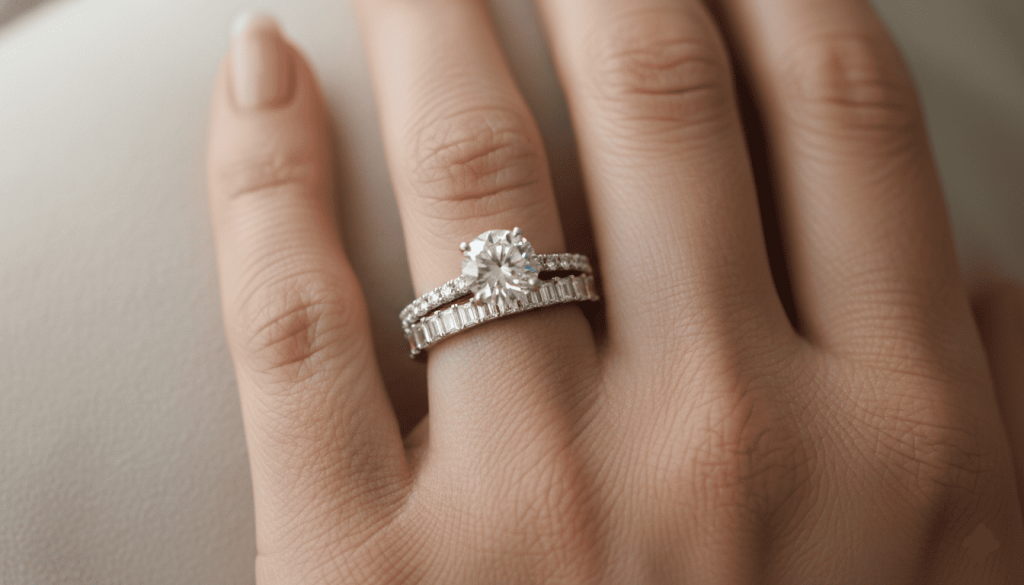
The short version: in the US, both rings are traditionally worn on the fourth finger of the left hand, with the wedding band closest to your heart and the engagement ring stacked above it. That’s the convention. But after standing next to more than 200 couples while they exchanged rings, I can tell you the “rules” bend constantly, and most of the time that’s completely fine.
From planning over 200 weddings on the East Coast, I’ve watched this exact question trip up brides at the altar, mothers reorganizing rings at the reception, and grooms who weren’t sure men’s rings even had an order. So here’s the full walkthrough: which hand, which finger, what goes on first, how to make two rings sit well together, and the day-of logistics nobody warns you about.
How to wear your rings — the quick version
- Step 1: Wear both rings on the fourth finger of your left hand (the US standard).
- Step 2: Put the wedding band on first, closest to your heart.
- Step 3: Stack the engagement ring above it.
- Step 4: On the wedding day, move the engagement ring to your right hand for the ceremony, then switch it back after.
- Step 5: If the two don’t sit flush, reverse the order, solder them, or wear them on separate hands.
What hand and finger do they go on?
In most of the US, both your engagement ring and wedding band live on the fourth finger of the left hand, the one between your middle finger and pinky. We call it the “ring finger” for a reason that’s more poetry than anatomy.
The tradition traces back to the ancient idea of the vena amoris, Latin for “vein of love.” Romans believed a vein ran straight from that fourth finger to the heart, so a ring there symbolized a direct line to your feelings. As The Knot notes, modern anatomy debunked that vein long ago (every finger connects to the heart), but the story was too lovely to abandon, so the placement stuck.
That said, “left hand” is not universal. In Germany, the Netherlands, and several Orthodox Christian countries like Greece and Poland, the wedding ring goes on the right hand. Some couples in those traditions wear the engagement ring on the left, then move it to the right after the ceremony. If your family follows one of these customs, that’s your default, not the American version.
If you want the deeper history and the full breakdown of placement by country, I walk through it in my guide on what finger a wedding ring goes on.
What goes on first: the wedding band or the engagement ring?
Here’s the question I get more than any other ring question: which ring goes on first? The traditional answer is the wedding band, slid on closest to your hand, with the engagement ring stacked on top.
The logic follows the vena amoris idea: the band you exchange during your vows sits closest to your heart, and the engagement ring “guards” it from the outside. The Knot ties this ordering to the same Roman-era tradition that put the rings on the left hand in the first place.
There’s also a practical reason this order holds up. Your engagement ring usually carries the center stone, so keeping it on the outside means it sits highest and catches the most light. The plain band underneath does the quiet structural work.
Here’s the part the jewelry blogs underplay: plenty of couples reverse it, and nobody at the wedding can tell. If your engagement ring has a setting that sits more comfortably against your hand, or your band has detail you want visible, flip them. The “commitment closest to the heart” framing is sentiment, not law.
The wedding-day switch I tell every bride about
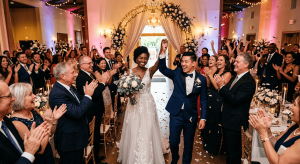
On the morning of the wedding, move your engagement ring to your right-hand ring finger before the ceremony. This leaves your left ring finger bare so your partner can slide the wedding band on cleanly during the vows, with no fumbling and no ring already in the way.
Once the ceremony is over, slip the engagement ring back onto your left hand, on top of the new band. I’ve seen a groom struggle for a full thirty seconds at the altar because the engagement ring was still on, and the photos caught every second of it. The right-hand switch takes two minutes that morning and saves you that moment.
Madison’s note
“If you’re worried about losing the engagement ring during the ceremony, hand it to your maid of honor instead of wearing it on your right hand. I’ve had her tuck it into a small zip pouch in her bouquet ribbon. It comes back to you for the recessional photos, and it never leaves the wedding party.”
— Madison Cole, Certified Wedding Planner
How to make two rings sit well together
Whether your rings nestle into one clean stack or fight each other all day comes down to how they were designed to pair. If you bought a matched bridal set, the band is contoured to hug the engagement ring’s setting, and you won’t think about it again.
If you’re pairing two rings that weren’t made for each other, a few things matter:
- Flush fit: The two rings should sit with no visible gap between them. A band that’s straight across will leave a wedge of space under a ring with a raised center stone.
- Band width: Keep the wedding band equal to or slightly narrower than the engagement ring’s shank. A wide band can visually swallow a delicate ring.
- Comfort fit: A band with a slightly domed interior reduces the rubbing you get from two rings grinding together for twelve hours straight.
- Metal: Matching metals read as a coordinated set; mixing them (white gold with rose gold, say) is a deliberate, on-purpose look that’s been fully acceptable for years now.
You have three easy fixes if your rings simply refuse to sit flush. Solder them together permanently so they always align, which is a quick job for a jeweler. Add a contoured “wrap” or shadow band shaped to your engagement ring. Or skip the stack entirely and wear them on separate hands, which is genuinely common and looks intentional.
Modern ways to wear them
The traditional single-finger stack is still the most common thing I see, but it’s no longer the only “correct” version. Here’s what couples actually do now:
- Engagement ring on the right hand, band on the left. Great if your rings don’t pair well, or if you don’t like stacking two rings on one finger. This is the everyday norm in countries like Germany, not a fringe choice.
- Engagement ring on top, band underneath (reversed). Some people prefer the engagement ring closest to the hand because of how the setting sits.
- Band stacks with anniversary or eternity rings. If you add rings over the years, the pieces that mean the most to you usually sit closest to your skin, with milestone bands on the outer edge.
- Engagement ring saved for special occasions. Plenty of my brides who work with their hands wear just the band day to day and bring out the engagement ring for events.
None of these is a downgrade from tradition. They’re just answers to real life: your job, your hands, your comfort.
Etiquette note
There’s no etiquette rule that requires you to wear both rings, or to wear them a particular way. The only convention worth honoring is your own family’s cultural tradition — if your heritage puts the band on the right hand or skips the engagement ring entirely, follow that over the generic “American” default. Outside of that, comfort wins.
How men wear engagement and wedding rings
For most men, this is simpler, because there’s usually just one ring. The wedding band goes on the fourth finger of the left hand, same as the Western tradition for women, and it goes on during the ceremony. No stacking, no order question.
What confuses people is the rise of men’s engagement rings. Historically, men in the US didn’t wear them. That’s shifting. Over the last decade, more men have chosen an engagement ring to mark the engagement period, often as a sign of an equal partnership. When a man does wear one, it typically goes on the left ring finger during the engagement, then he either keeps it there or swaps to the wedding band after the wedding.
There’s no fixed rule on whether he keeps both. Some men wear the engagement ring on the right hand after marriage and the band on the left; many simply transition to the wedding band alone. If you’re shopping for a groom, my breakdown of Manly Bands reviews covers durable everyday options for men who work with their hands.

Keeping your rings looking good
Two rings worn together rub against each other constantly, so a little maintenance keeps them sharp. Have your diamonds and settings checked once or twice a year, and a jeweler will confirm the prongs holding your center stone haven’t loosened, which is the failure that actually loses stones.
For day-to-day shine, warm water, mild dish soap, and a soft brush handle most of the grime. The film that dulls a diamond is usually lotion and soap residue, not damage. If you’re choosing metals and want to understand how they wear and tarnish over time, I compare two of the most common in my guide on white gold vs silver for wedding rings.
Frequently asked questions
Where do you wear a wedding ring?
In the US and most Western countries, the wedding ring goes on the fourth finger of the left hand. In Germany, the Netherlands, Greece, Poland, and several Orthodox Christian cultures, it’s worn on the right hand instead. Both are correct — it depends on your heritage.
Does the wedding band really have to go on first?
No. Tradition puts the band closest to your heart with the engagement ring stacked on top, but reversing the order is purely a matter of comfort and how the two rings sit. Nobody will notice the difference once they’re on your finger.
Can I wear my engagement ring and wedding band on different hands?
Absolutely. Wearing the engagement ring on the right hand and the band on the left is common, especially if the two rings don’t nestle well or you don’t like stacking. It’s the standard in some European countries and looks fully intentional.
What do you do with your engagement ring during the ceremony?
Move it to your right hand that morning, or hand it to your maid of honor, so your left ring finger is bare for the wedding band. Slide the engagement ring back on top of the band right after the ceremony.
Should I solder my rings together?
Soldering keeps the two rings permanently aligned and stops them from spinning or rubbing, which many people love. The trade-off is you can no longer wear them separately. If you like the option to split them, ask your jeweler about a contoured wrap band instead.
If you're still deciding what each ring even is, and whether you need both, start with my explainer on the difference between an engagement ring and a wedding ring. And if a band that doubles as a promise is on your mind, here's what a promise ring means and when to give one.
Sources
- The Knot — What Hand Does a Wedding Ring Go On. theknot.com
- The Knot — How to Wear Your Engagement Ring and Wedding Band. theknot.com
- Brilliant Earth — What Hand Does a Wedding and Engagement Ring Go On. brilliantearth.com
- Jared — How to Match Your Wedding Band to Your Engagement Ring. jared.com
Wear them the way that feels like yours. The tradition is a starting point (left hand, band first, engagement ring on top), but the only version that matters is the one you’ll still love putting on every morning years from now.
— Madison Cole, Certified Wedding Planner